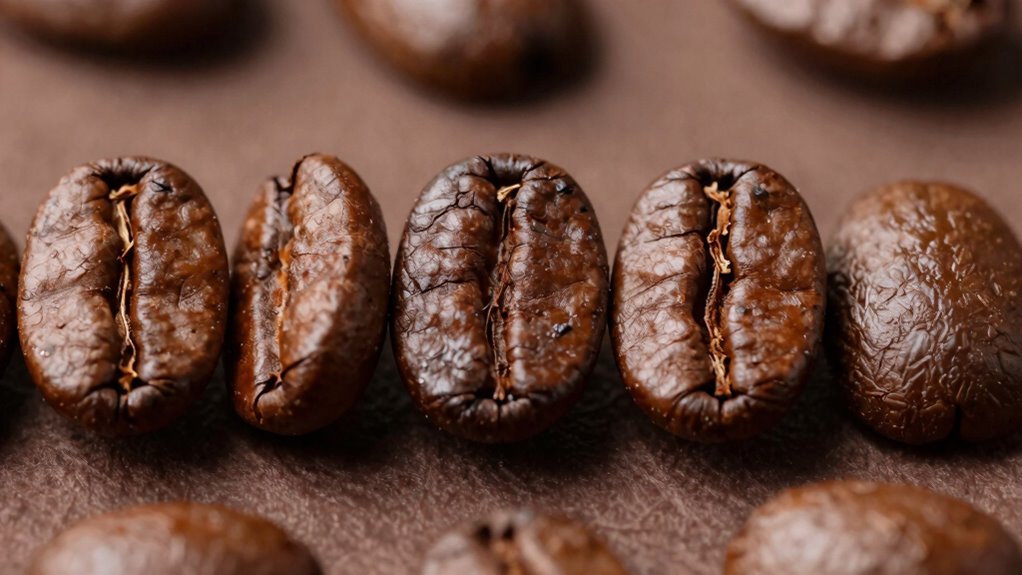

Your coffee’s bean density affects how water penetrates and extracts flavor. Denser beans resist water, leading to slower extraction, so you might need a coarser grind or longer brew time. Less dense beans allow water to flow more easily, risking over-extraction, so a finer grind or shorter brew can help. Adjusting your brewing parameters based on bean density guarantees balanced flavor. To learn more about optimizing extraction for different beans, keep exploring these essential tips.
Key Takeaways
- Denser beans resist water penetration, slowing extraction; less dense beans allow faster water flow, affecting flavor development.
- Roasting alters bean density: light roasts are denser and firmer, dark roasts are less dense due to moisture loss and expansion.
- Adjust grind size: coarser for denser beans, finer for less dense beans to optimize water flow and extraction.
- Modify brew time: longer for denser beans to ensure proper extraction; shorter for less dense beans to prevent over-extraction.
- Understanding bean density helps tailor brewing parameters, ensuring balanced flavor and consistent results.

Have you ever wondered how the density of coffee beans affects their extraction? It’s a key factor that influences how flavors develop during brewing. Bean density is shaped by various processing variables, including the way the beans are harvested, washed, and dried. These steps determine how tightly packed the beans are, which directly impacts how water interacts with their internal structure. Heavier, denser beans tend to have more compact cell structures, making them more resistant to water penetration. Conversely, less dense beans often allow water to flow through more easily, resulting in different extraction dynamics. To optimize your brewing, understanding these processing variables is vital, as they set the foundation for how the beans will behave during extraction. Additionally, processing variables significantly influence bean density, thereby impacting extraction outcomes.
Bean density influences extraction; processing steps determine how tightly packed beans interact with water.
The roasting impact is another essential element that affects bean density. Roasting transforms the internal composition of the beans, causing them to lose moisture and expand. Light roasts preserve more of the bean’s original density, maintaining a firmer structure, while darker roasts tend to be less dense due to the increased heat exposure that causes greater cell expansion and moisture loss. This change in density alters how quickly and evenly flavors are extracted. For example, denser, lightly roasted beans often require a different grind size or brewing method compared to lighter roasted, less dense beans. If you don’t account for these roasting-induced density changes, you might end up over- or under-extracting, leading to undesirable flavors like bitterness or sourness.
Adapting your brewing approach based on these variables helps you achieve a more balanced extraction. For dense beans, you might need to grind slightly coarser or increase brew time to allow water to penetrate fully. On the other hand, less dense beans could benefit from a finer grind or shorter brew times to prevent over-extraction. Experimenting with different parameters and paying close attention to the roasting impact allows you to fine-tune your process. This guarantees that the unique qualities of each batch are highlighted rather than lost due to a one-size-fits-all approach.
In essence, understanding how processing variables influence bean density, along with the roasting impact, empowers you to make smarter adjustments. By doing so, you improve your chances of extracting the full spectrum of flavors from your coffee, regardless of the bean’s initial density. Recognizing these factors helps you craft a more consistent and satisfying cup, tailored to the specific characteristics of each batch. The more you learn about how these elements interact, the better equipped you’ll be to adapt your methods and enjoy coffee at its best.

SHARDOR Electric Coffee Grinder, 70g Large Capacity Spice Grinder with Visual Timing Knob for Precise Grind, Quiet Coffee Bean Grinder for Espresso, French Press, Herbs and Grains, Black
- Precise Grinding Control: Visual timing knob for accurate grind
- Large Capacity & Versatile Use: 70g capacity for coffee and spices
- Quiet Operation: Operates at only 63 dB
As an affiliate, we earn on qualifying purchases.
As an affiliate, we earn on qualifying purchases.
Frequently Asked Questions
How Does Bean Density Affect Coffee Flavor Profiles?
Bean density impacts your coffee’s flavor profile considerably. Denser beans usually contain more soluble compounds, leading to richer flavor development during extraction. This density impact means you’ll notice enhanced depth, complexity, and often a fuller body in your brew. Conversely, lighter beans may produce a brighter, more acidic cup. Understanding this helps you adapt your grind size, brewing time, or temperature to optimize flavor extraction and achieve your desired profile.
Can Bean Density Influence Brewing Time and Temperature?
Think of your beans as tiny explorers maneuvering a maze; higher density measurement means they’re more compact, which can extend brewing time and require higher temperature for proper extraction. As they heat, bean expansion occurs, revealing their true flavor potential. You’ll need to adjust brewing time and temperature accordingly, ensuring the water penetrates thoroughly. So, denser beans call for patience and a bit more heat, opening richer, fuller flavors.
Does Roasting Alter Bean Density Significantly?
Roasting does alter bean density considerably. As you roast, especially with darker roast levels, the beans lose moisture content, making them less dense and more porous. This change affects extraction because lighter roasts retain more moisture and are denser, requiring different grind sizes or brewing times. Understanding how your roast level impacts moisture content helps you adapt your brewing technique for ideal flavor and extraction.
How Do Different Extraction Methods Respond to Density Variations?
Oh, the irony is thick—your extraction method might be more sensitive than you think. When you measure density, you see how it influences extraction consistency; espresso may struggle with high-density beans, while pour-over benefits from even density. Different extraction methods respond uniquely to density variations, so adjusting grind size, brew time, or pressure helps maintain consistency. Don’t assume one size fits all—adapt based on your bean’s density for ideal results.
Are There Specific Beans Better Suited for Particular Extraction Techniques?
Certain beans are better suited for specific extraction techniques because their bean selection and storage affect flavor and consistency. For example, lighter roasted beans work well with pour-over methods, while darker roasts excel with espresso. You should consider bean storage to maintain freshness, as stale beans can diminish extraction quality. Choosing the right beans for your method guarantees ideal flavor, aroma, and overall coffee experience tailored to your brewing preferences.

Maestri House S2 Espresso Coffee Scale with Timer 0.1g Precision Shot Scale
- Compact and Portable Design: Fits in your palm, lightweight for travel
- High Precision Measurement: 0.1g accuracy for perfect brewing
- Multiple Units and Timer Modes: Switch between g/oz/ml and timing modes
As an affiliate, we earn on qualifying purchases.
As an affiliate, we earn on qualifying purchases.
Conclusion
Understanding how bean density influences extraction helps you fine-tune your brewing process. By gently adjusting your grind size or brewing time, you can reveal the hidden potential within those beans, revealing richer flavors and smoother textures. Don’t be discouraged if things don’t go perfectly at first—sometimes, a little tweak here and there makes all the difference. Embrace the journey of discovery, and soon you’ll be savoring the perfect cup tailored just for you.

Horavie Single Serve Coffee Maker with Built-in Grinder, Fast Brew 6-16oz Single Cup for Whole Beans, Grounds, K Pod, Grind and Brew Coffee Maker with 47oz Water Tank, Descaling Alert, Black
- Versatile Coffee Options: Uses beans, grounds, or K-pods
- Fast Brewing Time: Brew a cup in just 2 minutes
- Built-in Reusable Bean Basket: Freshly grind beans for each brew
As an affiliate, we earn on qualifying purchases.
As an affiliate, we earn on qualifying purchases.

Amazon Fresh, Just Bright Whole Bean Coffee Light Roast, 32 Oz
- Roast Level: Light roast with crisp flavor
- Package Size: 32-ounce whole bean bag
- Coffee Type: 100% Arabica from Americas
As an affiliate, we earn on qualifying purchases.
As an affiliate, we earn on qualifying purchases.