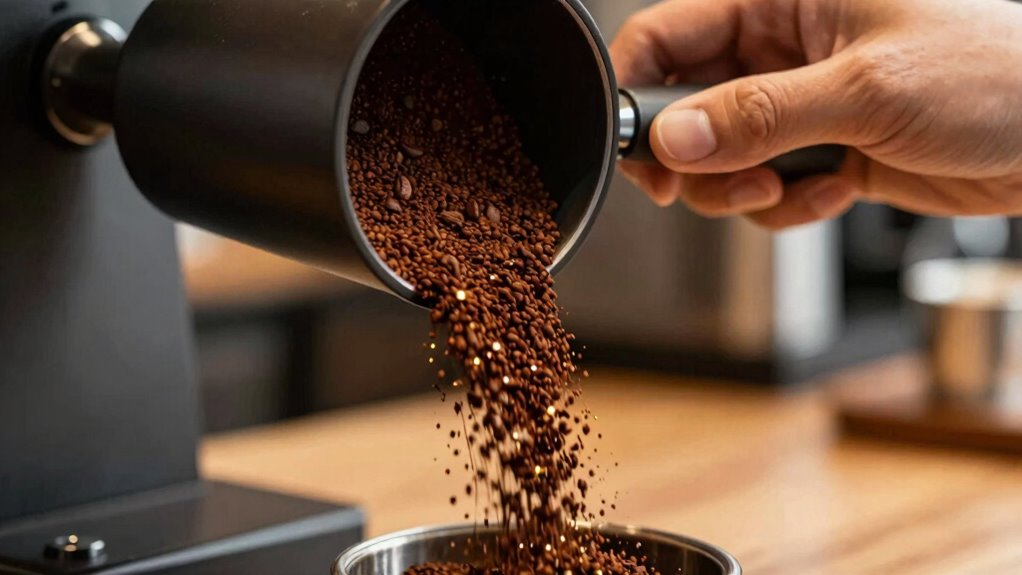

Your coffee density can change how your grind size responds during brewing because denser beans resist crushing more, requiring a finer grind. If the beans come from different origins, processing methods, or roast levels, their density varies, affecting how they pack and crush. Ignoring these differences leads to unexpected shifts in grind size and extraction. Understanding how density influences grinding helps you control flavor and consistency—there’s more to uncover about mastering these adjustments.

Get kitchen gear delivered free — and shop member deals
- Fast, free delivery on millions of items
- Access to Prime Big Deal Days deals on October 6–7
- Prime Video, Amazon Music and more included
Key Takeaways
- Variations in bean origin, processing, and roast level alter density, affecting how tightly beans pack and require different grind adjustments.
- Denser beans resist crushing, needing a finer grind, which can be underestimated if density isn’t properly assessed.
- Inconsistent measurement or assumptions about bean density lead to unexpected changes in grind size during brewing.
- Changes in moisture content or storage conditions can modify bean density, impacting grind consistency.
- Not accounting for bean density results in improper grind adjustments, causing over- or under-extraction.
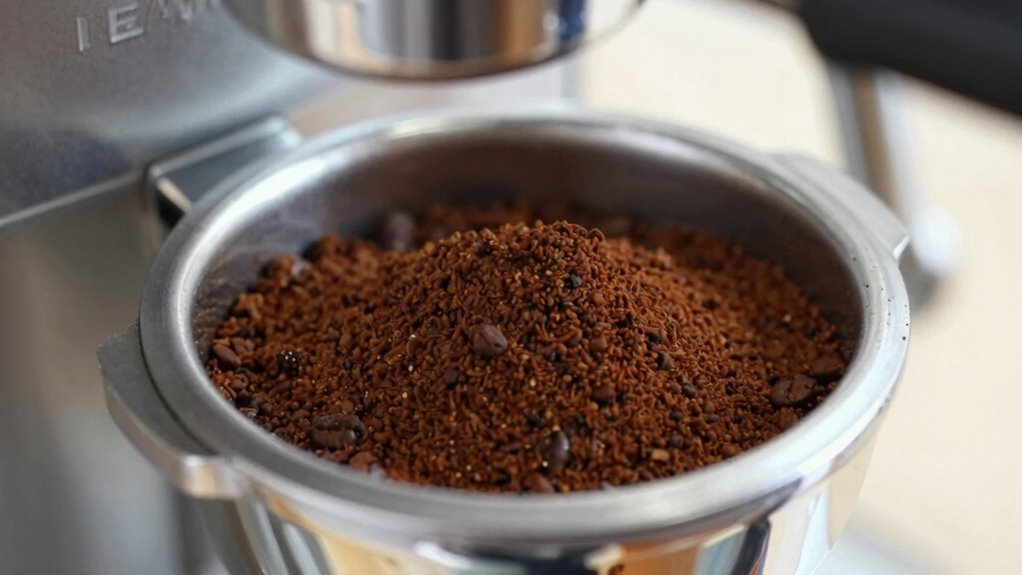
Understanding why coffee density affects grind size more than you might expect is essential for achieving the perfect brew. When you adjust your grind size without considering the density of your coffee beans, you might notice inconsistent flavor and uneven extraction. Coffee density influences how tightly the beans pack together, which directly impacts the grind’s particle size distribution. If your beans are denser, they resist crushing more, often requiring a finer grind to maintain optimal extraction. Conversely, lighter beans tend to produce a coarser grind. Recognizing this relationship helps you fine-tune your grind settings for better flavor consistency and extraction efficiency.
The key is understanding that two batches of beans weighing the same can have vastly different densities, depending on factors like origin, processing method, and roast level. Dense beans pack more tightly, meaning that when ground, the particles are smaller and more uniform if ground at the same setting as less dense beans. If you ignore this, you risk over-extracting or under-extracting your coffee, which leads to inconsistent flavor. Over-extraction results in bitter, harsh notes, while under-extraction leaves your brew sour or weak. Adjusting your grind size based on coffee characteristics like density ensures each cup maintains the intended flavor profile and prevents wasteful trial-and-error adjustments.
You might also find that density impacts extraction efficiency more than you’d expect. When beans are dense, their tightly packed structure makes it harder for water to penetrate evenly, requiring a finer grind. This finer grind increases surface area, promoting better extraction. However, if you don’t account for density, you could grind too coarse for dense beans, leading to under-extraction, or too fine for lighter beans, causing over-extraction. Both scenarios compromise flavor consistency. By understanding the density of your coffee and grind size adjustment, you can set your grinder accordingly, ensuring water flows uniformly through the grounds and extracts the optimal flavors. Additionally, precise grind adjustments can help compensate for variations in bean density, leading to more consistent brewing results. Paying attention to coffee characteristics such as density allows for more tailored adjustments and improves overall brewing success.
In essence, paying attention to coffee density allows you to refine your grind size more precisely, which boosts flavor consistency and maximizes extraction efficiency. Instead of blindly adjusting your grinder, consider the characteristics of your beans. Are they dense or light? This knowledge helps you adapt your process, resulting in a more balanced, flavorful cup every time. When you master the relationship between density and grind size, you’ll find that brewing becomes more predictable and your coffee’s taste more consistent, making every sip worth the effort. A better understanding of coffee density can significantly elevate your brewing skills and overall coffee quality.
coffee grinder with grind size adjustment
As an affiliate, we earn on qualifying purchases.
As an affiliate, we earn on qualifying purchases.
Frequently Asked Questions
How Does Altitude Affect Coffee Density?
Altitude effects cause coffee beans to expand less during roasting because lower air pressure at higher elevations leads to reduced bean expansion. When you roast coffee at high altitudes, the beans tend to be denser, affecting grind size and extraction. This means you’ll notice different brewing results since the altered density impacts water flow and flavor extraction. Adjusting your grind and brew method helps compensate for these altitude-induced changes.
Can Storage Conditions Alter Coffee Density Over Time?
Storage conditions can definitely alter coffee density over time; think of your beans as sponges soaking up moisture. If you don’t store them properly in airtight storage containers, moisture absorption can cause the beans to swell or shrink, changing their density. Keep your coffee in a cool, dry place and use airtight containers to prevent these fluctuations, ensuring consistent grinding and brewing results every time.
Does Roasting Level Influence Coffee Density?
Roasting level definitely influences coffee density. As you roast lighter, coffee beans retain more moisture and structure, resulting in higher density. Darker roasts lose moisture and expand, decreasing density and making the beans more porous. These roast impacts lead to density variations, affecting grind size and brewing extraction. So, understanding how roast impacts density helps you fine-tune your grind and brewing process for peak flavor.
How Does Bean Variety Impact Grinding Consistency?
Bean variety greatly influences grinding consistency because different beans have unique structures and densities. When you select specific beans, you influence grind uniformity, as some varieties grind more evenly than others. By choosing beans with consistent size and density, you help guarantee a more uniform grind, which leads to better extraction and flavor. So, your bean selection directly affects how consistent your grind turns out, impacting your overall brewing experience.
Is There a Way to Measure Coffee Density at Home?
You can measure coffee density at home using simple, homemade measurement methods and density estimation tools. For instance, weigh a specific volume of your coffee beans and compare it to standard density charts, or use a water displacement method to determine volume, then calculate density. These techniques help you better understand your beans’ characteristics, leading to more consistent grinding and brewing. It’s a fun way to optimize your coffee experience without fancy equipment.
coffee bean density measurement tools
As an affiliate, we earn on qualifying purchases.
As an affiliate, we earn on qualifying purchases.
Conclusion
So, next time you grind your coffee, remember it’s a bit like stirring a quiet pond—small changes ripple outward unexpectedly. The density shifts are gentle whispers of the beans’ true nature, revealing hidden depths beneath their surface. Embrace these subtle dance moves of your beans, knowing they hold secrets that can transform your brew. With patience and a watchful eye, you’ll uncover a richer, more harmonious cup—an artful symphony waiting to unfold each morning.
As an affiliate, we earn on qualifying purchases.
As an affiliate, we earn on qualifying purchases.
Fall Picks
fall essentials
As an affiliate, we earn on qualifying purchases.




![Dove Mangiare A Milano: Le Nuove Aperture [In Aggiornamento]](https://ashgrind.com/wp-content/uploads/2026/09/dove-mangiare-a-milano-le-nuove-aperture-in-aggiornamento-featured-260x140.jpg)