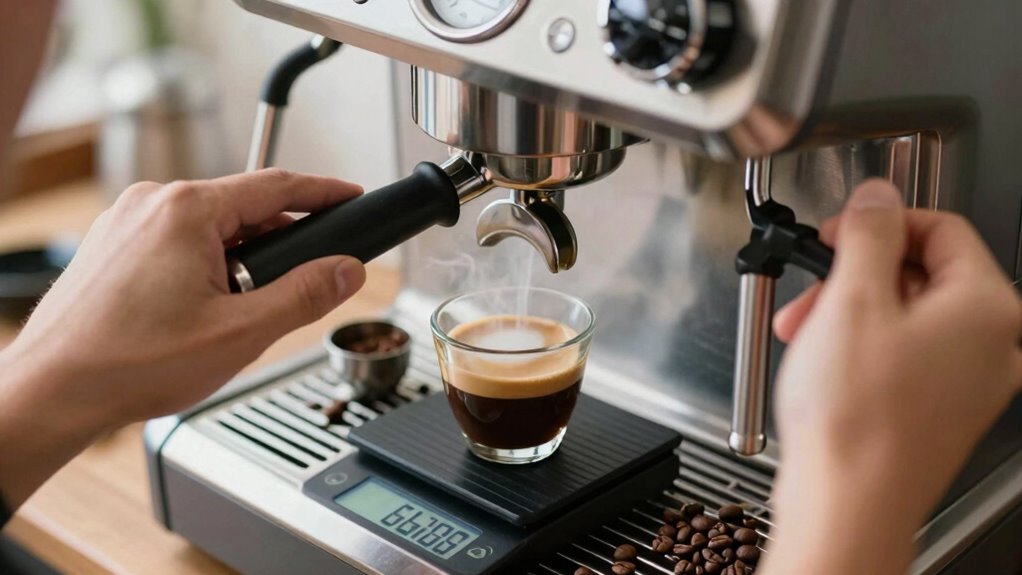

To scale espresso recipes without ruining balance, start by maintaining the coffee-to-water ratio to preserve flavor clarity. Adjust the grind size and brew time proportionally for larger or smaller batches, and guarantee your tamping pressure stays consistent with a calibrated tamper. Keep an eye on extraction time to avoid under- or over-extraction. By fine-tuning these factors systematically, you can produce a balanced shot at any size—more tips await if you continue exploring.

Get kitchen gear delivered free with Prime
- Fast, free delivery on millions of items
- Prime Video, Amazon Music and more included
- Member-only deals all year
Key Takeaways
- Maintain the original coffee-to-water ratio to preserve flavor balance during scaling.
- Adjust grind size proportionally to extraction time and flow rate for consistent results.
- Recalibrate tamping pressure and technique to ensure uniform extraction across batch sizes.
- Test with small batches before scaling up to fine-tune recipe adjustments.
- Keep brewing variables like temperature and extraction time consistent to avoid flavor distortion.
Products Worth Considering

De'Longhi Rivelia Automatic Espresso Machine with Grinder and Milk Frother, Beige

Instant Pot Duo Crisp 8-Quart 11-in-1 Air Fryer and Pressure Cooker

Instant Pot Duo Crisp Ultimate 6.5-Quart 13-in-1 Pressure Cooker and Air Fryer
As an affiliate, we earn on qualifying purchases.
Why Properly Scaling Espresso Recipes Matters for Flavor

Properly scaling espresso recipes is essential because small changes in proportions can substantially impact the flavor. When you adjust your recipe, it’s vital to consider your brewing equipment, as different machines can extract flavors differently. Using milk alternatives requires precise measurements; too much or too little can alter the drink’s balance and creaminess. Calibration techniques help ensure your measurements are accurate and consistent. Consistent scaling ensures that each shot maintains its intended intensity and aroma, regardless of whether you’re making a single or double shot. If you don’t scale properly, you risk over-extraction or under-extraction, leading to bitter or weak flavors. Accurate proportions preserve the intended profile and guarantee your espresso remains rich, smooth, and satisfying. Proper scaling is your key to replicating your favorite cup every time. Additionally, understanding your extraction process helps refine your technique and achieve consistent results, which is crucial for developing your barista skills and understanding flavor development. Recognizing the importance of precise measurement can significantly improve your overall brewing consistency and quality.
The Basics of Espresso Ratios and Extraction Techniques
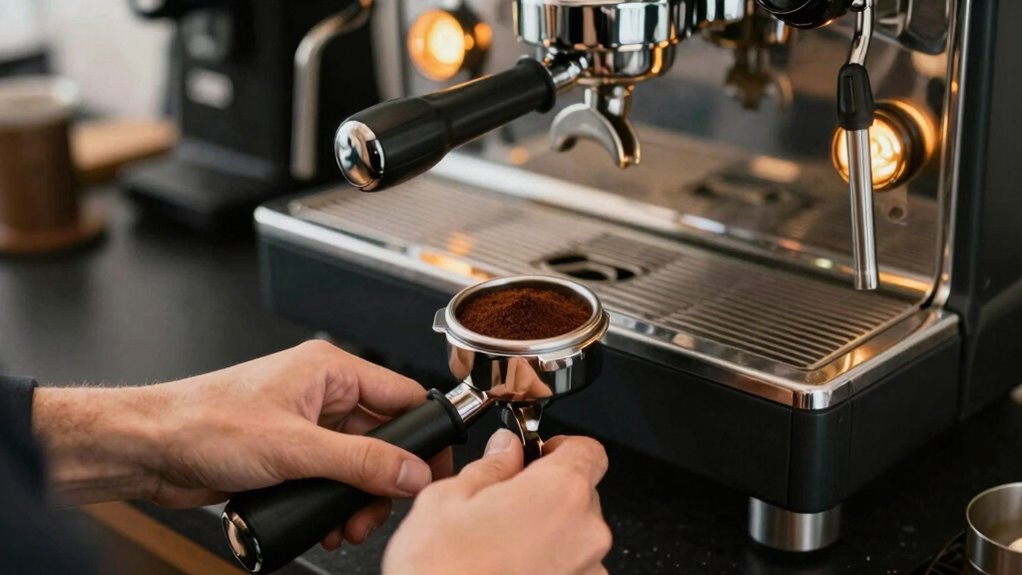
Understanding espresso ratios helps you control the strength and flavor of your shot, so start by knowing the ideal coffee-to-water balance. Optimizing extraction time guarantees you get the right balance of sweetness and bitterness, which you can achieve by adjusting your brew duration. Additionally, adjusting grind consistency is key to making sure water flows evenly through the coffee, leading to a proper extraction every time. Paying attention to visual harmony in your setup can also improve your overall brewing consistency. Being mindful of machine calibration ensures that your equipment performs accurately, further supporting your ability to scale recipes effectively. Maintaining consistent water temperature is also essential, as fluctuations can impact extraction quality and flavor balance. Incorporating proper dose measurement techniques can help achieve precise scaling without disrupting the overall balance. To ensure repeatability, regularly monitoring equipment and calibration practices can help maintain optimal extraction conditions.
Understanding Espresso Ratios
Getting the perfect espresso starts with knowing the right ratios, which directly influence flavor, strength, and extraction. The standard espresso ratio is typically around 1:2, meaning you use one part coffee to two parts water, but this can vary based on your desired profile. Understanding this ratio helps you control flavor balance and consistency. Additionally, factors like brew temperature and water quality play vital roles; a consistent brew temperature ensures proper extraction, while clean, high-quality water prevents off-flavors. When you grasp these basic ratios and how they interact with your brewing variables, you can adjust recipes confidently without sacrificing quality. This foundation enables you to scale recipes up or down while maintaining the flavor balance and clarity that make a great espresso stand out. Proper extraction techniques are crucial to ensure your adjustments do not compromise the final flavor profile. Recognizing how brew ratios influence extraction can help you fine-tune your process for different batch sizes.
Optimizing Extraction Time
Once you’ve established the right espresso ratio, fine-tuning extraction time becomes key to opening the full flavor potential. Proper extraction ensures your brew maintains the desired balance, crema stability, and richness. To optimize, focus on controlling brew temperature, which directly influences extraction speed and flavor clarity. Too short an extraction under-extracts, resulting in sour notes, while too long over-extracts, causing bitterness. Monitoring extraction time helps you hit that sweet spot. Smart temperature control systems can help maintain consistent brew temperatures for optimal extraction. Watch for crema stability as an indicator of proper extraction. Use shot timing as a guide to maintain flavor consistency across scaled recipes.
Adjusting Grind Consistency
Adjusting grind consistency is essential for achieving the perfect espresso extraction, as even minor changes in grind size can profoundly impact flow rate and flavor. If your grind is too coarse, water flows too quickly, resulting in under-extraction and weak taste. Too fine, and the water struggles to pass through, causing over-extraction and bitterness. Focus on maintaining grind uniformity to ensure uniform particle size, which helps achieve tamp uniformity. Consistent grind size allows you to apply even pressure during tamping, leading to better extraction and balanced flavors. Regularly adjust your grinder settings to fine-tune your grind, especially when scaling recipes up or down. Monitoring grind uniformity helps you spot inconsistencies early, ensuring optimal extraction and flavor balance. Paying attention to particle size distribution can help you better understand how your grind affects extraction and flavor development. Incorporating consistent dosing techniques can further enhance your ability to control extraction parameters and achieve reliable results. Additionally, understanding how extraction yield correlates with grind adjustments can provide deeper insight into optimizing your espresso.
How to Calculate Your Coffee Dose When Scaling Up or Down
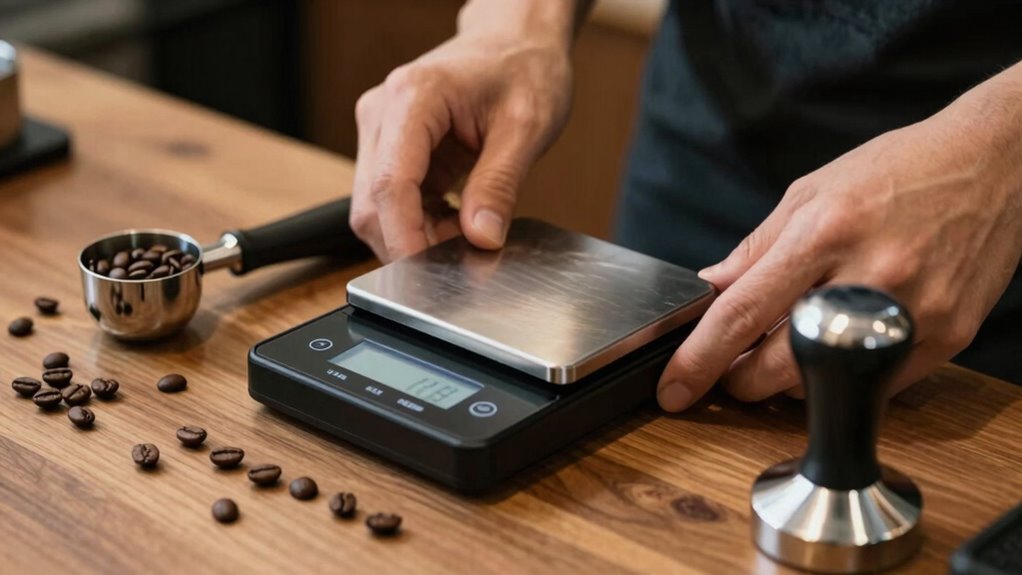
When scaling your espresso recipe, calculating the right coffee dose is essential to maintain consistency and flavor. To do this accurately, consider the coffee’s density and the desired extraction yield. Adjusting the dose proportionally helps preserve balance, but small variations can impact flavor. Use precise measurements and keep track of your ratios. Remember, scaling up or down affects extraction efficiency, so recalibrate your parameters accordingly. Understanding how coffee density influences weight and volume ensures you don’t over- or under-dose. Accurate measurements help ensure your scaling maintains the desired extraction and flavor profile. Additionally, understanding coffee density allows you to better predict how changes in dose will influence the final shot. Also, factor in how extraction yield may shift with different batch sizes to maintain the same flavor profile. Correct dose calculation is key to replicating your perfect shot, no matter the batch size.
Adjusting Grind Size and Brew Time for Different Batch Sizes
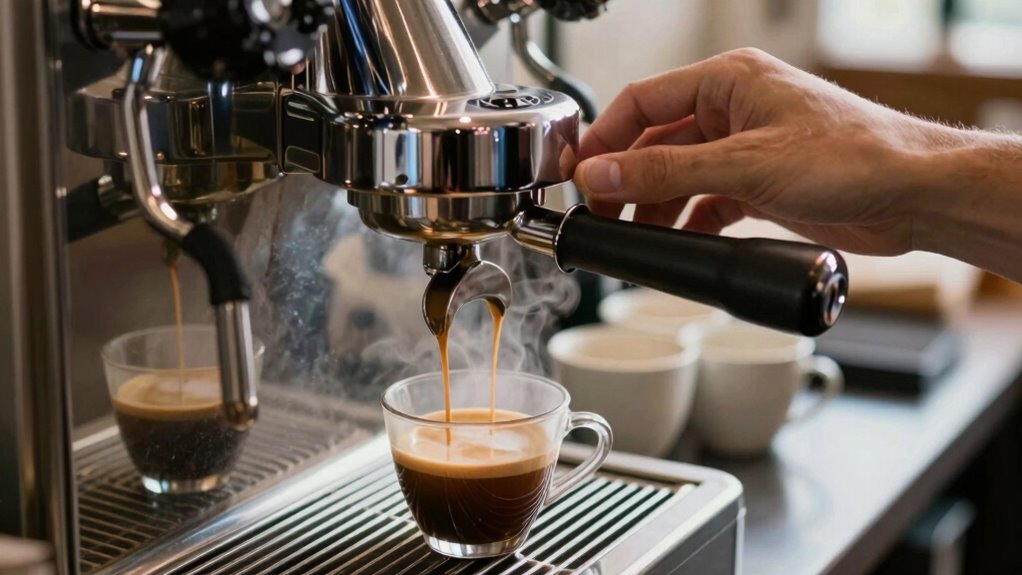
As you scale your espresso batch size, you need to modify your grind size and brew time to guarantee ideal extraction. When increasing the batch, you’ll want to make your grind slightly coarser to prevent over-extraction, while decreasing the batch calls for a finer grind to maintain contact time. Similarly, adjusting brew time is essential—larger batches may require a longer extraction, whereas smaller batches often need a shorter brew time to avoid over-extraction. Pay close attention to how these changes affect flavor, and tweak gradually. Remember, small adjustments in grind size can profoundly impact brew time and flavor balance. Proper extraction techniques are key to achieving consistent and desirable results. Continuously taste and observe the extraction to find the perfect harmony between grind size and brew time for each batch size. Precision in adjustments ensures consistent results and optimal flavor profiles.
How to Maintain Consistent Tamping Pressure During Scaling
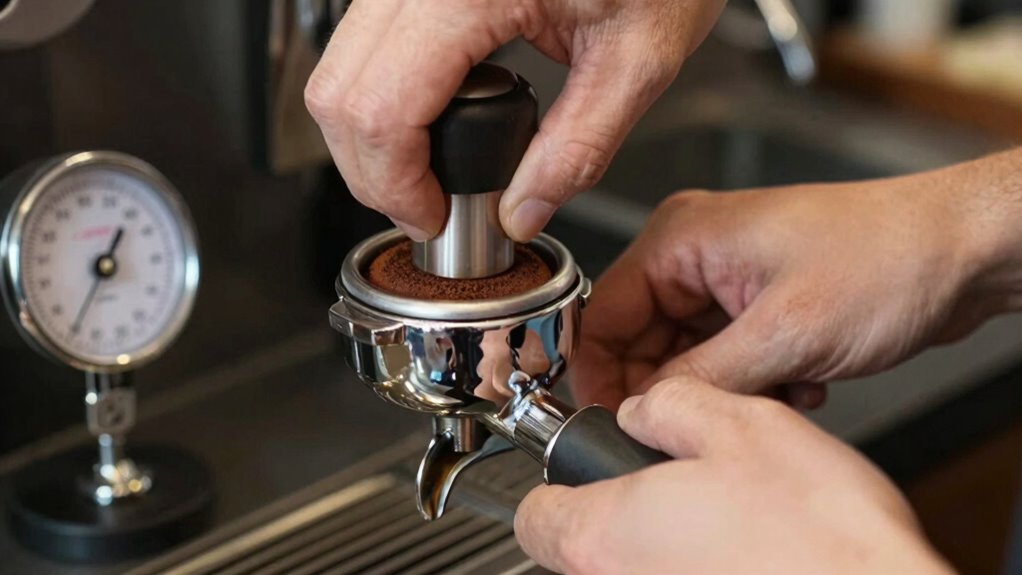
Maintaining consistent tamping pressure during scaling is essential for ensuring uniform extraction, regardless of batch size. When you adjust your recipe, focus on applying the same tamping pressure each time to achieve dose consistency. Variations in tamping can lead to uneven extraction and flavor imbalance. To keep your tamping pressure steady:
- Use a calibrated tamper to apply uniform force.
- Maintain a steady hand and consistent motion.
- Record your tamping pressure settings for future reference.
- Practice on different doses to develop muscle memory.
Simple Ways to Scale Recipes Without Losing Flavor

Scaling coffee recipes can seem tricky, but with the right approach, you can preserve the rich flavors and balance of your original brew. To do this, focus on maintaining the coffee bean origin’s unique profile by adjusting the grind size and extraction time proportionally. When increasing or decreasing doses, keep the ratio of coffee to water consistent to preserve flavor clarity. Additionally, pay attention to milk frothing techniques, as altering milk volumes can impact texture and taste. Use the same frothing method for small adjustments to ensure smooth, velvety milk that complements the espresso. By carefully scaling your ingredients and techniques, you’ll keep your espresso balanced and flavorful, no matter the batch size. This approach guarantees your brew remains true to its origin and maintains excellent taste.
Common Mistakes to Avoid When Changing Espresso Quantities
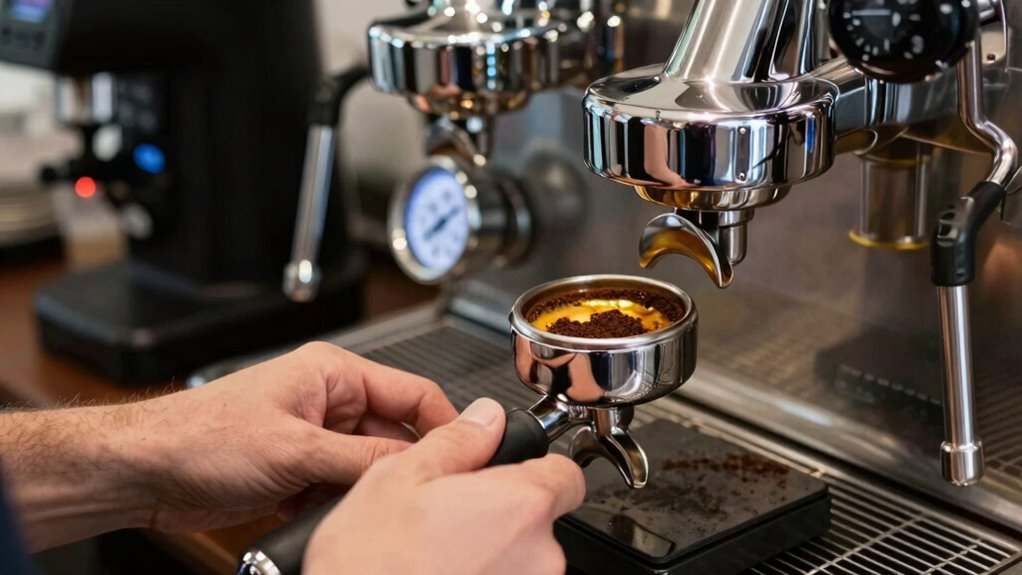
Changing espresso quantities without careful consideration can lead to flavor imbalance and extraction issues. When adjusting your recipe, avoid neglecting key details that affect overall quality. For example, scaling up or down might require rethinking milk frothing techniques to maintain texture and temperature. Additionally, skipping cup warming can cause rapid temperature drops, dulling flavors. Be cautious of these common mistakes:
- Ignoring the impact on brew ratio, which can lead to over- or under-extraction
- Forgetting to adjust grind size accordingly, risking bitterness or sourness
- Overlooking the need to re-evaluate milk frothing methods to preserve creaminess
- Failing to warm cups properly, which can affect aroma and temperature stability
Avoid these pitfalls to keep your espresso balanced and flavorful, regardless of size adjustments.
Tips for Testing and Refining Your Scaled Recipes
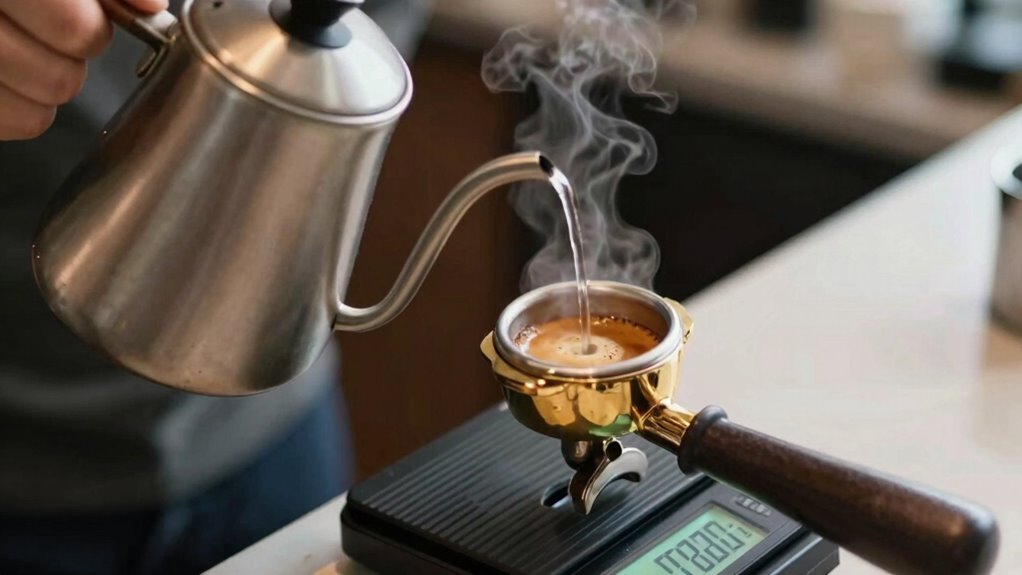
When testing your scaled espresso recipes, start with small batches to accurately evaluate the flavor. Use consistent measurement techniques to guarantee reliable comparisons, and keep an eye on extraction time to fine-tune your results. Adjust these variables carefully to achieve the perfect balance in your final brew.
Small Batch Testing
Testing your espresso recipe on a small scale is essential for making precise adjustments before brewing larger batches. It allows you to evaluate key factors like water temperature and coffee freshness, ensuring your scaled recipe maintains balance. Small batch testing helps detect subtle issues without wasting resources. During testing, focus on controlling variables to identify what needs refinement.
- Adjust water temperature to see how it impacts extraction and flavor
- Use freshly roasted coffee to maintain ideal freshness
- Keep grind size consistent for accurate results
- Record each test to track changes and outcomes
Consistent Measurement Techniques
To refine your scaled espresso recipes effectively, maintaining consistent measurement techniques is key. Focus on achieving uniform grind distribution to ensure even extraction, avoiding clumps or uneven flow. Use a scale to measure your coffee dose precisely each time, regardless of recipe size. Consistent tamping pressure is equally important; apply firm, even pressure to create a level puck that promotes uniform water flow. Keep your tamping technique steady, avoiding variability that can alter extraction. Also, aim for consistent grind size and distribution as you scale your recipe, so the espresso’s flavor profile remains balanced. By sticking to these measurement practices, you’ll reduce variables that can impact extraction quality and reproduce great results every time, whether you’re making a single shot or a larger batch.
Adjusting for Extraction Time
Adjusting for extraction time is essential when refining your scaled espresso recipes, as it directly impacts flavor and strength. Longer extraction can lead to bitterness, while shorter ones may result in sourness. To optimize, monitor your brew temperature and water quality, since both influence extraction speed. Consistently test and tweak variables to find the ideal balance.
- Adjust brew temperature to control extraction rate without compromising flavor.
- Use high-quality water to ensure consistent extraction and prevent off-flavors.
- Modify grind size slightly to fine-tune extraction time without changing dose.
- Track extraction time alongside flavor notes to develop a reliable reference point.
Essential Tools for Accurate Espresso Recipe Scaling
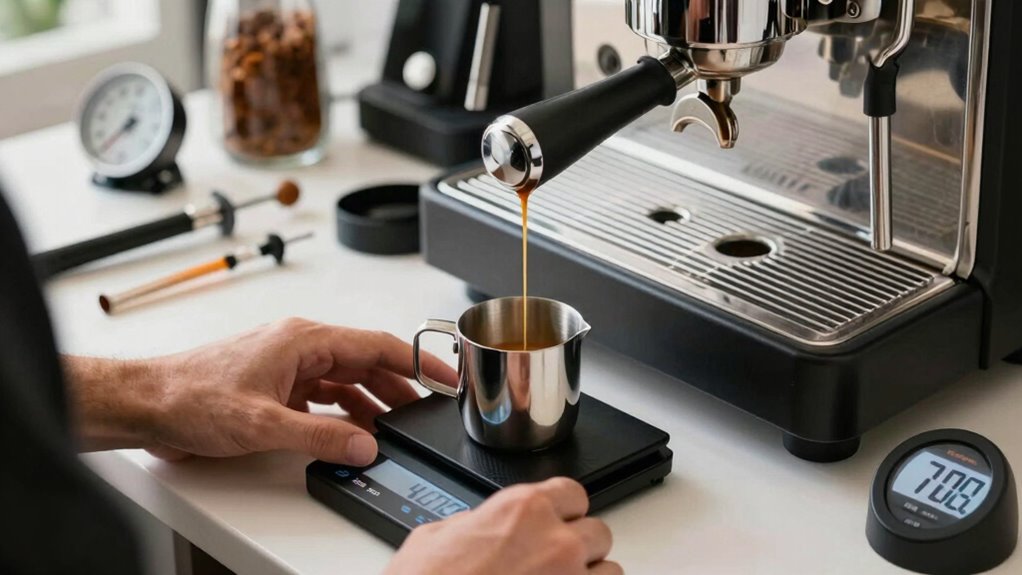
Accurate espresso recipe scaling relies on having the right tools to measure ingredients precisely. You need reliable measuring tools like digital scales to weigh coffee grounds and water accurately, ensuring consistent results. A high-quality scale with precise calibration techniques helps you maintain accuracy when adjusting recipes. Use scales that can measure in grams or ounces, depending on your preference, and ensure they are zeroed out before each use. Calibration is essential to prevent errors caused by drift or mechanical issues. Regularly verify your scale’s accuracy with calibration weights or follow manufacturer instructions. Investing in precise measuring tools and maintaining proper calibration techniques will give you the consistency needed to scale your espresso recipes confidently without sacrificing flavor balance.
Troubleshooting Flavor Imbalances After Scaling Your Espresso
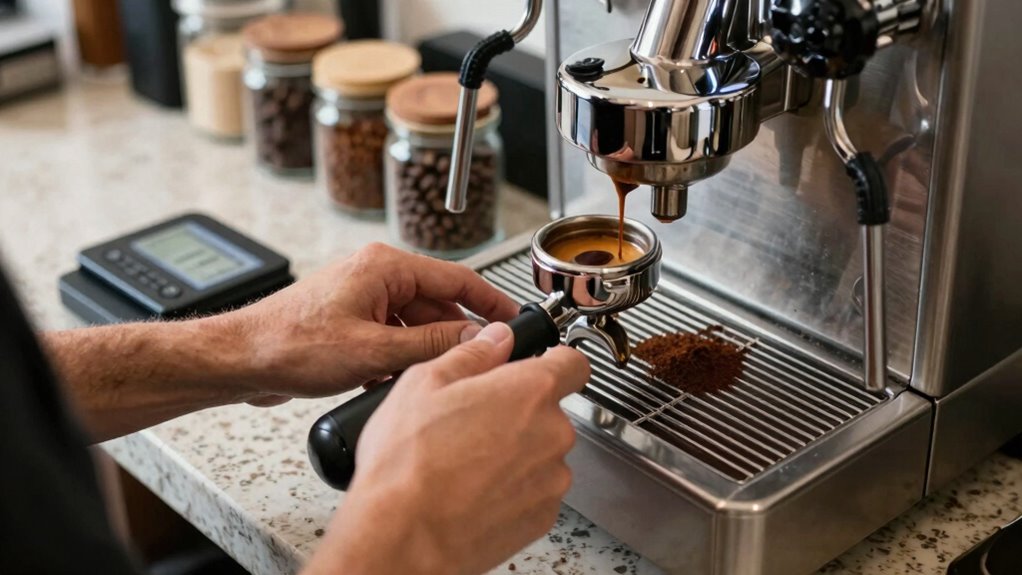
Scaling espresso recipes can lead to unexpected flavor imbalances, even when your measurements are precise. You might notice changes in coffee aroma or crema stability that affect overall taste. To troubleshoot, start by adjusting grind size—finer for over-extraction, coarser for under-extraction. Pay attention to extraction time, ensuring it aligns with the scaled amount. Consider the freshness of your beans, as scaling can make subtle flavor shifts more pronounced. Finally, evaluate your tamping pressure; inconsistent tamping can compromise crema stability and flavor balance.
- Fine-tune grind size to improve extraction.
- Monitor extraction time closely.
- Use fresh beans to enhance aroma.
- Maintain consistent tamping pressure to stabilize crema.
Frequently Asked Questions
How Does Scaling Affect Espresso Crema Quality?
Scaling espresso recipes can impact crema quality by affecting brew consistency and crema stability. When you increase or decrease the dose, water-to-coffee ratio shifts, which may lead to thinner or uneven crema. To maintain ideal crema, you should adjust grind size and extraction time accordingly. Proper scaling ensures your espresso remains balanced, with a rich, stable crema that enhances flavor and presentation, regardless of the recipe size.
Can You Scale Recipes for Different Espresso Machine Brands?
Did you know that over 60% of baristas struggle with recipe consistency across different machines? You can scale recipes for various espresso machine brands, but you need to take into account machine compatibility. Adjust grind size, dose, and extraction time to match each machine’s specs. This ensures you maintain flavor balance and consistency, preventing over-extraction or under-extraction, and keeps your espresso quality high regardless of equipment differences.
What Impact Does Scaling Have on Flavor Profile Longevity?
Scaling espresso recipes can affect flavor stability, making taste consistency harder to maintain over multiple shots. When you increase or decrease quantities, subtle flavor notes may become less distinct, and the overall profile might shift. To maintain flavor stability, adjust grind size and extraction time accordingly, and always taste-test after scaling. This way, you can ensure your espresso’s taste remains consistent and enjoyable, regardless of recipe size changes.
Is There a Recommended Maximum or Minimum Batch Size?
You should keep your batch size within your machine’s recommended limits to guarantee ideal performance and consistency. Typically, small batch sizes under 10 grams aren’t practical, while large batches over 30 grams may strain your equipment or affect extraction. Always check your machine compatibility before adjusting. Staying within these bounds helps preserve flavor balance, ensures even extraction, and reduces wear on your espresso machine.
How Do Environmental Factors Influence Scaled Espresso Recipes?
Did you know that slight changes in environment can alter espresso extraction by up to 15%? Environmental factors like temperature and humidity impact your brew, making adjustments essential. When scaling recipes, you need to tweak grind size and water temperature to compensate for these changes. For instance, in humid conditions, you might need a slightly finer grind, and in colder environments, increase water temperature to maintain flavor balance.
Conclusion
Scaling your espresso recipes carefully is key to preserving that perfect balance you love. Remember, about 60% of baristas report that inconsistent scaling affects flavor profiles, so precision matters. By understanding ratios, adjusting grind size, and maintaining proper tamping, you’ll guarantee every shot tastes just right—no matter the batch size. Keep testing and refining, and you’ll master the art of scalable espresso, delighting every cup with consistency and flavor.