
TL;DR

Get kitchen gear delivered free with Prime
- Fast, free delivery on millions of items
- Prime Video, Amazon Music and more included
- Member-only deals all year
Porcelain wood-look tile is drawing renewed attention as manufacturers introduce more realistic grain, texture and wood species. Designers cited in House Beautiful see practical uses in moisture-prone spaces, but the material is harder and cooler underfoot, and some high-end installations can cost as much as hardwood. The source does not establish that tile is replacing hardwood overall.
Wood-look porcelain tile is getting more realistic, prompting renewed interest from designers, but the trend does not show that it is replacing hardwood floors across homes. A House Beautiful report on new tile collections and designer projects describes the material as a practical option for some spaces, especially where moisture, humidity or outdoor exposure make natural wood harder to maintain.
At Cersaie, the annual ceramic tile and bathroom furnishings exhibition in Bologna, Italy, manufacturers presented porcelain planks designed to imitate a wider range of wood species and more closely reproduce natural grain and texture. Atlas Concorde’s expanded Log Anthology collection includes Douglas fir, ash, elm, walnut, teak and zebrano. The company says its surface technology pairs slip resistance with a softer feel, while high-definition decoration reproduces irregularities in wood.
Marca Corona’s Elisir Pura takes inspiration from Slavonian oak. House Beautiful reports that it comes in two looks, one with fewer knots and subtle veining and another with more pronounced markings. The company says a custom glaze creates small depressions along the grain to give the tile a tactile quality. Floor & Decor has also introduced its NatureMatch line, which the company says focuses on more realistic visuals and textures.
The design preference described by Floor & Decor trend expert Ashley Biscan is for light tones, restrained variation and understated grain, rather than prominent artificial-looking knots. These product releases show manufacturers investing in the category; they do not establish how many homeowners are choosing tile over hardwood or whether market-wide sales are shifting.
Where Wood-Look Tile Fits Best
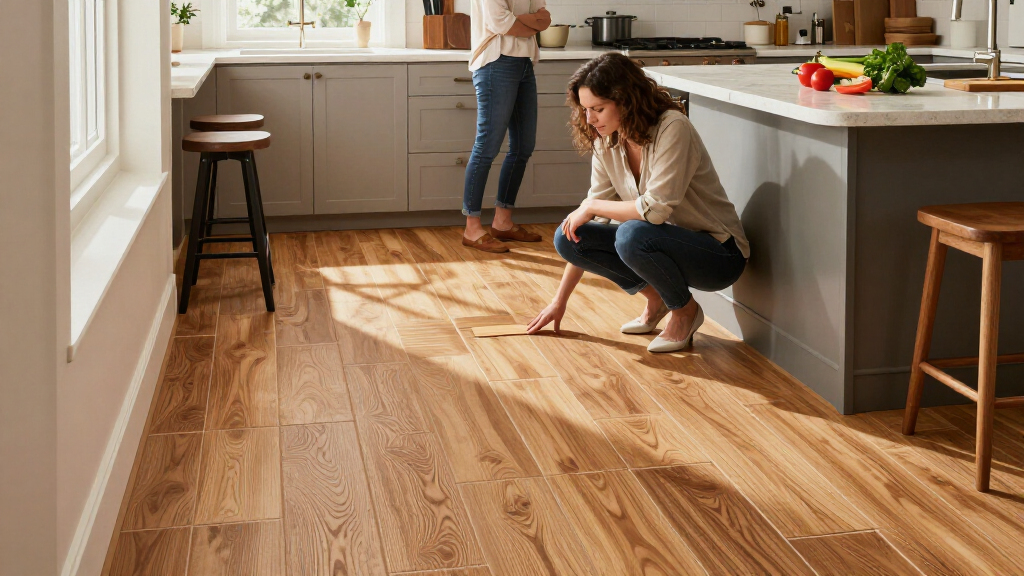
The appeal is not only visual. Porcelain resists moisture, scratches and everyday wear better than natural hardwood, according to the report, making it a candidate for kitchens, bathrooms, mudrooms and other demanding areas. That can matter to homeowners who want a wood-like appearance in a room where they are concerned about water or heavy use.
Designer Britney Stein of Florida-based Sketch Design Studio described specifying the material for an oceanfront home exposed to humidity, salt air and moisture. She also said she is working on a project using chevron-patterned porcelain in an outdoor loggia, color-matched to indoor hardwood so the spaces appear connected when glass doors are open. Those are examples of project-specific decisions, not evidence that designers generally prefer tile.
The trade-offs remain practical as well as aesthetic. Porcelain feels harder and cooler underfoot than wood, and Stein cautioned that higher-end tile plus installation can cost as much as natural hardwood. The best choice can depend on the room, climate, budget and how much the occupants value a softer, warmer floor.
As an affiliate, we earn on qualifying purchases.
A Mature Wood-Effect Category
Wood-look tile is not a new product category. House Beautiful says it has been available for decades as an alternative for people seeking a wood appearance with different maintenance demands. The current development is a refinement: manufacturers are putting greater emphasis on texture, realistic species variation and more restrained patterns, rather than relying only on printed grain.
That refinement reflects a broader effort to extend tile finishes across different settings. Atlas Concorde offers coordinating indoor planks, outdoor pavers, herringbone formats and large slabs, according to the report. Matching formats can help designers carry a similar look from interior floors to outdoor areas, though the products remain manufactured surfaces rather than natural timber.
The report’s examples suggest a selective use alongside hardwood, not necessarily a replacement. One designer is matching outdoor porcelain to indoor wood, while another specified tile for an oceanfront setting. The available information concerns product launches and individual projects; it does not provide comparative sales figures, adoption rates or a broad survey of designer opinion.
“Realism today is as much about touch as it is about sight.”
— Viola Pagani of Atlas Concorde
As an affiliate, we earn on qualifying purchases.
No Evidence of a Broad Switch
The source does not show that wood-look tile is replacing hardwood at a market-wide level. It offers product announcements, comments from people associated with manufacturers and retailers, and examples from designers’ projects, but no sales data or independent survey measuring consumer or designer preferences.
The report also introduces a section on designers’ views but cuts off before completing one designer’s comment. The full range of opinions in that section is therefore unavailable here. Comparative installed costs are not provided either, and prices can vary by product and project. The claim that tile may be more affordable is not universal: Stein says some premium tile installations can match hardwood costs.
As an affiliate, we earn on qualifying purchases.
Watch Adoption Beyond Product Launches
The next useful evidence would be sales and installation data showing whether homeowners are choosing wood-look porcelain more often, and in which rooms. More complete designer commentary could also clarify how frequently the material is specified compared with hardwood and what factors drive those decisions.
For now, the reported collections point to continued product development rather than a confirmed flooring-wide shift. Homeowners comparing options can weigh moisture resistance and durability against underfoot comfort, project cost and the distinct appearance of natural wood, using the conditions of the specific space as the guide.
As an affiliate, we earn on qualifying purchases.
Key Questions
Is wood-look tile replacing hardwood floors?
There is no evidence in the report of a broad replacement. It describes more realistic tile products and selected designer uses, but gives no market-wide sales or adoption data.
What makes wood-look porcelain tile useful?
Porcelain is described as resistant to moisture, scratches and everyday wear, which can make it suitable for kitchens, bathrooms, mudrooms and some outdoor areas.
What are the drawbacks compared with hardwood?
Tile is generally harder and cooler underfoot. The report also notes that premium porcelain and installation can cost as much as natural hardwood, so it is not always the less expensive option.
What wood styles are popular in newer tile collections?
Floor & Decor’s Ashley Biscan described demand for light wood tones, minimal color variation and understated grain, rather than exaggerated knots and markings.
Where are designers using wood-look tile?
The cited projects include an oceanfront home exposed to humidity and salt air, as well as an outdoor loggia designed to visually match indoor hardwood.
Source: rss
Fall Picks
fall essentials
As an affiliate, we earn on qualifying purchases.