
TL;DR

Get kitchen gear delivered free with Prime
- Fast, free delivery on millions of items
- Prime Video, Amazon Music and more included
- Member-only deals all year
Experts recommend specific storage practices to help fruits and vegetables last longer. Proper techniques can reduce waste and save money. This guide summarizes confirmed methods and ongoing research.
Food storage experts confirm that proper storage techniques can significantly extend the freshness and shelf life of fruits and vegetables, helping consumers reduce waste and save money.
Recent guidance from food preservation specialists emphasizes the importance of storing fruits and vegetables in specific conditions to maximize their lifespan. Key recommendations include using the refrigerator appropriately, controlling humidity levels, and utilizing suitable containers or storage environments.
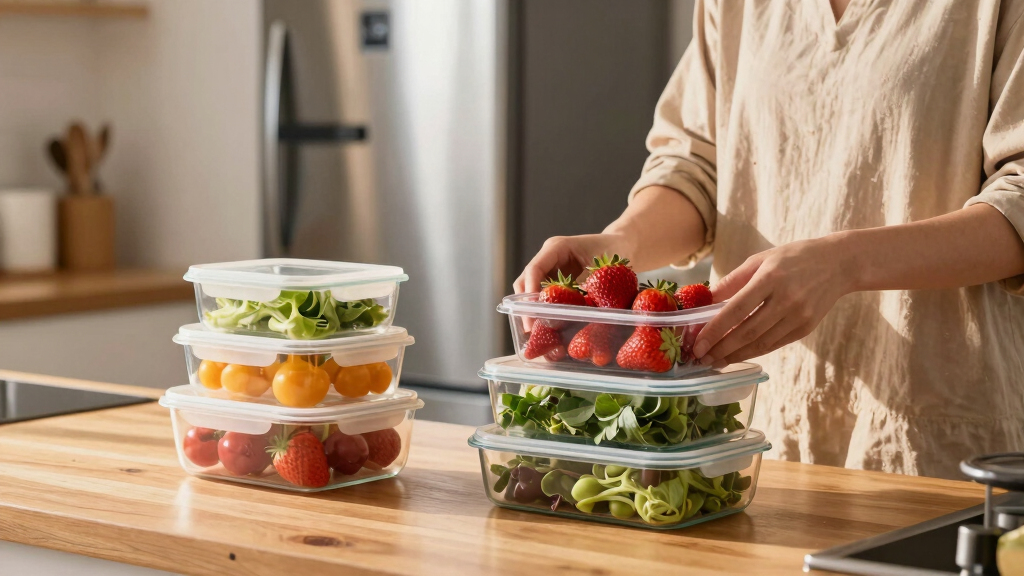
For example, leafy greens should be stored in perforated plastic bags in the crisper drawer to maintain moisture, while berries benefit from being kept in breathable containers to prevent mold. Tomatoes, on the other hand, should be stored at room temperature away from direct sunlight to avoid spoilage.
Experts also highlight that certain fruits emit ethylene gas, which can accelerate ripening and spoilage of nearby produce. Keeping ethylene-producing fruits like apples and bananas separate from sensitive vegetables can help prolong freshness.
Why Proper Storage Techniques Impact Food Waste and Savings
This guidance matters because improper storage is a leading cause of food spoilage, leading to increased household waste and financial loss. By following proven methods, consumers can extend the usability of their produce, reduce trips to grocery stores, and contribute to less environmental impact from food waste.
refrigerator produce storage containers
As an affiliate, we earn on qualifying purchases.
As an affiliate, we earn on qualifying purchases.
Recent Advances in Food Storage Recommendations
Over the past decade, research into food preservation has identified specific environmental conditions—such as temperature, humidity, and airflow—that influence produce longevity. While traditional advice has focused on refrigeration and cool, dark places, recent studies emphasize tailored storage solutions for different types of fruits and vegetables.
Organizations like the USDA and food safety agencies have updated their guidelines based on new findings, but consumer awareness remains inconsistent. This advice builds on longstanding principles, refining them with recent scientific insights.
“Using the right storage containers and maintaining optimal humidity levels can double the shelf life of many common fruits and vegetables.”
— Dr. Susan Miller, Food Preservation Expert
As an affiliate, we earn on qualifying purchases.
Unanswered Questions About Storage Techniques Effectiveness
While many storage methods are supported by scientific evidence, some claims about extending freshness beyond standard practices remain under investigation. It is not yet clear how different storage conditions interact across various types of produce or how long the effects last in typical household environments.
Further research is needed to quantify the benefits of specific storage methods and to develop universally applicable guidelines for consumers.
humidity control refrigerator drawers
As an affiliate, we earn on qualifying purchases.
As an affiliate, we earn on qualifying purchases.
Future Research and Consumer Guidance on Food Storage
Researchers plan to conduct controlled studies to better understand optimal storage conditions for a wider range of produce. Meanwhile, consumer education campaigns are expected to disseminate updated, evidence-based storage tips. Manufacturers may also develop new storage products designed to extend freshness based on ongoing research.
As an affiliate, we earn on qualifying purchases.
Key Questions
What is the best way to store leafy greens?
Store leafy greens in perforated plastic bags in the refrigerator’s crisper drawer to maintain moisture and prevent wilting.
Can I store all fruits and vegetables in the fridge?
No, some fruits like tomatoes and bananas should be stored at room temperature away from direct sunlight to prevent spoilage.
Does separating ethylene-producing fruits really help?
Yes, keeping ethylene producers like apples and bananas away from sensitive produce can slow ripening and extend freshness.
Are there storage containers that help keep produce fresh longer?
Yes, breathable containers and perforated bags designed for specific produce types can help regulate humidity and prolong shelf life.
Is there scientific evidence supporting these storage tips?
Yes, recent studies and expert guidelines support many of these practices, though some areas still require further research.
Source: rss
Evergreen bestsellers Picks
bestsellers
As an affiliate, we earn on qualifying purchases.