TL;DR
A turkey roasting pan with a rack lifts the bird so hot air can circulate beneath it while juices collect for gravy. Check the pan’s interior size, sturdy construction, rack shape, depth, and stovetop compatibility before buying; then use a food thermometer to check doneness.
A turkey can look perfectly golden on top while its underside sits in a puddle of juices. A roasting pan with a rack helps solve that problem by lifting the bird above the pan’s bottom, where hot air can move around it and drippings can collect.

Get kitchen gear delivered free with Prime
- Fast, free delivery on millions of items
- Prime Video, Amazon Music and more included
- Member-only deals all year
This guide covers what the rack does, how to choose a pan that fits your turkey and oven, and what to check before you use it for gravy or cleanup. You’ll also get practical roasting tips for a crowded holiday kitchen, where a heavy bird, hot juices, and a narrow oven door leave little room for guesswork.
Choose a pan by its usable interior dimensions and your oven space, not by turkey weight alone.
A V-shaped rack cradles the bird; a flat rack often works for more kinds of roasts.
Check stovetop and induction compatibility before planning to make gravy in the roasting pan.
Use a food thermometer in the thickest breast and inner thigh, avoiding bone.
Support disposable foil pans with a sturdy sheet pan before adding a heavy turkey.
See What the Rack Does for Your Turkey
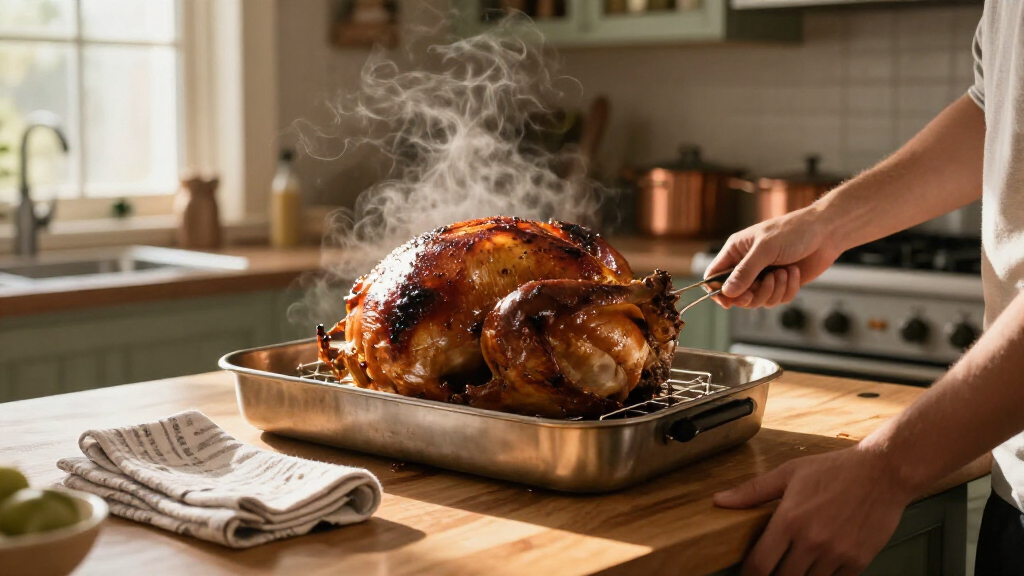
A turkey roasting pan with a rack holds the bird above the pan’s bottom so hot air can reach beneath it while the juices collect below. That separation can help the underside roast instead of simmer in its own juices, while keeping valuable drippings available for gravy. It doesn’t guarantee even cooking on its own: the oven, the bird’s shape, and how tightly the pan is packed still affect heat flow.
The rack’s shape affects how the bird sits and how easy it is to handle. A V-shaped rack cradles the turkey and helps keep it steady, which is useful when you lift or turn a heavy bird. Its snug shape can leave less room for other items in the pan. A flat rack can work for other roasts and may be easier to store, but the turkey may shift more easily. Either way, it should fit securely and support the bird without bowing under its weight.
Imagine lifting a 14-pound turkey from a hot pan: a wobbly rack can tilt, spill drippings, or make the bird harder to control. A stable rack gives you a more secure place to rest the bird before carving. If you don’t own one, a bed of sturdy vegetables can raise the turkey, though the vegetables absorb some drippings and their uneven surface may support the bird less consistently.
Think of the rack as a little platform: it supports the turkey, while the pan catches the flavor that runs off.
Products Worth Considering

Le Creuset Alpine Outdoor Enameled Cast Iron Square Grill Pan, 10.25 in

Instant Pot Duo Crisp Ultimate 6.5-Quart 13-in-1 Pressure Cooker and Air Fryer

Le Creuset Signature Enameled Cast Iron Saucepan, 2.25 qt., Cerise
As an affiliate, we earn on qualifying purchases.
Choose a Pan That Fits Both Bird and Oven
The best turkey roasting pan is large enough to hold the bird without touching its sides, yet small enough to sit level in your oven with room for air to circulate. Check the pan’s interior dimensions, not just its outside measurements, because thick rims and handles take up space without supporting the turkey. Compare the usable area with both the bird and your oven rack.
A pan that barely fits can scrape the oven walls or block airflow, and those tight clearances make it harder to slide a heavy, hot pan out safely. A very large pan may heat unevenly and be awkward to handle; its extra open area can also spread drippings thinly, so they may dry out sooner. For example, before Thanksgiving, measure the oven opening and the space between the oven walls, then check whether the loaded pan can slide out without catching on the door frame.
Look at depth and shape too. Sides should contain juices, but very tall sides can shield the turkey’s lower sides from direct oven heat, slowing browning there. Rounded corners make it easier to stir gravy and wipe away browned bits, while a broad, flat base gives the drippings room to spread and makes stovetop heating more practical when the pan is compatible.
Turkey weight can help you narrow your search, but don’t rely on a weight label alone. Birds of the same weight can have different lengths and widths, and a bird that fits by weight may still press against the pan’s sides. If you can, compare the turkey’s approximate length and width to the pan’s usable interior space before you buy.
Compare Materials, Handles, and Rack Styles
Turkey roasting pans with racks come in several materials, and the best choice depends on how you cook, clean, and store your pan. Stainless steel is durable and generally nonreactive, but its weight can make a full pan harder to maneuver. Aluminum heats efficiently, which can help the pan respond quickly to temperature changes, but it may react with acidic ingredients unless it has a suitable coating or lining. Enameled steel and coated pans can simplify cleanup, though surface damage or exceeding the maker’s temperature limits may shorten their useful life.
A sturdy, heavy pan is less likely to warp under a large bird, but more weight can make carrying it harder. Wide, secure handles help balance that tradeoff: a thin grip can be difficult to hold with oven mitts, especially when the pan is full of hot juices. Think about a cook carrying a 16-pound turkey from oven to counter—the handles need to feel secure before the pan is hot.
Use this quick comparison to match the pan to your kitchen:
| Feature | What it offers | What to check |
|---|---|---|
| Stainless steel | Durability and a generally nonreactive surface | Weight and stovetop compatibility |
| Aluminum | Efficient heating | Whether acidic ingredients need a lining |
| Coated or enameled finish | Potentially easier cleanup | Care instructions and temperature limits |
| V-shaped rack | Cradles and steadies a turkey | Fit and support under the bird |
| Flat rack | Flexibility for other roasts | Whether it keeps the turkey stable |
Newer sets may include removable racks, nonstick coatings, or parts labeled dishwasher-safe. Those features can save cleanup time, but they don’t remove the need to protect the pan’s surface. Check the current product instructions for oven limits and cleaning rules; a dishwasher-safe rack doesn’t mean every pan surface or handle belongs in the dishwasher.
Make Sure the Pan Can Handle Your Gravy Plan
If you want to make gravy directly in the roasting pan, check that the manufacturer says it is safe for your stovetop. Oven-safe does not automatically mean stovetop-safe, and compatibility varies by burner. Induction users should check specifically for induction support before setting a pan on the cooktop. A pan that spans multiple burners may heat unevenly unless its base is designed for that setup.
Here’s why that detail matters: after roasting, the browned bits and drippings hold concentrated flavor, but you need to move the pan from oven to burner to loosen them. A pan that isn’t designed for that job may be damaged or may not heat properly, leaving some areas too cool to release the browned bits while others scorch. In a kitchen with a gas range, a wide pan may also sit across multiple burners, so check whether the design supports that use.
Drippings can scorch if the pan is too shallow, the oven is too hot, or the juices dry out. Scorched drippings can make gravy taste bitter, so follow your recipe’s directions for adding liquid and check the pan during cooking if the recipe calls for it. If you’re not sure about stovetop use, pour the drippings into a saucepan instead; a few extra seconds of transferring can save an incompatible pan and give you more control over the gravy’s heat.
Always use dry oven mitts and keep your hands and forearms clear of steam when handling a hot pan. Hot fat can spit when you add liquid, so add it carefully and follow the recipe.
Roast With Less Guesswork and Better Drippings
Good roasting starts with a dry surface, a stable setup, and a thermometer. Drying the turkey skin before it goes in the oven helps it brown because moisture on the surface must evaporate before browning can progress. Leaving space around the bird gives heat room to move; a pan crowded with vegetables can block airflow and soak up juices you might want for gravy. That tradeoff may be worthwhile if roasted vegetables are part of the meal, but keep them from pressing tightly against the turkey.
Follow this simple sequence for a steadier roast:
- Check the fit. Set the empty pan and rack in the oven to confirm they sit level and have room to slide out. Finding a clearance problem while the pan is empty is easier and safer than discovering it with a hot, heavy bird.
- Set up the bird. Place the turkey securely on the rack, with the breast and legs positioned as your recipe directs. A stable fit reduces shifting when you move the pan.
- Roast according to your recipe. If the recipe calls for liquid in the pan, add it as directed and check that the drippings don’t dry out. Keeping enough liquid can protect the flavor you’ll use for gravy, though too much may reduce browning where the turkey or vegetables touch it.
- Check temperature. Use a food thermometer in the thickest part of the breast and inner thigh, avoiding bone. This checks the interior directly; skin color and cooking time are only clues. Follow current food-safety guidance for the target temperature and resting time.
- Rest before carving. Move the bird carefully to a carving board, then use the collected drippings as your recipe directs. Resting gives the juices time to settle, while leaving the drippings in the pan keeps them available for gravy.
A turkey’s browned skin can tempt you to judge doneness by color, but appearance alone doesn’t tell you the temperature inside. If the breast browns too quickly, follow your recipe’s guidance on covering it, and continue to use the thermometer to check doneness.
Handle the Pan Safely and Clean It Without Damage
A roasting pan loaded with turkey and hot juices is heavy, slippery, and harder to steer than an empty pan. Before the bird goes in, clear the route from oven to counter and check that the handles are easy to grip with your oven mitts. A clear route matters because you need to watch the pan and keep it level, rather than stepping around clutter with hot liquid. If your counter has little space, make room before roasting begins instead of balancing the pan while looking for a landing spot.
For a disposable foil pan, place it on a sturdy sheet pan before adding the turkey. Thin foil may flex under a heavy bird, especially when you lift one edge, which can spill hot juices or shift the turkey. A separate rack or a bed of vegetables can raise the turkey, but test the setup while everything is cold so it doesn’t shift when hot.
After dinner, follow the pan’s care label. Soaking the pan and rack in warm, soapy water can loosen sticky browned bits without aggressive scraping; avoid abrasive scrubbers on coated or enameled surfaces because they can scratch or wear. If residue clings to a coated pan, use the cleaning method the maker recommends rather than scraping it with a metal utensil. Gentler cleanup helps preserve the surface, which matters because damaged coatings can become harder to clean.
Before buying, check oven-temperature limits for the pan, rack, handles, and coating. Different parts of a set may have different limits. That small bit of label reading can spare you a damaged handle or a pan that is difficult to clean after the meal.
Frequently Asked Questions
Do I need a rack to roast a turkey?
No. A rack lifts the turkey above the pan so air can move underneath, but a bed of sturdy vegetables or another oven-safe support can work. The vegetables may absorb drippings, and the bird may not roast as evenly.
How do I choose the right size roasting pan?
Compare the pan’s interior dimensions with the turkey and check that the pan fits level in your oven with room to slide out. The bird should not touch the sides, and the pan should leave space for air to circulate.
Is a V-shaped rack better than a flat rack?
A V-shaped rack cradles a turkey and can help keep it steady. A flat rack may suit more foods and be easier to clean. Choose based on how you plan to use the rack and whether it supports your bird securely.
Can I use my roasting pan on the stovetop for gravy?
Only if the manufacturer says the pan is safe for your stovetop and burner type. Check induction compatibility if you have an induction cooktop. Otherwise, transfer the drippings to a saucepan.
How can I keep turkey drippings from burning?
Follow your recipe’s directions for adding water or stock, and check the pan during cooking if instructed. Drippings can scorch if they dry out, so don’t leave the pan unattended when the recipe calls for monitoring.
Can I roast a turkey in a disposable foil pan?
Yes, but thin foil can flex under a heavy bird. Set the disposable pan on a sturdy sheet pan for support, and use a separate rack or sturdy vegetables to lift the turkey.
Conclusion
Choose a pan that fits your bird and oven, gives the rack a steady hold, and matches how you plan to cook and clean. Check the maker’s instructions before using it on a stovetop or above its stated temperature limit.
Then let the thermometer call the turkey done, not its golden color. A stable pan, a properly rested bird, and a bowl of warm gravy make a much calmer finish to the meal.