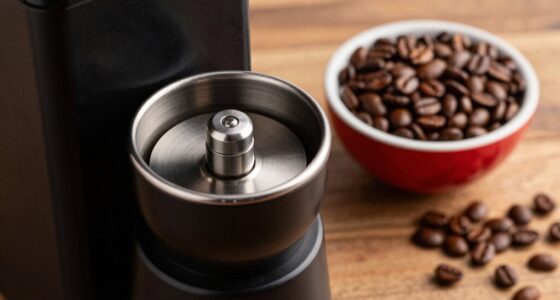

Finer grind size alone won’t fix your fast espresso shots because other factors like tamping, machine pressure, and water flow play key roles. Light tamping can create channels, letting water pass through too quickly, while inconsistent distribution causes uneven extraction. Adjusting machine pressure and water temperature also impact shot timing. By focusing on these elements together, you can better control your brew. Keep exploring these aspects to master your espresso timing more precisely.

Get kitchen gear delivered free with Prime
- Fast, free delivery on millions of items
- Prime Video, Amazon Music and more included
- Member-only deals all year
Key Takeaways
- Finer grind size alone doesn’t control flow rate; other factors like tamping and machine pressure also affect shot speed.
- Inconsistent tamping or distribution can cause rapid water flow despite a fine grind.
- Machine pressure settings and water temperature are crucial; improper calibration can lead to quick shots regardless of grind.
- Water flow dynamics and machine pressure influence extraction speed, often overriding grind size adjustments.
- A holistic approach addressing tamping, machine calibration, and water parameters is essential to fix fast shots.
Have you ever wondered why some athletes seem to make quick decisions effortlessly while others struggle with timing? The same principle applies to brewing espresso. When it comes to the fast shot problem—that is, pulling a shot that’s too quick—you might assume that grinding finer would fix the issue. But surprisingly, that’s not always the case. You see, grind size influences extraction speed, but it’s not the only factor at play. If your shot pulls too fast despite a finer grind, it’s time to look beyond just the grind setting.
Fast espresso shots aren’t fixed by finer grind alone — consider tamping, pressure, and temperature for better control.
You might think that making your grind finer will slow down extraction, giving you better control and richer flavors. However, if the coffee still flows through too quickly, it indicates that other variables are influencing the process. For example, tamping pressure, distribution, and machine factors all affect extraction speed. Tamping too lightly can create channels, letting water pass through with minimal contact, regardless of how fine your grind is. Similarly, inconsistent coffee bed density can cause uneven extraction, leading to a fast shot that’s not improved by simply grinding finer. Adjusting the machine’s pressure settings can also be crucial to controlling flow rate and ensuring proper extraction. Additionally, understanding how water flow dynamics influence extraction can help troubleshoot issues more effectively. Recognizing the role of tamping technique is essential for achieving consistent resistance and optimal extraction.
Sometimes, adjusting grind size alone isn’t enough because the extraction process depends on more than just the grind. The water temperature, pressure, and flow rate all play essential roles. If your machine’s pressure isn’t ideal, even a finer grind won’t slow down the shot enough. Or if your water is too hot, it can accelerate extraction, resulting in a quick, underdeveloped flavor profile. On the flip side, if your machine is over-pressurized, it may push water through the puck rapidly, regardless of grind size. Additionally, understanding how consistent tamping helps ensure uniform resistance and optimal extraction is crucial to troubleshooting this issue. Moreover, ensuring your water temperature is correctly set can significantly impact extraction speed.
Understanding that grind size is just one piece of the puzzle helps you troubleshoot more effectively. Instead of fixating solely on making the grind finer, you should evaluate the entire brewing process. Adjust tamping pressure to guarantee uniform resistance, check your machine’s pressure settings, and consider water temperature. Sometimes, a slight tweak in one area can dramatically improve extraction speed without changing the grind size. Remember, the goal is to control extraction speed to develop balanced flavors, and that requires a holistic approach rather than relying solely on finer grind adjustments.
In essence, if your shot is fast despite a finer grind, it’s a sign that other factors are influencing the brew. The fast shot problem isn’t solved by grinding finer alone. Instead, you need to look at the bigger picture—tamp pressure, machine settings, water temperature, and even distribution—to truly master the art of dialing in a perfect shot.
As an affiliate, we earn on qualifying purchases.
Frequently Asked Questions
What Causes the Fast Shot Problem in Brewing?
The fast shot problem occurs when your espresso extracts too quickly, often due to stale coffee beans or uneven grind size. When your coffee isn’t fresh, extraction timing shortens because stale beans release their flavors faster. Additionally, a grind that’s too fine can cause water to flow through too quickly, resulting in a fast shot. To fix this, use fresh beans and adjust grind size for a more controlled extraction time.
Can Equipment Upgrades Resolve the Fast Shot Issue?
Upgrading your equipment won’t magically fix the fast shot problem—think of it as trying to tame a wild stallion with a new saddle. Instead, explore alternative brewing methods or experiment with different coffee bean varieties, which can dramatically influence shot speed. You might find that changing your approach, rather than just gear, is the key to controlling your espresso flow. Sometimes, the best fix is a fresh perspective.
How Does Temperature Affect the Fast Shot Problem?
Coffee temperature markedly impacts espresso stability and the fast shot problem. When your machine’s temperature is too low, the coffee extracts too quickly, causing uneven shots. Conversely, if it’s too high, you risk over-extraction and burnt flavors. Maintaining a consistent coffee temperature helps stabilize the shot timing, ensuring a balanced extraction. By controlling temperature, you can reduce the fast shot issue and achieve more consistent, high-quality espresso.
Is There a Specific Grind Size for Preventing Fast Shots?
There isn’t a one-size-fits-all grind size for preventing fast shots because it depends on your machine and beans. Focus on maintaining consistent grind size and tamping technique; these are key. A slightly coarser grind might help, but make certain your grind consistency and tamp pressure stay steady. Experiment gradually, adjusting until your shots pour at the right pace, and always keep your technique uniform for best results.
What Troubleshooting Steps Can I Take for Persistent Fast Shots?
To troubleshoot persistent fast shots, start by checking your grind size—sometimes finer isn’t enough if your coffee isn’t fresh. Make certain your coffee is fresh, as stale beans can cause uneven extraction. Adjust your tamping pressure to improve flavor extraction and prevent water from rushing through too quickly. Also, verify your machine’s pressure settings and clean your equipment regularly, as buildup can impact shot timing and flavor.
As an affiliate, we earn on qualifying purchases.
Conclusion
So, you’ve tried grinding finer, yet the fast shot problem still persists. Isn’t it frustrating when the usual fixes don’t do the trick? Sometimes, the solution requires looking beyond the surface and exploring other adjustments or techniques. Don’t settle for quick fixes—delve deeper and experiment. Are you ready to challenge the status quo and find a real solution? After all, persistence and curiosity often lead to the breakthrough you need.
water temperature control for espresso machine
As an affiliate, we earn on qualifying purchases.
As an affiliate, we earn on qualifying purchases.
As an affiliate, we earn on qualifying purchases.
Halloween Picks
halloween
As an affiliate, we earn on qualifying purchases.