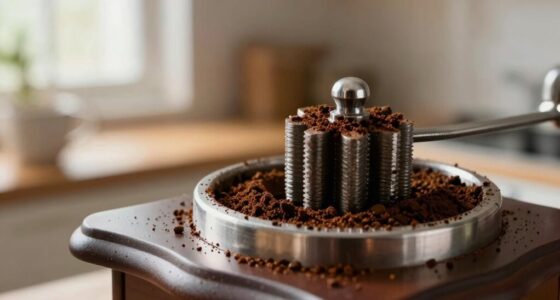

If your espresso tastes thin in milk drinks, try adjusting your grind to be finer, which slows extraction and boosts flavor strength. Confirm your brew time is around 25-30 seconds and tamp firmly and evenly to promote better water flow. Use fresh, quality beans roasted specifically for espresso. Fine-tuning these factors will give you a richer, more robust shot that holds up well with milk. Keep exploring these tips to achieve a balanced, full-bodied flavor every time.

Get kitchen gear delivered free with Prime
- Fast, free delivery on millions of items
- Prime Video, Amazon Music and more included
- Member-only deals all year
Key Takeaways
- Use a finer grind size to slow extraction and increase espresso strength.
- Ensure brew time is around 25-30 seconds for proper flavor concentration.
- Tamp with consistent pressure to promote even water flow and better extraction.
- Use high-quality, freshly roasted beans specifically suited for espresso.
- Maintain proper steaming and milk texture to prevent overpowering the espresso’s flavor.

If your espresso tastes thin and lacks the bold flavor you expect in milk drinks, you’re not alone. Many home baristas and coffee enthusiasts encounter this issue, often wondering how to improve the espresso’s flavor and ensure it pairs well with milk. The key lies in understanding the concepts of espresso strength and milk compatibility. When your espresso isn’t strong enough or doesn’t have the right balance of flavors, it can get lost once mixed with milk, resulting in a dull, watered-down taste.
A weak espresso can get lost when mixed with milk, leading to dull, watered-down drinks.
First, focus on the espresso strength. A weaker shot often results from under-extraction, which occurs when water passes through the coffee too quickly or the grind is too coarse. To boost the flavor, try grinding your coffee finer, which increases the surface area and slows down extraction, allowing more flavors to develop. Also, check your brew time—aim for around 25-30 seconds. If it’s too short, your espresso may lack depth and body. Adjust your tamping pressure as well; a firmer tamp ensures water evenly penetrates the coffee bed, extracting more of the rich oils and flavors that contribute to a bold taste.
Next, consider milk compatibility. Milk can mute or overpower subtle espresso flavors if the shot isn’t robust enough. To prevent this, ensure your espresso has a solid, full-bodied profile before mixing. If your coffee is weak, no amount of milk will bring out a rich flavor; it will just dilute what little taste remains. Using fresh, high-quality beans roasted for espresso helps create a more resilient flavor profile. Additionally, pay attention to the temperature and texture of your milk. Steaming milk to the right temperature (around 150-155°F) and creating a smooth microfoam enhances the overall experience and ensures that the milk complements, rather than masks, the espresso.
Finally, experiment with your coffee-to-milk ratio. If your espresso isn’t strong enough, try using a double shot or increasing the amount of coffee grounds slightly. This will give your milk drinks the depth they need and prevent them from tasting thin. Remember, the goal is to extract a concentrated shot with enough strength to stand up to the milk, maintaining its boldness and richness. Additionally, understanding the importance of consistent extraction can help you refine your brewing process for better results. With these adjustments—focusing on espresso strength and milk compatibility—you’ll notice a significant improvement in your milk-based coffee drinks, achieving a balanced, satisfying flavor every time.
As an affiliate, we earn on qualifying purchases.
Frequently Asked Questions
Can the Type of Espresso Beans Affect Taste in Milk Drinks?
Yes, the type of coffee bean varieties and roast profiles definitely affect the taste in milk drinks. Choosing different beans, like Arabica or Robusta, changes the flavor complexity, while lighter or darker roasts influence richness and body. By experimenting with these factors, you can find the perfect balance to prevent your espresso from tasting thin when mixed with milk. Adjusting the beans and roast profiles helps create a fuller, more satisfying flavor.
How Does Water Temperature Influence Espresso Flavor in Milk Beverages?
You’ll notice that water temperature greatly influences espresso flavor in milk drinks. If the water’s too hot, it can extract bitter flavors, making your drink taste harsh. Use water with good quality, free of impurities, and maintain proper brewing pressure to guarantee ideal extraction. This balance helps your espresso shine through the milk, delivering a richer, more balanced flavor instead of a thin or dull taste.
What Role Does Grind Size Play in Espresso Strength?
Think of grind size like tuning a guitar; small adjustments dramatically affect the sound. When your grind is too fine, extraction becomes overdone, making your espresso overly strong and bitter. Conversely, too coarse grind results in weak, under-extracted shots. Finding the right grind size guarantees consistent extraction, balancing flavor strength perfectly. This control helps you craft a rich, robust espresso that maintains its integrity even when mixed into milk drinks.
Does the Freshness of Coffee Beans Impact Milk Drink Flavor?
Yes, the freshness of your coffee beans considerably impacts milk drink flavor. Proper coffee storage keeps beans fresh longer, preserving their aroma and taste. Fresh beans, especially lighter roasts, provide brighter, more vibrant flavors, while older beans can taste dull or stale. Using freshly roasted beans enhances the richness of your milk drinks, ensuring a more robust and balanced flavor. Always store your beans in an airtight container away from light and heat for best results.
How Can I Adjust Brewing Time for a Richer Espresso in Milk Drinks?
You should extend your brewing duration to increase extraction time for a richer espresso. Aim for a slightly longer extraction, about 25-30 seconds, to enhance flavor without over-extracting. Adjust the grind size to be a bit finer, which allows water to flow more slowly and increases extraction. Keep an eye on the shot’s flow rate; a steady, slightly slower flow indicates a more robust espresso ideal for milk drinks.
espresso tamper with consistent pressure
As an affiliate, we earn on qualifying purchases.
As an affiliate, we earn on qualifying purchases.
Conclusion
Think of your espresso as the heart of your milk drink—if it feels too thin, it’s like trying to carry a torch with a flickering flame. By adjusting your grind size, tamping pressure, or extraction time, you breathe new life into that core, strengthening its glow. When you get it just right, your drink becomes a symphony of warmth and richness, symbolizing the perfect harmony between the bold and the smooth—your personal masterpiece in a cup.
milk frother for perfect microfoam
As an affiliate, we earn on qualifying purchases.
As an affiliate, we earn on qualifying purchases.
As an affiliate, we earn on qualifying purchases.
Halloween Picks
halloween
As an affiliate, we earn on qualifying purchases.