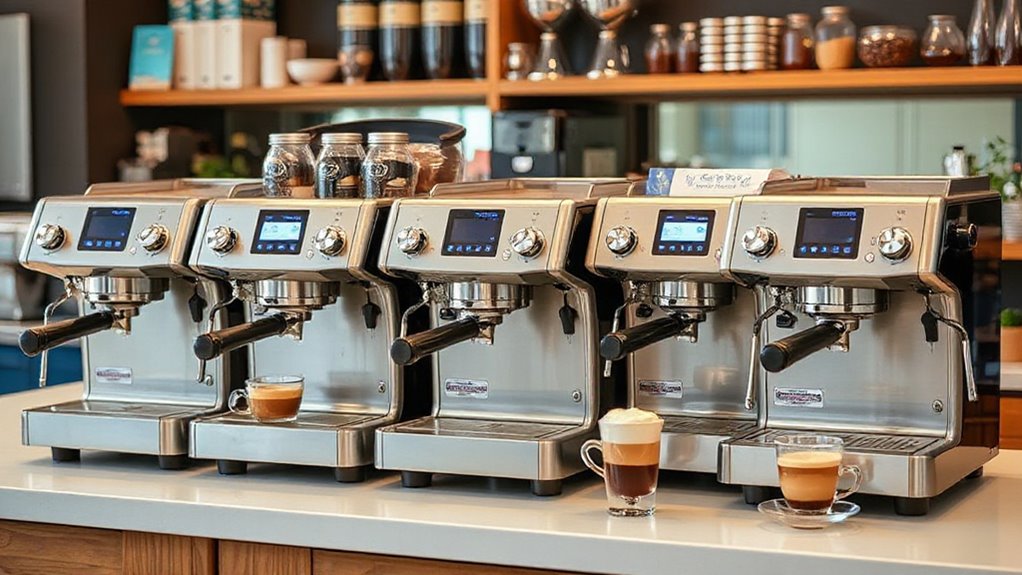

For a commercial espresso machine under $3,000, my best overall pick is the Gevi Dual Boiler Espresso Machine with Built-In Burr Grinder: its dual boilers, 58mm portafilter, and 31 grind settings suit buyers who want an all-in-one setup with room to refine drinks. The HibreW H10 stands out for hands-on control and a commercial-style group head, while the two-group semi-automatic is the better match for serving several drinks in quick succession. The main tradeoff is between compact, integrated home-style machines and larger equipment built for sustained service; price alone does not make them equally suitable for a café. I compare workflow, temperature and steam capabilities, grinder inclusion, upkeep, and likely fit for each buyer. Read on for the full breakdown and help choosing the right machine for your space and workload.

Get kitchen gear delivered free with Prime
- Fast, free delivery on millions of items
- Prime Video, Amazon Music and more included
- Member-only deals all year
Complete the kit


Key Takeaways
- The Gevi Dual Boiler with Grinder is the strongest all-in-one choice in this lineup for buyers who want separate brewing and steaming systems plus built-in grinding.
- The HibreW H10 and Gevi 58mm PID model emphasize control through commercial-size group hardware and temperature features, but they call for more hands-on espresso preparation than automatic milk systems.
- The two-group, rotary-pump machine is the only listed option clearly aimed at higher-volume service; its size and installation needs make it a poor default for a home counter.
- Built-in grinders simplify setup across several picks, but they limit upgrade flexibility compared with choosing a separate grinder suited to the beans and workload.
- “Commercial” means different things here: most options are compact, home-oriented machines, so buyers planning daily business service should check duty cycle, service support, and electrical requirements before purchasing.




| commercial espresso machine under 3000 | Dimensions |
|---|---|
| Kismile Espresso Machine with | — |
| HibreW H10 Customizable Espres | 10.8 × 8.5 × 11.6 in (D × W × H) |
| Gevi 58mm Commercial Espresso | 12.2 × 10.3 × 13 in (D × W × H) |
| Chefman CraftBrew Espresso Mac | — |
| Gemilai G3028A Semi-Automatic | 10.43 × 14.8 × 13.18 in (D × W × H) |
| Gevi Dual Boiler Espresso Mach | — |
| Breville BES870XL Barista Expr | — |
| COWSAR 20 Bar Espresso Machine | — |
| Meraki Dual Boiler Espresso Ma | 14.57 × 14.57 × 16.33 in (D × W × H) |
| Commercial-Grade Semi-Automati | 20.5 × 21.65 × 20.5 in (D × W × H) |
| COWSAR 15-Bar Semi-Automatic E | 13.03 × 11.5 × 16.1 in (D × W × H) |
More Details on Our Top Picks
Kismile Espresso Machine with Grinder, 20 Bar, Milk Frother, Stainless Steel (2026 Upgrade)
The built-in grinder is the main reason I’d put the Kismile on a commercial-style shortlist: its 30 settings let buyers adjust the grind without adding a separate grinder to the counter. Paired with PID temperature control and a steam wand, it offers more control over espresso and milk drinks than the simpler Chefman CraftBrew. Its included pitcher, portafilter, filters, tamper, and cleaning kit also make it a ready-to-start package. The tradeoff is that this is a home-oriented machine, not a substitute for a commercial unit built for sustained service. Setup may take some learning, and its stated bulky footprint could be a problem in a tight kitchen. I’d choose it over the Gevi when an integrated grinder matters more than a clearly specified water capacity.
Pros:- Built-in grinder with 30 settings reduces the need for a separate grinder.
- PID temperature control supports more consistent brew temperature.
- Steam wand handles milk drinks such as cappuccinos and lattes.
- Includes a pitcher, portafilter, filters, tamper, and cleaning kit.
Cons:- Setup may take extra time for buyers unfamiliar with espresso machines.
- The described bulky build may not suit a crowded counter.
- No reservoir capacity or dimensions are provided for planning counter and refill needs.
Best for: Home baristas who want an integrated grinder, adjustable grind settings, and milk steaming without buying separate equipment.
Not ideal for: Small-kitchen owners or café operators who need a compact machine or equipment specified for sustained commercial service.
- Pump pressure:20 bar
- Power:1500 W
- Grind settings:30
- Temperature control:PID
- Material:Stainless steel
- Included accessories:Milk frothing pitcher, portafilter, brew filters, tamper, cleaning kit
Our verdict“Choose the Kismile if you want a grinder and espresso-making accessories in one home-focused package, and can accommodate a potentially bulky machine.”
HibreW H10 Customizable Espresso Machine with 58mm Commercial Group Head, One-Touch Steam & Extraction, Temp Switch, Auto Pressure Release, Backflush, Stainless Steel Coffee Maker
The 58 mm group head gives the HibreW H10 a more café-style format than the Chefman CraftBrew, while its adjustable brewing parameters give involved home baristas room to tune shots. One-touch extraction and steaming, a temperature switch, and an independent hot-water outlet make it more versatile for espresso and Americanos than a basic steam-wand machine. At 10.5 pounds, it is also relatively light beside the Gevi, though its 8.5-inch width and 11.6-inch height still need counter space. The compromise is a more demanding workflow: beginners may find its controls and upkeep less straightforward than the CraftBrew’s programmable shot-volume approach. Its 1.8-liter capacity suits home or office use, but the product details do not establish commercial-duty capacity for continuous café service.
Pros:- 58 mm group head offers a commercial-style portafilter format.
- Adjustable brewing parameters allow users to tailor extraction.
- Independent hot-water outlet supports Americanos and hot-water needs.
- One-touch switching between extraction and steaming streamlines drink preparation.
Cons:- Advanced controls and ongoing cleaning may challenge first-time users.
- Requires counter space despite its relatively light weight.
- Product details do not specify a grinder, so a separate grinder may be needed for fresh-ground coffee.
Best for: Home or office baristas who want a 58 mm group head, adjustable extraction, and a separate hot-water outlet.
Not ideal for: Complete beginners seeking the simplest workflow, or café owners who need a machine explicitly rated for high-volume service.
- Portafilter size:58 mm
- Operation mode:Semi-automatic
- Wattage:1350 W
- Voltage:110 V
- Water capacity:1800 ml
- Dimensions:10.8 × 8.5 × 11.6 in (D × W × H)
- Weight:10.5 lb
- Output pressure:20 bar
Our verdict“Pick the HibreW H10 for hands-on control and a 58 mm group head at home or in an office, rather than for high-volume café duty.”
Gevi 58mm Commercial Espresso Machine with PID & NTC Temp Control and Steam Wand
Dual PID and NTC temperature control is the Gevi’s clearest differentiator: the listed 194°F–204°F range gives buyers a defined brewing window, while adjustable temperature and shot volume allow further tuning. That makes it a stronger fit for repeatable, hands-on espresso than the more straightforward Chefman CraftBrew. Its 58 mm portafilter also aligns with commercial-style equipment, and the included pitcher, tamper, filters, and cleaning pin reduce the need to assemble a starter kit. Unlike the Kismile, however, it has no listed built-in grinder, so fresh-ground coffee means buying a separate one. The 2.2-liter capacity is useful for multiple drinks between refills, but this remains a semi-automatic machine: the user still controls key preparation steps, and it is not presented as a high-volume commercial workhorse.
Pros:- PID and NTC temperature control supports a defined brewing range.
- Adjustable shot volume and temperature offer control over extraction.
- 58 mm portafilter provides a commercial-style format.
- Includes a tamper, pitcher, filters, and cleaning pin.
Cons:- No built-in grinder is listed, adding equipment and counter-space needs.
- Semi-automatic operation requires user skill and attention.
- Its 12.2-inch depth may be restrictive on shallow counters.
Best for: Espresso drinkers who prioritize brew-temperature adjustment, a 58 mm portafilter, and a ready-to-use accessory kit.
Not ideal for: Buyers who want an integrated grinder or fully automated drink preparation, and cafés needing documented high-volume capability.
- Operation mode:Semi-automatic
- Wattage:1350 W
- Voltage:120 V
- Water capacity:2.2 L
- Dimensions:12.2 × 10.3 × 13 in (D × W × H)
- Weight:13.7 lb
- Temperature control:PID and NTC; listed brewing range 194°F–204°F
- Material:Stainless steel
Our verdict“Choose the Gevi if temperature control and a 58 mm portafilter matter more to you than an integrated grinder or automated operation.”
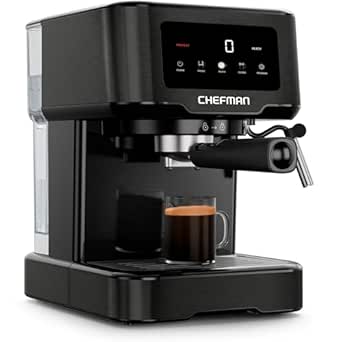
Chefman CraftBrew Espresso Machine, 15-Bar Pump Digital Espresso Maker with Steam Wand, 1.5L Water Reservoir, Black
Simple, programmable shot volume gives the Chefman CraftBrew a more approachable role than the HibreW H10, whose customizable brewing parameters invite more hands-on tuning. Its 1.5-liter removable reservoir is easy to fill and clean, and the compact design is better suited to kitchens where the Gevi’s deeper footprint may be awkward. The steam wand and two shot baskets cover the basics for espresso and milk drinks without the extra setup of a built-in-grinder machine like the Kismile. That simplicity has limits: the listing offers less detail about temperature control and brewing adjustment than the Gevi, and no grinder is specified. Buyers should also allow time to learn the steam wand and keep up with descaling. It is a home convenience pick, not a machine described for commercial service.
Pros:- Programmable shot volume makes repeatable brewing easier.
- Removable 1.5-liter reservoir simplifies filling and cleaning.
- Compact design can fit kitchens with limited counter space.
- Includes two shot baskets and a steam wand.
Cons:- No built-in grinder is listed, so buyers may need separate equipment.
- The steam wand takes practice to use well.
- Regular descaling is required, and listed brewing controls are less detailed than the Gevi’s.
Best for: Home espresso drinkers who want programmable shot volume, a removable reservoir, and a compact machine with a steam wand.
Not ideal for: Baristas seeking detailed temperature control, a built-in grinder, or equipment specified for café-level continuous use.
- Pump pressure:15 bar
- Water reservoir capacity:1.5 L
- Power:1350 W
- Voltage:120 V
- Shot control:Customizable shot volume
- Included accessories:Two shot baskets, steam wand
- Design:Compact; black
Our verdict“Pick the Chefman CraftBrew for a compact, comparatively straightforward home setup, not for advanced brewing control or commercial-volume service.”
Gemilai G3028A Semi-Automatic Espresso Machine with Automatic Milk Frother
The automatic milk frother sets the Gemilai apart from the manual-wand Gevi and Chefman: a temperature sensor helps manage milk foam, reducing one of the more skill-dependent parts of making cappuccinos and lattes. It pairs that convenience with dual PID controls, configurable pre-infusion, and adjustable extraction pressure from 6 to 11 bar, giving the user meaningful brewing control too. A touchscreen, descaling reminders, removable tank, and 28-minute auto shutoff make its daily routine more guided than the HibreW H10’s. The tradeoff is that it uses ground coffee only; unlike the Kismile, it does not include a grinder, so buyers need one separately or must use pre-ground coffee. Its 14.8-inch width also makes it a less natural fit for narrow counters.
Pros:- Automatic milk frother with a temperature sensor reduces manual steaming work.
- Dual PID controls manage brew and steam temperatures independently.
- Adjustable extraction pressure and configurable pre-infusion support shot tuning.
- Removable tank and drip tray, descaling reminders, and auto shutoff simplify routine care.
Cons:- Uses ground coffee and does not include a grinder.
- Its 14.8-inch width may not fit narrow counters.
- Extraction still depends on grind size, dose, tamping, and preheating.
Best for: Home or office users who make milk drinks often and want automatic frothing alongside adjustable brewing controls.
Not ideal for: Buyers who need an integrated grinder, have narrow counter space, or prefer a manual steam wand and fully hands-on milk preparation.
- Machine type:Semi-automatic
- Brew boiler capacity:550 ml
- Water tank capacity:57 oz
- Power:1450 W
- Voltage:120 V
- Adjustable extraction pressure:6–11 bar
- Brewing system:58 mm
- Dimensions:10.43 × 14.8 × 13.18 in (D × W × H)
- Coffee input:Ground coffee
Our verdict“Choose the Gemilai if milk-drink convenience and adjustable extraction matter more than having a built-in grinder or a narrow footprint.”
Gevi Dual Boiler Espresso Machine With Built-In Burr Grinder, 58mm Commercial Portafilter, 31 Grind Levels, Stainless Steel Steam Wand, Sterling Silver
I’d put the Gevi Dual Boiler on the shortlist for home baristas who want separate brew and steam systems without moving to a dedicated café machine. Its NTC and PID temperature control and 58mm portafilter give it a more gear-focused setup than the Breville Barista Express, while the built-in grinder keeps the workflow self-contained. The 31 grind levels offer room to adjust for different beans, though they provide fewer marked steps than Meraki’s 45-setting grinder. Dual boilers can help reduce the wait between pulling a shot and steaming milk, a practical advantage for back-to-back drinks. The tradeoff is a steeper learning curve than a simpler, more guided machine, and the supplied details don’t establish café-scale capacity. I’d choose it for deliberate home use, not sustained service.
Pros:- Separate boilers support brewing and steaming with less waiting between tasks.
- NTC and PID temperature systems offer control over brewing temperature.
- Built-in burr grinder provides 31 grind levels without a separate grinder.
- 58mm portafilter and stainless steel steam wand suit hands-on espresso preparation.
Cons:- The range of controls may take time for beginners to learn.
- The 31 grind levels offer fewer marked adjustments than Meraki’s 45.
- The supplied product information does not establish capacity for commercial-volume service.
Best for: Home espresso enthusiasts who want dual boilers, temperature controls, and a built-in grinder in a compact setup.
Not ideal for: New users who want a guided, low-adjustment workflow, or cafés needing proven high-volume capacity.
- Boiler system:Dual boiler
- Portafilter:58mm
- Grinder:Built-in burr grinder
- Grind levels:31
- Temperature control:NTC and PID
- Steam wand:Stainless steel
- Color:Sterling silver
Our verdict“Choose the Gevi for control-minded home use with dual boilers, but not for café service or a beginner-first experience.”
Breville BES870XL Barista Express Espresso Machine, Brushed Stainless Steel
The Breville Barista Express makes the most sense for buyers who want an integrated grinder and a familiar, hands-on espresso routine, rather than the faster simultaneous workflow of a dual-boiler machine. Its 67 oz water tank and 1/2 lb bean hopper suit regular home use, while adjustable grinding and manual override let users shape extraction as their skills grow. The included portafilter, tamper, milk jug, and cleaning tools also mean fewer separate accessories to source. Compared with the Gevi Dual Boiler or Meraki, this model is a more compact all-in-one approach, but its 54mm portafilter is smaller than their 58mm setups and it lacks a listed dual-boiler system. Manual operation still takes practice, and its footprint can be a poor fit for tight counters.
Pros:- Built-in grinder keeps grinding and espresso preparation in one machine.
- Adjustable grind settings and manual override allow hands-on recipe changes.
- 67 oz water tank supports multiple drinks before refilling.
- Includes a portafilter, tamper, milk jug, and cleaning accessories.
Cons:- Manual preparation requires practice to achieve repeatable results.
- Its 54mm portafilter is smaller than the 58mm setups on the Gevi and Meraki.
- The machine’s footprint may be difficult to accommodate in a compact kitchen.
Best for: Home users who want an established all-in-one workflow, included brewing accessories, and room to learn manual espresso.
Not ideal for: Buyers who need simultaneous brewing and steaming, a 58mm portafilter, or a small-footprint machine.
- Portafilter:54mm stainless steel
- Bean hopper capacity:1/2 lb
- Water tank capacity:67 oz
- Power:1600 watts
- Voltage:120 volts
- Operation settings:Single or double shots, adjustable grind, manual override
- Warranty:1-year limited
Our verdict“Pick the Barista Express for an accessory-rich, grinder-integrated home setup, but choose a dual-boiler model for faster milk-drink workflow.”
COWSAR 20 Bar Espresso Machine with Grinder & Milk Frother – Dual Boiler, Stainless Steel Coffee Maker, 58mm Portafilter, Home & Commercial Use
The COWSAR 20 Bar stands out for buyers who want a visible pressure gauge and adjustable brewing settings alongside a built-in grinder. Its stated 195°F–204°F temperature range gives users a defined window for tuning extraction, while the dual boilers support brewing and steaming at the same time. That makes it a closer workflow match to the Gevi Dual Boiler than to the single-boiler-style Breville Barista Express. The 58mm portafilter and stainless-steel construction also point toward a more hands-on, substantial setup. Still, the advertised 20-bar pump pressure is not by itself a measure of better espresso, and the available details don’t specify capacity for sustained commercial service. Its controls and bulk may be more machine than a casual user needs.
Pros:- Dual boilers allow brewing and milk steaming at the same time.
- Temperature range is specified as 195°F–204°F for adjustment.
- Pressure gauge provides a visible reference during extraction.
- Includes a grinder and 58mm portafilter in a stainless-steel machine.
Cons:- Multiple adjustable settings may be challenging for beginners.
- The machine is described as bulky and needs dedicated counter space.
- The supplied specifications do not confirm sustained commercial throughput.
Best for: Experienced home baristas or small-workspace operators who want dual boilers, adjustable settings, and a pressure gauge.
Not ideal for: Beginners seeking a simple workflow, or busy cafés that need documented high-volume capacity and service details.
- Boiler type:Dual boiler
- Stated pressure:20 bar
- Material:Stainless steel
- Portafilter:58mm
- Temperature range:195°F–204°F
- Display:Espresso pressure gauge
- Certification:ETL
Our verdict“Choose this COWSAR if you value visible pressure feedback and dual-boiler workflow, but don’t treat its 20-bar rating as proof of café readiness.”
Meraki Dual Boiler Espresso Machine with Grinder and Built-In Scales
The Meraki MEM03 Gen2 is the most measurement-focused option here: its built-in scales track both dose and espresso yield to a stated 0.2 g accuracy. That can reduce guesswork for buyers refining recipes, while the 45 marked grind settings with micro-adjustment give more adjustment points than the Gevi’s 31. Separate brew and steam boilers, PID control, a heated grouphead, and controlled pre-infusion make this a feature-rich alternative to the more straightforward Breville Barista Express. Its 9-bar pump pressure is specified, unlike the headline pressure figure on the COWSAR. The tradeoff is a semi-automatic workflow that asks the user to stay involved, plus a 120-volt specification that may not suit other electrical systems. At 14.57 inches wide, it also needs a planned counter spot.
Pros:- Built-in scales track coffee dose and espresso yield to a stated 0.2 g accuracy.
- Dual boilers support brewing and milk steaming at the same time.
- 45 marked grinder settings with micro-adjustment offer fine tuning.
- Includes a 58mm E61-compatible portafilter and controlled pre-infusion.
Cons:- Semi-automatic operation requires active user control.
- The 120-volt specification may not fit electrical systems in other regions.
- Its 14.57-inch width and depth require dedicated counter space.
Best for: Detail-oriented home baristas who weigh dose and yield, adjust grinder settings, and want simultaneous brewing and steaming.
Not ideal for: Buyers who prefer one-touch drinks, avoid hands-on control, or need compatibility outside 120-volt electrical systems.
- Model:MEM03 Gen2
- Operation mode:Semi-automatic
- Boiler capacities:350 ml brew boiler; 550 ml steam boiler
- Grinder:45 marked settings with micro-adjustment
- Scale accuracy:Within 0.2 g
- Pump pressure:9 bar
- Portafilter:58mm, E61-compatible
- Water capacity:2 liters
- Dimensions:14.57 × 14.57 × 16.33 in (D × W × H)
Our verdict“Pick the Meraki if measured recipes and grinder adjustment matter more than a simpler, less hands-on workflow.”
Commercial-Grade Semi-Automatic 2-Group Espresso Machine with 1.6-Gallon Boiler and Rotary Pump
This is the clear choice in the group for a café or restaurant that needs two brewing groups and a listed 6-liter boiler, rather than a home machine with an integrated grinder. Two groups allow concurrent espresso preparation, while the rotary pump and semi-automatic controls suit staff who can manage extraction manually. Against the Gevi, Breville, and Meraki, it prioritizes service capacity over compact size and built-in grinding; the product data lists ground coffee as its input, so a separate grinder belongs in the setup. Its 20.5-inch depth and 21.65-inch width also call for a substantial counter and a suitable installation plan. The available description does not provide power, voltage, or detailed warranty terms, so buyers should verify those before treating it as a ready-to-install commercial purchase.
Pros:- Two groups support simultaneous espresso preparation.
- Listed 6-liter boiler provides greater stated capacity than the home-focused machines here.
- Rotary pump and semi-automatic operation offer hands-on control for trained staff.
- Stainless-steel construction is suited to a commercial service environment.
Cons:- Large dimensions require substantial counter space and installation planning.
- Uses ground coffee, so a separate grinder is needed.
- Supplied product data omits power and voltage details and gives no specific warranty term.
Best for: Cafés and restaurants that need two groups for concurrent drink preparation and have staff trained in semi-automatic espresso.
Not ideal for: Home users, small counters, or buyers who need an integrated grinder or complete electrical and installation details.
- Group heads:2
- Boiler capacity:6 liters (1.6 gallons stated in title)
- Pump:Rotary pump
- Operation mode:Semi-automatic
- Coffee input:Ground coffee
- Material:Stainless steel
- Dimensions:20.5 × 21.65 × 20.5 in (D × W × H)
- Cup warmer:Yes
Our verdict“Choose this machine for a staffed café needing two groups and a large boiler, not for a home setup or an all-in-one grinder workflow.”
COWSAR 15-Bar Semi-Automatic Espresso Machine with Grinder and Milk Frother, White
I’d place the COWSAR CM5431D-UL in the convenience-first spot: its built-in grinder, 15-bar pump, and steam wand combine the main steps for espresso and milk drinks in one countertop unit. The single control knob keeps operation straightforward, while the 2.3-liter removable tank means fewer refills than a compact reservoir would require. Compared with the Gevi Dual Boiler, this COWSAR is a simpler choice, but it lacks the dual-boiler design and stated 58mm commercial portafilter that make the Gevi more suited to repeat drink-making and hands-on control. Its 18.1-pound weight and plastic-and-stainless-steel construction also point to home convenience rather than demanding café service. I’d skip it if commercial throughput or precise technical documentation is the priority: the listed power is inconsistent at 1450 versus 1500 watts, and another capacity figure is unclear.
Pros:- Integrated grinder combines grinding and brewing in one appliance.
- Steam wand and milk frother support cappuccinos, lattes, and other milk drinks.
- Removable 2.3-liter water tank and detachable drip tray simplify refilling and cleanup.
- Includes a milk jug, filter, tamper, and cleaning brush.
Cons:- Listed power conflicts between 1450 watts and 1500W.
- The separate 4.9-pound capacity figure is not clearly identified.
- Compared with the Gevi Dual Boiler, it has fewer stated features aimed at sustained, controlled drink preparation.
Best for: Home users who want one machine for grinding, espresso, and milk drinks, with a removable tank and included milk jug and tamper.
Not ideal for: Cafés or high-volume users who need commercial-duty capacity, and buyers who require clearly documented power specifications or a commercial group-head setup.
- Model:CM5431D-UL
- Machine type:Semi-automatic espresso machine
- Pump pressure:15 bar
- Power:1450 watts in specs; description also states 1500W
- Water tank capacity:2.3 L
- Dimensions:13.03 × 11.5 × 16.1 in (D × W × H)
- Weight:18.1 lbs
- Materials and color:Plastic and stainless steel; white
- Certification:ETL
Our verdict“Choose this COWSAR for a straightforward home all-in-one setup, but pick a more commercially oriented machine if you need higher-volume service or clearer technical specifications.”

How We Picked
I ranked these machines by how convincingly their design suits the under-$3,000 commercial-espresso search, not by feature count alone. I weighed brewing and steaming workflow, temperature and pressure controls, group-head and portafilter format, grinder integration, and whether the machine appears suited to repeated drinks or occasional use. I also considered counter space, cleaning demands, and how much skill a buyer needs to get consistent results.
The order favors useful capability balanced with practical fit. The Gevi dual-boiler grinder model leads as an integrated setup with distinct brew and steam systems; the HibreW and PID-equipped Gevi appeal more to buyers who value manual control. The two-group machine earns a specialized role rather than a universal top spot because its service-oriented format brings greater space and setup demands. Compact and entry-level models remain relevant for lighter workloads, but they rank lower for buyers who need sustained commercial service. Product descriptions do not establish certifications, duty cycles, or service coverage, so I treat those as points for buyers to verify rather than assumed strengths.
Factors to Consider When Choosing Commercial Espresso Machine Under 3000
Choosing a machine in this category starts with matching the equipment to the number of drinks you expect to make, not chasing the word “commercial.” These checks help separate a capable home setup from gear suited to a staffed service counter.
Match the machine to your real drink volume
Estimate your busiest hour, not just your average day. A compact single-group machine may handle occasional espresso service, yet become a bottleneck when several customers order milk drinks together. A two-group model can support parallel preparation, but it also takes more space and may need more involved installation. Ask sellers for a documented duty cycle and recovery performance rather than assuming that a “commercial” label guarantees continuous operation. If volume is modest, a simpler single-group machine may free budget for a better grinder, water treatment, or service support.
Separate boiler count from actual workflow
Dual boilers can let brewing and steaming happen at the same time, which helps when milk drinks dominate the menu. They do not automatically make a machine faster if the grinder, barista workflow, or water supply is the limiting step. A single-boiler machine can suit a low-volume setup if drinks are prepared one at a time and the operator accepts pauses between brewing and steaming. Check whether the manufacturer explains how temperatures are controlled and how long recovery takes after steaming. Choose the arrangement around your menu and pace, not boiler count as a stand-alone badge.
Decide whether an integrated grinder is a benefit or a constraint
A built-in grinder reduces the number of separate purchases and keeps a compact station tidy. The tradeoff is that grinder performance, adjustment range, and repair options are tied to the espresso machine. For a new operator, an integrated unit can make setup less complicated, but a busy shop may prefer a separate grinder so one component can be serviced or replaced independently. Consider whether staff will switch beans during a shift and whether the grinder offers repeatable adjustments. A portafilter machine without a grinder is not a complete setup unless you already own a suitable one.
Check electrical, water, and space requirements before buying
Measure the machine’s full footprint, including room to load beans, open panels, fill a reservoir, and work with the steam wand. A tank-fed design is easier to place in a home or pop-up setting, while plumbed equipment can be more practical for continuous service but needs a suitable water connection and drainage plan. Verify voltage, amperage, plug type, and any installation requirements with the seller or manufacturer before ordering. Larger machines can also need a stable counter that can support their weight. A machine that fits the budget but cannot be installed safely is not a workable purchase.
Plan for cleaning, water quality, and repairs
Daily backflushing, cleaning the steam wand, and keeping the grinder clear are part of operating an espresso station, not occasional chores. Before choosing, check whether the machine supports backflushing and whether cleaning parts and instructions are available. Water hardness affects scale buildup, so find out what water treatment the manufacturer recommends and whether it affects warranty coverage. For business use, ask about parts availability, repair access, and expected service intervals. A machine with more controls or integrated components may offer convenience, but a breakdown can interrupt more of the setup.
Spend for the bottleneck, not the longest feature list
When comparing machines under this budget ceiling, set aside money for the pieces the machine does not include, such as a capable grinder, water filtration, knock box, tamper, and installation. Buyers making mostly straight espresso may gain more from grind consistency and temperature control than from automatic milk features. A café serving many lattes may value steam capacity and recovery more than extra menu modes. Avoid paying for a two-group footprint if your volume will not use both groups, and avoid assuming a built-in grinder is an upgrade without checking its adjustability. The best spend is the one that removes your actual service bottleneck.
Frequently Asked Questions
Can these machines handle daily café service, or are they mainly for home use?
The lineup spans compact, home-oriented machines and a dedicated two-group semi-automatic, so the answer depends on the model and workload. Most single-group options are better treated as light-duty or low-volume equipment unless the manufacturer provides a suitable commercial duty rating. For a café, confirm expected drinks per hour, recovery performance, warranty terms, and local repair support before buying. The two-group model is the clearest service-counter candidate here, but its installation needs still require checking. Do not infer commercial readiness from a product title alone.
Is a dual-boiler machine worth choosing over a simpler single-boiler model?
A dual boiler is most useful when you regularly prepare espresso and steam milk at the same time. That parallel workflow can reduce waiting during a rush, especially for milk-heavy menus. If you make drinks one at a time, the additional system may add cost, size, and maintenance without changing your routine much. Also compare steam recovery and temperature control details rather than relying only on the boiler count. The Gevi and COWSAR dual-boiler listings are relevant choices, but the right fit depends on actual service pace.
Should I buy a machine with a built-in grinder or purchase a separate grinder?
An integrated grinder is convenient when you want a compact station and are starting without equipment. It also means the grinder and machine are harder to upgrade independently, which can matter as skill or drink volume grows. A separate grinder gives you more flexibility in selection and can keep the machine usable if the grinder needs service. Compare adjustment range, consistency claims, replacement options, and the cost of completing the whole setup. For frequent business use, independent components may be easier to maintain than an all-in-one unit.
What should I verify before installing the two-group espresso machine?
Ask the seller for the machine’s electrical specifications, water connection requirements, drainage needs, dimensions, weight, and installation instructions. Confirm that your counter and available circuit can support the equipment, and check whether a plumber or electrician is needed. Find out what water filtration is recommended and whether the unit requires a direct connection rather than a refillable tank. Also verify warranty coverage and access to local repairs. These checks matter more for a large rotary-pump machine than for a compact reservoir-fed model.
Which features should a first-time espresso buyer prioritize over advanced controls?
Start with a manageable workflow, clear cleaning instructions, and a grinder setup that allows repeatable adjustments. A 58mm portafilter and temperature controls can support more hands-on learning, but they do not replace practice or good beans. Automatic milk functions may reduce the learning curve for milk drinks, though they can limit how much control you have over texture. First-time buyers should also check whether the machine includes the accessories they need and how easy replacement parts are to source. The simplest choice is the one that fits the drinks you make and the effort you are ready to put in.
Conclusion
For the broadest mix of grinding and brewing capability, I’d choose the Gevi Dual Boiler Espresso Machine with Built-In Burr Grinder as best overall. The best value for manual control is the Gevi 58mm PID model if you already have a grinder or plan to buy one separately. For premium, higher-volume service, the two-group rotary-pump machine is the specialized pick, provided your site can support its installation and upkeep. Beginners should look toward the Chefman CraftBrew or the Kismile with Grinder for a more approachable, integrated setup, while buyers who prioritize a commercial-style group head and hands-on settings should compare the HibreW H10. Before committing, verify duty cycle, support, and installation details; those answers will tell you whether a compact machine or true service format belongs in your workspace.