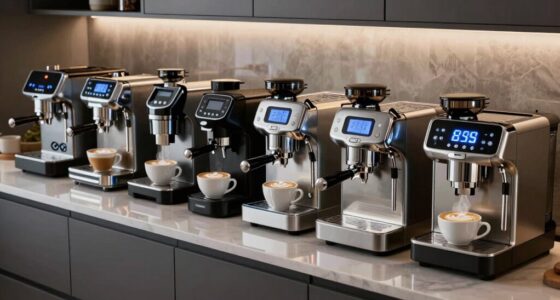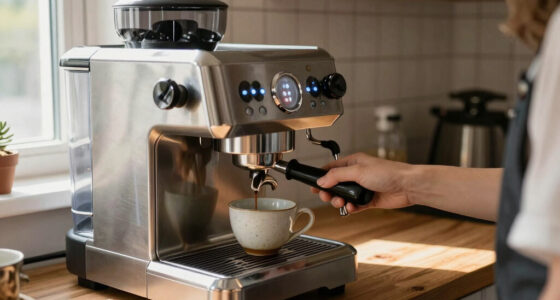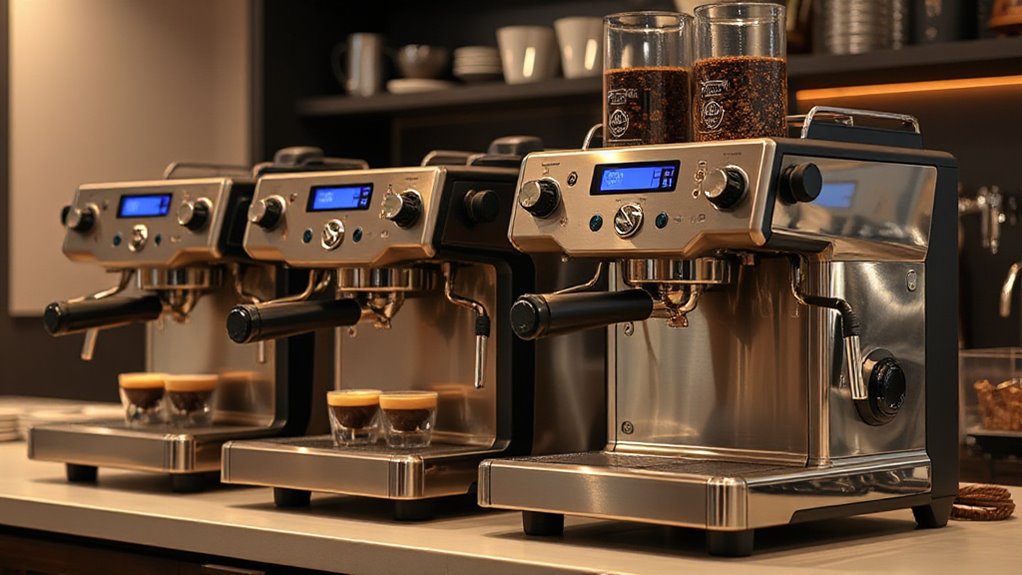
For a prosumer espresso machine under $3,000, my best overall pick is the Breville Barista Express: its built-in grinder and hands-on controls make it a practical all-in-one starting point. The Diletta Bello suits buyers who want a more traditional, machine-focused setup, while the Breville Bambino is a compact choice for faster, simpler daily brewing. The main tradeoff is between an integrated grinder and convenience, a separate grinder and more flexibility, or a smaller footprint with fewer workflow extras. Pump-pressure claims alone do not tell you how well a machine will suit your routine, so I compare controls, steaming, upkeep, and room to grow. Read on for the full breakdown of all 15 options and the buyer each one fits.

Get kitchen gear delivered free with Prime
- Fast, free delivery on millions of items
- Prime Video, Amazon Music and more included
- Member-only deals all year
Complete the kit



Key Takeaways
- The Breville Barista Express leads as an all-in-one pick because its integrated grinder reduces the number of separate purchases and gives new home baristas hands-on control.
- The Diletta Bello stands apart from compact appliance-style machines as the choice for buyers who want a more traditional semi-automatic workflow and are willing to manage more of the process.
- The Bambino prioritizes a small footprint and straightforward daily use, but buyers should weigh that convenience against the additional control and flexibility of larger setups.
- Grinder-equipped models are not automatically the best value: AIRMSEN, AMZCHEF, and EUHOMY combine grinding and brewing, but feature lists should be weighed against workflow, consistency, and long-term service needs.
- Many of the listed machines emphasize compact designs and steam wands; the meaningful differences are how much control, counter space, and setup complexity each buyer is willing to accept.




More Details on Our Top Picks
AIRMSEN Espresso Machine with Burr Grinder, 20 Bar, Milk Frother Steam Wand, Stainless Steel Coffee Maker for Home
The AIRMSEN makes the most sense for buyers who want grinding and espresso in one appliance rather than a separate grinder-and-machine setup. Its built-in conical burr grinder has 10 settings, and the manual steam wand gives you room to practice milk texture—more hands-on control than the touch-oriented workflow suggests. Compared with the Diletta Bello, it takes up less counter depth and bundles in grinding, but it does not offer the Bello’s heat-exchanger design for brewing and steaming at once. The touchscreen and drink choices, including iced coffee, make routine use approachable, though a screen cannot remove the need to dial in grind and tamp. The 61-ounce tank reduces refill interruptions, while the machine’s broad feature set and 4.1-inch cup clearance may still feel limiting for larger vessels.
Pros:- Built-in conical burr grinder with 10 settings reduces the need for a separate grinder.
- Manual steam wand supports hands-on milk texturing.
- 61-ounce water tank suits repeated drinks before refilling.
- Touchscreen offers access to espresso, milk drinks, and iced coffee.
Cons:- The combination of grinder, touchscreen, and drink settings can take time to learn.
- A 4.1-inch cup clearance restricts taller mugs.
- The all-in-one design occupies more counter space than a compact standalone machine.
Best for: Home baristas who want a built-in grinder, manual milk steaming, and several drink styles without buying separate equipment.
Not ideal for: Experienced users who prioritize simultaneous brewing and steaming, or buyers who want a simple machine with few settings.
- Pump pressure:20 bar
- Power:1350 W
- Water tank:61 oz
- Grind settings:10
- Cup clearance:4.1 in
- Dimensions:7.9 × 10.2 × 14.6 in
- Material:Stainless steel
Our verdict“Choose the AIRMSEN if you want one appliance to cover grinding, espresso, and milk drinks, and accept a more involved setup than a basic machine requires.”
Espresso Machine 20 Bar, Compact Espresso Coffee Maker with Milk Frother, Stainless Steel, 34oz Removable Water Tank, for Home and Office (Silver)
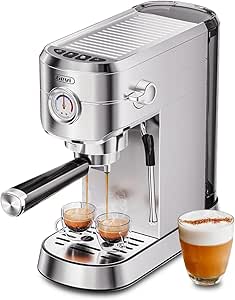
At just 5.3 inches wide, this semi-automatic is the lineup’s clearest fit for a narrow counter or office kitchenette. Its visible pressure gauge gives brewing a more legible, hands-on feel than the button-led XIXUBX, while the 20-second preheat helps shorten the wait for a first shot. The tradeoff is a small 34-ounce tank, so frequent drink-making means frequent refills; the AIRMSEN is a better fit for households that want a larger reservoir and an integrated grinder. Milk drinks also require some workflow planning: the machine may need to cool between frothing and brewing to avoid its overheat protection. That makes it less fluid for back-to-back cappuccinos than a machine designed to brew and steam simultaneously, such as the Diletta Bello.
Pros:- Narrow 5.3-inch width is well suited to crowded counters.
- Visible pressure gauge offers a useful brewing reference.
- Fast stated preheat time of about 20 seconds.
- Removable water tank and drip tray simplify refilling and cleanup.
Cons:- The 34-ounce tank needs regular refilling during heavier use.
- Cooling may be needed between steaming milk and brewing another shot.
- No built-in grinder is specified, so espresso-ready grounds or a separate grinder are needed.
Best for: Apartment dwellers and office users with limited counter width who make a few espresso drinks at a time.
Not ideal for: Households making drinks continuously, or users who want a grinder included and a smooth brew-to-steam workflow.
- Pump pressure:20 bar
- Power:1450 W
- Water tank:34 oz, removable
- Preheat time:About 20 seconds
- Dimensions:5.3 × 12.2 × 11.5 in
- Machine type:Semi-automatic with steam wand
- Material:Stainless steel
Our verdict“Pick this model when counter width and quick startup matter more than tank capacity or uninterrupted milk-drink preparation.”
XIXUBX 20-Bar Compact Espresso Machine with Milk Frother
The XIXUBX stands out among the compact options by pairing PID temperature control with gentle pre-infusion, two features aimed at making shot results less erratic. Its one-button single- or double-shot option and included pitcher lower the initial setup burden, while still leaving grinding and tamping in the user’s hands. That makes it more guided than the narrow 20-bar machine in this list, which has a pressure gauge and fast preheat but no stated PID control. It is also less hands-off than the AIRMSEN: there is no built-in grinder, and its semi-automatic workflow expects some technique. The compact, quieter design suits small kitchens, but buyers seeking a machine that handles more of the preparation in one appliance should look at the AIRMSEN instead.
Pros:- PID temperature control is designed to stabilize brewing temperature.
- Gentle pre-infusion supports a more gradual start to extraction.
- Single- and double-shot controls simplify shot selection.
- Compact, noise-reduced design and included stainless steel pitcher suit smaller setups.
Cons:- Grinding and tamping still require practice for consistent results.
- No built-in grinder is listed.
- Semi-automatic controls are less convenient for buyers who want push-button automation.
Best for: New espresso drinkers in small kitchens who want temperature stabilization and simple shot controls while learning to grind and tamp.
Not ideal for: Buyers who want an integrated grinder, fully automatic operation, or a machine suited to continuous high-volume drink making.
- Pump pressure:20 bar
- Temperature control:PID stabilization
- Extraction:Semi-automatic with gentle pre-infusion
- Brew options:Single or double shot
- Stated brew time:22–30 seconds
- Milk frother:High-output steam wand
- Included accessory:Stainless steel milk pitcher
- Warranty:1 year
Our verdict“Choose the XIXUBX if you want a compact learning machine with temperature control, but are willing to supply a grinder and build basic puck-preparation skills.”
Diletta Bello Semi-Automatic Espresso Machine, Stainless Steel
The Diletta Bello is the most traditional, equipment-focused choice here: a heat-exchanger boiler lets you brew espresso and steam milk at the same time, a meaningful advantage for preparing several milk drinks without pausing between tasks. Its manual brew and steam controls give experienced users direct involvement, unlike the guided shot buttons on the XIXUBX. In return, the Bello asks more of its owner: it uses ground coffee, has no listed built-in grinder, and offers fewer convenience cues than the AIRMSEN’s touchscreen setup. The three-liter capacity and insulated stainless steel construction suit a permanent home coffee station, but its 50-pound weight and nearly 18-inch depth make it a poor match for cramped or frequently rearranged kitchens. This is the choice for workflow and hands-on control, not compact simplicity.
Pros:- Heat exchanger supports brewing and steaming at the same time.
- Manual controls give the user direct command of brewing and steaming.
- Insulated stainless steel boiler and stainless steel case and frame.
- Three-liter capacity supports longer sessions between refills.
Cons:- Manual operation demands more attention and technique than the guided XIXUBX.
- At 50 lb and 17.75 inches deep, it is difficult to move and needs substantial counter space.
- Ground coffee input means a separate grinder is needed for whole beans.
Best for: Experienced home baristas who prepare multiple milk drinks and want manual control plus simultaneous brewing and steaming.
Not ideal for: Beginners seeking guided controls, renters with very limited counter depth, or anyone who needs to move the machine often.
- Boiler:Insulated stainless steel heat exchanger
- Capacity:3 liters
- Power:1500 W
- Voltage:120 V
- Dimensions:17.75 × 11 × 14.5 in (D × W × H)
- Weight:50 lb
- Coffee input:Ground coffee
- Controls:Manual brew and steam controls
Our verdict“Choose the Bello for a dedicated, hands-on coffee station where simultaneous steaming and brewing matter more than compact size or guided operation.”
Gevi Commercial Espresso and Coffee Maker, 20 Bar Professional Espresso Machine with Milk Frother, Stainless Steel
The Gevi suits buyers who want espresso alongside hot-water options such as Americano, tea, or instant soups, without stepping up to the Bello’s heavier, manual heat-exchanger setup. Its pre-infusion and NTC temperature control add brewing assistance, while the pressure gauge gives a visible reference during operation. The XIXUBX offers more specific temperature control with PID, and the AIRMSEN adds an integrated grinder; Gevi’s appeal is instead its broad water functions and compact stainless steel design. The main compromise is preparation: no built-in grinder is listed, and the machine’s limited capacity is a constraint for serving several people in succession. Its features may help with consistency, but they do not remove the need to learn grinding and puck preparation for good espresso.
Pros:- Pre-infusion and NTC temperature control provide brewing support.
- Pressure gauge makes brewing pressure visible.
- Hot-water functions cover Americano, tea, and instant soups.
- Compact stainless steel construction suits home or office counters.
Cons:- No built-in grinder is specified, so a separate grinder or prepared grounds are needed.
- Limited capacity may interrupt serving several drinks in succession.
- Getting the best results still depends on barista skills and preparation.
Best for: Small households or office users who want espresso, milk drinks, and hot-water beverage options from a compact machine.
Not ideal for: Frequent multi-person serving, buyers who want a built-in grinder, or users seeking the Bello’s simultaneous brewing and steaming.
- Pump pressure:20 bar
- Material:Stainless steel
- Temperature control:NTC
- Brewing feature:Pre-infusion
- Milk frother:Milk frother
- Pressure gauge:Included
- Water functions:Hot water, Americano, tea, and instant soups
Our verdict“Choose the Gevi for a compact machine with espresso and varied hot-water functions, but look elsewhere if you need an integrated grinder or higher-volume workflow.”
AMZCHEF Espresso Machine with Grinder, Milk Frother, Touch Screen, and Cold Brew Mode
The AMZCHEF is the most versatile choice here for buyers who want espresso and cold brew from one appliance. Its 44 grind settings and adjustable brew temperature offer more ways to tune a cup than the CASABREWS CM5418, which focuses on espresso and milk drinks without a built-in grinder. The dedicated cold brew mode also gives this machine a broader role than a typical entry-level espresso setup.
That flexibility comes with a learning curve: beginners may need time to find settings that suit their beans and taste. Its 60 oz water tank reduces refill interruptions, but takes up more room than the CM5418’s 34 oz tank. I’d choose it for a varied home coffee routine, not for a minimal, compact setup.
Pros:- 44 grind settings and adjustable temperature give experienced users room to tune extraction.
- Dedicated cold brew mode adds an option the espresso-focused CASABREWS CM5418 lacks.
- Built-in grinder avoids the need for a separate grinder.
- One-touch controls and a descaling function simplify routine operation and care.
Cons:- Numerous grind and temperature adjustments can make setup less intuitive for beginners.
- The 60 oz tank needs more counter and refill-access space than the CM5418’s smaller reservoir.
Best for: Home coffee drinkers who want an integrated grinder, adjustable brewing, and both espresso and cold brew without separate appliances.
Not ideal for: Beginners seeking a straightforward machine with few adjustments, or owners with limited counter space who do not need the large tank.
- Temperature range:190°F–201°F
- Grind settings:44
- Water tank capacity:60 oz
- Heating power:1350 W
- Steam wand:8 mm stainless steel
- Display:IMD HD touch screen
- Brew modes:Espresso and cold brew
- Color:Silver
Our verdict“Choose the AMZCHEF if you want an adjustable, grinder-equipped machine for espresso and cold brew and have room to accommodate its larger footprint.”
Breville Barista Express Espresso Machine, Black Truffle
The Breville Barista Express is a strong fit for buyers who want to control the espresso process rather than rely on touch-screen presets. Its integrated conical burr grinder feeds coffee directly into the portafilter, while PID temperature control and low-pressure pre-infusion support a more controlled extraction. Compared with the AMZCHEF, it has no listed cold brew mode or extensive grind-count specification, but its semi-automatic workflow puts the focus squarely on dialing in espresso.
The manual steam wand lets users texture milk themselves, which suits latte-art practice but adds work compared with a more automated routine. Its 67 fl oz tank is generous, though the 22.1 lb weight makes moving it less convenient. I’d pick it over the CASABREWS 3700 for an integrated grinder and temperature-focused brewing, but not for effortless milk preparation.
Pros:- Integrated conical burr grinder sends fresh grounds directly into the portafilter.
- PID temperature control and low-pressure pre-infusion support controlled extraction.
- Manual steam wand gives users hands-on control for microfoam and latte art.
- Includes brewing and cleaning accessories, including a milk jug and water filter.
Cons:- Manual milk texturing takes practice and adds steps to making milk drinks.
- At 22.1 lb, it is less convenient to move than a lighter, more compact machine.
- The one-year limited warranty is a constraint for buyers seeking longer stated coverage.
Best for: Espresso enthusiasts who want an integrated grinder, manual milk texturing, and more control over shot preparation.
Not ideal for: Buyers who want automatic milk drinks, a lightweight machine to move often, or cold brew from the same appliance.
- Operation mode:Semi-automatic
- Grinder:Integrated precision conical burr grinder
- Water tank capacity:67 fl oz
- Bean hopper capacity:0.5 lb
- Power:1600 W
- Voltage:120 V
- Dimensions:13.8 × 12.5 × 15.9 in
- Weight:22.1 lb
- Portafilter:54 mm stainless steel
Our verdict“Choose the Barista Express if you want a grinder-equipped, hands-on espresso workflow and are willing to learn its manual steaming process.”
CASABREWS 3700 Essential Stainless Steel Espresso Machine with Steam Wand
The CASABREWS 3700 Essential is the simplest fit in this group for someone who wants to learn manual espresso without committing to an integrated grinder. Its stainless-steel body, removable 43.9 oz water tank, and included portafilter and filters cover the basics, while the steam wand opens the door to cappuccinos and lattes. Unlike the Breville Barista Express, it leaves grinding to a separate device, so buyers can choose their own grinder rather than accept a built-in one.
That choice adds another purchase and another step to the routine. The stated 20-bar pump does not remove the need to learn dosing, tamping, and milk steaming, and the machine requires an initial setup cycle. Compared with the compact CM5418, its larger tank means fewer refills, but its simpler listed feature set offers fewer dial-in aids. I’d choose it as a basic manual setup, not as an all-in-one prosumer station.
Pros:- Removable 43.9 oz tank supports multiple drinks before refilling.
- Stainless-steel construction gives it a durable, straightforward design.
- Steam wand supports milk drinks as well as straight espresso.
- Includes a portafilter, tamper, spoon, and brewing filters.
Cons:- No built-in grinder, so buyers need a separate grinder for fresh-ground espresso.
- Manual preparation requires practice with grinding, dosing, tamping, and steaming.
- Initial setup and a first-use cycle add work before brewing.
Best for: New manual-espresso users who already own a grinder or want to select one separately, and need a removable tank for home or office use.
Not ideal for: Buyers who expect an integrated grinder, automated brewing, or extra controls to help them dial in shots.
- Water tank capacity:43.9 oz
- Pump pressure:20 bar
- Power:1350 W
- Material:Stainless steel
- Steam wand:Included
- Grinder:Not included
- Included accessories:Portafilter, tamper, spoon, and brewing filters
Our verdict“Choose the CASABREWS 3700 if you want a basic manual espresso machine with a larger removable tank and are prepared to supply a separate grinder.”
EUHOMY Espresso Machine with Grinder, 20 Bar Professional Coffee Maker with Milk Frother for Home Use
The EUHOMY stands out for pairing a built-in grinder with a 58 mm portafilter and PID temperature control. That portafilter size is the key distinction from the Breville Barista Express, which uses a 54 mm portafilter; buyers who specifically want a 58 mm format may prefer the EUHOMY’s setup. Its 30 grind levels provide a meaningful range for adjustment, though fewer than the AMZCHEF’s 44.
The listed 20-bar pump is only one part of a good espresso workflow, and the available product details say less about capacity and controls than they do for the Breville. Setup may feel complicated to beginners, and the machine can be noisy and needs regular cleaning. I’d consider it for someone who values the larger portafilter format and integrated grinding, but buyers who prioritize clearer operating details may find the Breville easier to evaluate.
Pros:- 58 mm portafilter distinguishes it from the Breville Barista Express’s 54 mm format.
- PID temperature control supports more consistent brewing temperatures.
- Built-in grinder offers 30 adjustment levels.
- Anti-clog system is designed to help keep grinding operation clear.
Cons:- Setup may be complicated for beginners learning espresso preparation.
- Operation may be noisy, which could bother users in shared spaces.
- Regular cleaning adds ongoing maintenance to the routine.
Best for: Home espresso drinkers who want an integrated grinder and specifically prefer a 58 mm portafilter with PID temperature control.
Not ideal for: First-time users who want a simple setup, or noise-sensitive households and buyers who need clear capacity information before choosing.
- Pressure:20 bar
- Portafilter size:58 mm
- PID control:Yes
- Grind settings:30 levels
- Milk frother:Yes
- Anti-clog system:Included
Our verdict“Choose the EUHOMY if a 58 mm portafilter, built-in grinder, and PID control matter more to you than beginner-friendly setup or quiet operation.”
CASABREWS CM5418 Compact Espresso Machine with Milk Frothing Steam Wand
The CASABREWS CM5418 earns its place for buyers who need a compact, manual espresso machine rather than an all-in-one grinder setup. Its 34 oz removable tank and stainless-steel construction suit a smaller kitchen or office, while the built-in pressure gauge gives users a visible reference as they adjust their brewing. Compared with the CASABREWS 3700, the CM5418 offers that extra dial-in feedback but holds less water; compared with the AMZCHEF, it is a simpler espresso-focused choice without built-in grinding or cold brew.
The steam wand can make microfoam, but milk preparation is not hands-off. The machine also needs a cool-down period between frothing and brewing to avoid its over-heating protection mode, which can interrupt a drink-making sequence. Its 20-bar pump and pressure gauge appeal to learners, though neither removes the need for practice. I’d favor it when counter space matters more than capacity or integrated grinding.
Pros:- Compact stainless-steel design is suited to limited kitchen or office counter space.
- Built-in pressure gauge gives users a visible reference while dialing in coffee.
- Removable 34 oz tank is convenient to refill.
- Steam wand supports microfoam for lattes, cappuccinos, and macchiatos.
Cons:- Requires a cool-down period between frothing milk and brewing coffee.
- Semi-automatic preparation takes practice for new espresso makers.
- No built-in grinder, so fresh espresso preparation requires a separate grinder.
Best for: Apartment dwellers or office users who want a compact semi-automatic machine with a pressure gauge and removable tank.
Not ideal for: Households making many consecutive milk drinks, or buyers who want an integrated grinder and fewer pauses between steaming and brewing.
- Model:CM5418
- Type:Semi-automatic 2-in-1 espresso maker
- Pump pressure:20 bar Italian pump
- Power:1350 W
- Water tank capacity:34 oz, removable
- Material:Stainless steel
- Pressure gauge:Built-in
- Included filters:One-cup and two-cup brewing filters
Our verdict“Choose the CM5418 if counter space and a useful pressure gauge matter more than a large tank, integrated grinding, or uninterrupted milk-drink preparation.”
Breville Bambino Espresso Machine, Brushed Stainless Steel
The Breville Bambino is the easiest fit here for a kitchen with little spare counter space: it is just 6.3 inches wide and reaches brewing temperature in three seconds. PID temperature control and low-pressure pre-infusion give it more extraction-focused tools than the basic workflow of the Chefman CraftBrew, while its automatic steam wand reduces the technique needed for milk drinks. That mix makes it approachable without removing the hands-on step of preparing and extracting ground coffee. Its compact size comes with compromises: the 47-ounce tank is smaller than the Gaggia Classic Evo Pro’s 2.1-liter capacity, and the Bambino’s 54 mm portafilter is smaller than the Gaggia’s 58 mm format. Choose it for fast, space-conscious home brewing, not for a heavier-duty setup or a fully automatic process.
Pros:- Three-second ThermoJet heat-up reduces waiting between turning on the machine and brewing.
- PID temperature control and low-pressure pre-infusion support more controlled extraction.
- Automatic steam wand offers adjustable milk temperature and texture.
- Narrow 6.3-inch width suits kitchens where larger machines like the Gaggia Classic Evo Pro are harder to place.
Cons:- Requires ground coffee and manual preparation and extraction.
- The 47-ounce water capacity is smaller than the Gaggia Classic Evo Pro’s 2.1-liter tank.
- Its 54 mm portafilter is less aligned with the commercial-style 58 mm format used by the Gaggia.
Best for: Apartment dwellers and newer home baristas who want quick heat-up, guided milk texturing, and a narrow machine for a small counter.
Not ideal for: Experienced baristas seeking a 58 mm portafilter and larger-capacity setup, or buyers who want the machine to grind beans and handle espresso preparation automatically.
- Model:BES450BSS
- Machine type:Semi-automatic
- Heating system:ThermoJet
- Heat-up time:3 seconds
- Portafilter:54 mm; 19 g dose
- Water capacity:47 fl oz
- Dimensions:13.7 × 6.3 × 12 in (D × W × H)
- Power:1560 W
Our verdict“Choose the Bambino if counter space and quick, accessible brewing matter more than a larger tank or a 58 mm portafilter.”
CASABREWS PFAS-Free Espresso Machine with Milk Frother Steam Wand, 20-Bar, Stainless Steel, 34oz Water Tank
The clearest reason to choose this CASABREWS is its stated PFAS-free internal water path, a material detail that sets it apart from the Neretva and Chefman options in this group. Its stainless steel body and steam wand cover the familiar home espresso basics, while the compact footprint suits smaller kitchens. The listed 20-bar pump figure is not, on its own, a reason to expect better espresso than the Gaggia Classic Evo Pro, whose stated 9-bar extraction pressure is a more specific brewing target. Workflow is another distinction: unlike the Breville Bambino’s three-second heat-up and automatic milk-texturing settings, the CASABREWS requires manual frothing and a cooldown after steaming before brewing. Its 34-ounce tank also suits modest use better than several drinks in succession.
Pros:- PFAS-free internal water path is a distinct material feature among the listed alternatives.
- Compact stainless steel construction fits smaller home setups.
- Steam wand provides a manual route to frothing milk.
- Single and double portafilters allow different shot preparations.
Cons:- The 34-ounce tank may require frequent refilling during heavier use.
- Requires a cooldown after frothing before brewing, interrupting a multi-drink workflow.
- Manual milk frothing takes practice, unlike the Bambino’s automatic steam wand.
Best for: Home users who prioritize a PFAS-free internal water path, stainless steel construction, and a compact machine for occasional espresso and milk drinks.
Not ideal for: Households making several milk drinks back-to-back, or buyers who want fast switching between steaming and brewing or more capacity between refills.
- Pressure system:20 bar
- Water tank capacity:34 oz
- Material:Stainless steel
- Water path:PFAS-free
- Frothing:Milk frother steam wand
- Included portafilters:Single and double
Our verdict“Pick this CASABREWS if its PFAS-free water path is your priority and you are comfortable with manual frothing and a smaller tank.”
Neretva 20-Bar Compact Stainless Steel Espresso Machine with Steam Wand and LED Display
The Neretva gives temperature feedback a visible place in the workflow: its LED display shows the brewing temperature, while pre-infusion supports a more measured start to extraction. That makes it a useful step up from the simpler control layout of the Chefman CraftBrew for buyers who want brewing information at a glance. Its removable 1.31-liter tank, cup warmer, and steam wand add everyday flexibility, though the tank is modest for frequent multi-drink use. The 20-bar specification should not be read as a direct quality advantage over the Gaggia Classic Evo Pro; that machine lists a 9-bar extraction pressure and pairs it with a 58 mm portafilter. Neretva’s pressurized filters make it less suited to buyers seeking a traditional, more adjustable barista setup, and its semi-automatic operation still takes practice.
Pros:- LED temperature display makes brewing temperature visible during operation.
- Pre-infusion adds a controlled opening phase to extraction.
- Removable tank and cup warmer bring useful day-to-day convenience.
- Compact stainless steel body offers espresso and milk-drink functions in a modest footprint.
Cons:- The 1.31-liter tank can need frequent refilling with regular multi-cup use.
- Pressurized filters offer less scope for a traditional adjustable barista workflow than the Gaggia’s 58 mm portafilter setup.
- Semi-automatic preparation and milk frothing require practice for repeatable results.
Best for: Newer home baristas who want a compact semi-automatic machine with a temperature display, pre-infusion, and basic milk-drink capability.
Not ideal for: Experienced espresso hobbyists seeking a 58 mm portafilter and a less entry-oriented filter setup, or households brewing many drinks without pauses for refills.
- Operation mode:Semi-automatic
- Pressure:20 bar
- Power:1350 W
- Water temperature:198°F
- Water tank capacity:1.31 L
- Dimensions:11 × 12 × 9.1 in
- Filter type:Reusable pressurized filters
- Interface:Buttons and LED temperature display
Our verdict“Choose the Neretva if a visible temperature display and pre-infusion matter more to you than a larger tank or a traditional 58 mm setup.”
Gaggia RI9380/46 E24 Espresso Machine – Brushed Stainless Steel
The Gaggia Classic Evo Pro is the most traditional barista-oriented choice in this group. Its 58 mm portafilter and stated 9-bar extraction pressure give it a different focus from compact entry models such as the Breville Bambino and Neretva, which emphasize space-saving convenience and, in Neretva’s case, pressurized filters. A commercial-style steam wand and three-way solenoid valve make this the stronger fit for buyers who want hands-on shot preparation, milk texturing, and a familiar café-style workflow. That control asks more of the owner: unlike the Bambino, it does not list an automatic steam wand or a three-second heat-up, and its 20-pound steel construction is not a lightweight counter accessory. The larger 2.1-liter water capacity helps offset that heft for regular home use.
Pros:- 58 mm portafilter supports a traditional commercial-style preparation workflow.
- Stated 9-bar extraction pressure is a defined brewing target rather than a headline pump-pressure figure.
- Commercial-style steam wand supports hands-on milk texturing and latte art.
- 2.1-liter water capacity is larger than the Bambino’s 47-ounce tank.
Cons:- At 20 pounds, it is heavier than compact alternatives and less convenient to move.
- Manual steaming and shot preparation require more skill than the Bambino’s automatic milk-texturing option.
- Its larger, more traditional setup is less suited to buyers prioritizing quick, simple operation.
Best for: Hands-on home baristas who want a 58 mm portafilter, manual milk texturing, and a sturdier machine for practicing café-style preparation.
Not ideal for: Beginners seeking automatic milk texturing and minimal learning, or buyers who need a light machine that can be moved or stored frequently.
- Country of origin:Italy
- Housing material:Solid steel
- Extraction pressure:9 bar
- Portafilter size:58 mm
- Water capacity:2.1 L
- Power:1200 W
- Dimensions:8 × 9.5 × 14.2 in (D × W × H)
- Weight:20 lb
Our verdict“Choose the Gaggia if you want hands-on control and a 58 mm portafilter, and can accept a heavier machine with a steeper learning curve.”
Chefman CraftBrew Espresso Machine, 15-Bar Pump Digital Espresso Maker with Steam Wand, 1.5L Removable Water Reservoir, Stainless Black
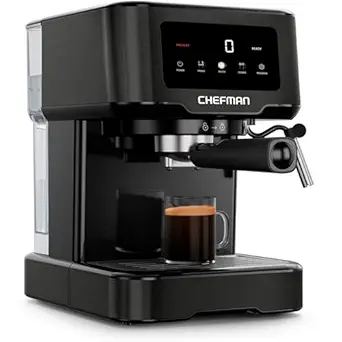
The Chefman CraftBrew puts customizable shot volume and a timer behind a touch control panel, giving it a more digitally guided workflow than the button-operated Breville Bambino. Its 1.5-liter removable reservoir also holds more water than the Bambino’s 47-ounce tank, which means fewer interruptions for refilling during everyday use. This is a practical pick for people who want to adjust single or double shots and make milk drinks without moving into the Gaggia Classic Evo Pro’s heavier, more hands-on style. The tradeoff is that the Chefman’s digital controls do not replace a grinder or automate espresso preparation, and its steam wand still calls for manual milk work. Its 15-bar pump is a listed specification, not a guarantee of better extraction than the Gaggia’s stated 9-bar setup.
Pros:- Touch panel and timer allow customization of shot volume.
- Removable 1.5-liter reservoir is straightforward to refill and clean.
- Steam wand supports lattes and cappuccinos without a separate frother.
- Single- and double-shot options offer a simple choice of serving size.
Cons:- Requires ground coffee and does not include a grinder.
- Manual steam-wand use means milk texturing still takes practice, unlike the Bambino’s automatic option.
- Compact design may be limiting for heavy daily use.
Best for: Home users who value touch controls, adjustable shot volume, and a removable reservoir for regular espresso and milk drinks.
Not ideal for: Baristas looking for a 58 mm portafilter and manual café-style control, or buyers who expect a machine to grind beans and fully automate preparation.
- Model:RJ54-SS-15-D-BLK
- Pump pressure:15 bar
- Water reservoir:1.5 L, removable
- Power:1350 W
- Shot options:Single or double
- Controls:Touch control panel with built-in timer
- Frother:Built-in steam wand
- Warranty:1-year assurance from Chefman
Our verdict“Pick the CraftBrew if adjustable touch-controlled shots and an easy-to-remove reservoir matter more than grinder integration or traditional barista hardware.”

How We Picked
I ranked these machines around the needs of a buyer seeking a prosumer-style home setup, not just a pump-pressure headline. I weighed workflow and control, grinder inclusion, milk-steaming capability, footprint, water-tank access, construction cues, and the amount of setup or maintenance a typical owner should expect. I also separated traditional semi-automatic machines from compact, appliance-style models, since they serve different levels of involvement.
The order reflects usefulness across common home routines, not a claim that every machine suits every buyer. The Barista Express ranks first for its balanced all-in-one approach; the Diletta Bello appeals to buyers who prioritize a more traditional machine experience; and the Bambino earns a place for compact simplicity. The remaining models are differentiated by their grinder bundles, compact format, materials, and stated features. Buyers should check current manufacturer specifications, regional versions, included accessories, and service terms before choosing.
Factors to Consider When Choosing Prosumer Espresso Machine Under 3000
Before choosing, decide what you want the machine to make easier: dialing in espresso, preparing milk drinks, saving counter space, or limiting separate equipment. A prosumer-style purchase is a workflow choice as much as a machine choice, and the grinder, water, and maintenance routine can shape results as much as the machine itself.
Choose the Grinder Setup Before the Machine
A grinder has a major effect on espresso consistency, so an included grinder can simplify the first purchase but should not be treated as a free bonus. Think about whether you want one compact appliance or the flexibility to replace or upgrade the grinder separately. An integrated unit can save space and reduce setup decisions, while a separate grinder may make troubleshooting and future upgrades easier. Before buying, check whether the grinder offers adjustments fine enough for espresso and whether changing beans requires repeatable settings. A common mistake is spending the whole budget on the machine and leaving too little for a capable grinder. If you already own a suitable grinder, a machine without one may be the more sensible route.
Match the Workflow to Your Daily Routine
Semi-automatic brewing asks you to manage steps such as grinding, dosing, tamping, and stopping the shot; that involvement can be rewarding, but it takes practice. More guided controls can make repeat drinks less fiddly, especially when several people share the machine. Consider how many drinks you make in a row and whether you usually prepare espresso alone or with steamed milk. A machine that suits occasional morning use may feel slow during a busy household routine. Do not assume a high pump-pressure number means easier dialing-in or better-tasting coffee. Choose for the controls and sequence you will actually use, rather than for the most impressive-sounding specification.
Plan for Milk Drinks and Back-to-Back Use
If cappuccinos and lattes are part of your routine, the steam wand and the time needed to move between brewing and steaming matter more than a general claim of professional performance. A manual wand offers hands-on control over texture, but learning to make consistent microfoam takes practice. If you mostly drink straight espresso, investing attention in steaming features may add complexity without much benefit. Buyers who prepare several milk drinks in succession should check the machine’s stated operating guidance and allow for warm-up or recovery time. A common mismatch is choosing a small, simple machine for a household that expects fast rounds of milk drinks. Prioritize the drinks you make most often, not the occasional recipe you might try.
Measure Counter Space and Daily Access
Measure the space where the machine will sit, including room above it for filling and room in front for the portafilter and cup. Compact machines can fit more easily, but a small footprint does not always mean the water tank, drip tray, or controls are convenient to reach. Check the tank capacity and whether it can be removed without moving the machine. Also account for the grinder, knock box, tamper, and space to set down a cup; the espresso maker is only one part of the station. A frequent mistake is measuring the appliance but not the whole brewing workflow. If the machine must be moved each time you use it, a smaller model may still prove awkward.
Budget for Upkeep, Water, and Accessories
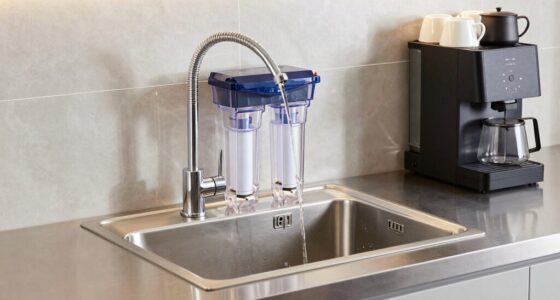
Buying the machine is only one part of the ongoing commitment: espresso machines need regular cleaning, and water quality can affect both flavor and scale buildup. Read the care instructions before choosing, particularly if you want a low-effort routine or expect the machine to be used every day. Factor in essentials such as a grinder if one is not included, a scale, cleaning supplies, and a suitable tamper where needed. Check what replacement parts and service channels are available in your region before committing to a less familiar brand. Paying more makes sense when it buys a workflow or construction advantage you will use, rather than a feature that sounds appealing but changes little in practice. A machine that is easier to maintain may be a better fit than one with a longer feature list.
Frequently Asked Questions
Is the Breville Barista Express the right choice if I am new to espresso?
It can be a practical starting point if you want a grinder and espresso machine in one setup, along with room to learn hands-on preparation. Expect to adjust grind size and dose as beans change; an integrated grinder does not remove the learning curve. If your main priority is a compact machine with a simpler routine, the Bambino may be a better fit, though you will need a separate grinder for espresso. Choose the Barista Express if you want an all-in-one station and are willing to practice. Choose a simpler setup if you value speed and low involvement over adjustment.
Should I buy a machine with a built-in grinder or choose a separate grinder?
A built-in grinder is attractive when you want fewer appliances and a single purchase to set up your coffee station. A separate grinder gives you more freedom to change grinders later without replacing the espresso machine. The right choice depends on your existing equipment, available counter space, and willingness to compare grinder capabilities. If you already own a grinder that can produce espresso-fine grounds, paying for another one may not add much value. If you are starting from scratch, compare the bundled workflow and adjustment range rather than relying on the word “professional.”
Does a 20-bar label mean a machine will make better espresso than a 15-bar model?
No single pressure figure tells you how easy a machine is to use or how good a particular shot will taste. Grinder quality, fresh coffee, dose, temperature stability, and repeatable preparation all affect the result. The machines in this roundup advertise different pressure figures, but that specification should not outweigh a control layout or workflow that better suits your routine. Look for clear operating instructions and features you can use consistently. Treat the headline number as one detail to verify, not a ranking shortcut.
Is a compact machine a good choice for making milk drinks every day?
It can be, but the machine’s footprint does not tell you how smoothly it handles repeated brewing and steaming. Check the wand style, tank access, and manufacturer guidance for the sequence and pace of milk-drink preparation. A compact machine may make sense for one or two drinks in a limited space, while a busier household may prefer a setup built around a more involved workflow. Manual steaming also takes practice, regardless of machine size. Match the machine to the number of drinks you actually make rather than choosing by dimensions alone.
What should I check before buying an unfamiliar espresso machine brand?
Look for a clear manual, accessible customer support, replacement-part availability, and specific cleaning and descaling instructions. Confirm what comes in the box, since baskets, portafilters, and other accessories can vary by model or regional version. Check the exact product listing for features such as grinder type, tank capacity, and materials rather than assuming they match a similarly named machine. Consider whether the seller or manufacturer provides a usable service route if a part needs repair. Those checks help you judge long-term ownership, not just the appeal of a feature list.
Conclusion
For the broadest mix of convenience and hands-on control, I recommend the Breville Barista Express as best overall. The Diletta Bello is my best premium-style choice for buyers who want a more traditional semi-automatic setup, while the Bambino is my beginner-friendly and compact pick for a simpler counter-friendly routine. For shoppers seeking an all-in-one bundle, compare the AIRMSEN, AMZCHEF, and EUHOMY against your grinder needs and preferred controls; for a compact machine with a steam wand, the CASABREWS models and other small-format options deserve a closer feature check. The best value depends on what you already own: choose an integrated grinder if you need one, or put more of your budget toward the machine and a separate grinder if flexibility matters more. Before deciding, verify the exact model specifications, included accessories, and service support for your region.