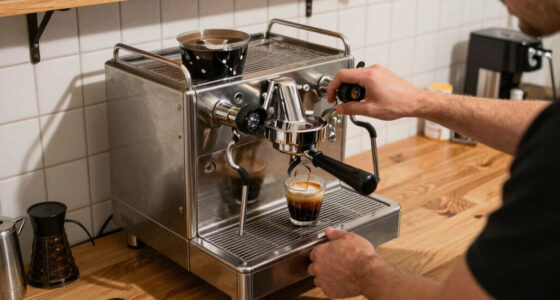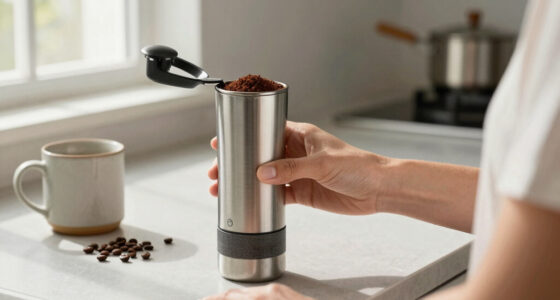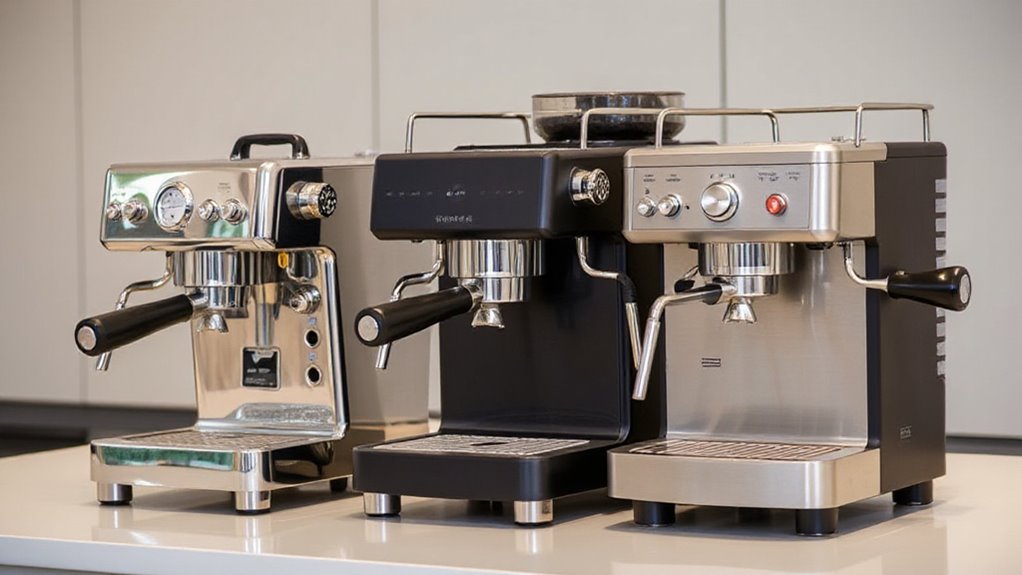

Searching for a spring lever espresso machine under $3,000 means sorting out an important distinction: several machines in this roundup use a hand-operated lever, but they are not all spring-lever machines. A spring mechanism can apply brewing pressure for you; a direct manual lever relies on your force and technique. I’ve ranked the five options by how clearly their design, controls, and capacity suit buyers seeking lever espresso within this budget, while calling out where a listing doesn’t establish that it uses a spring.

Get kitchen gear delivered free with Prime
- Fast, free delivery on millions of items
- Prime Video, Amazon Music and more included
- Member-only deals all year
The Flair 49 PRO is my control-focused pick, with a pressure gauge, two basket options, and a brew path described as free of plastic. For a traditional heated machine that can serve espresso and milk drinks, the La Pavoni PC-16 Professional offers a boiler, pressure gauge, and two frothing systems. The Flair Classic is the simpler manual alternative, while the Europiccola prioritizes a compact, iconic format. The XDTKJDZ’s advertised pressure adjustment sounds ambitious, but its limited product information makes it harder to recommend with confidence. The central tradeoff is manual control versus convenience, alongside a second one: whether a product’s claimed lever style actually meets your spring-lever requirement.
Complete the kit


Key Takeaways
- The Flair 49 PRO is my strongest pick for hands-on pressure control, but its description identifies a direct manual lever, not a spring mechanism.
- The La Pavoni PC-16 is the most capable listed option for pairing lever espresso with milk drinks, thanks to its boiler and dual frothing systems.
- The Flair Classic offers a straightforward way into manual lever brewing, with a gauge and two portafilter options, but no automatic assistance.
- The Europiccola combines a 0.8-liter capacity with a compact traditional design, though its listing gives less detail about pressure feedback and workflow.
- The XDTKJDZ claims adjustable extraction from 1 to 16 bar, but the supplied specifications and product details leave more unanswered questions than the other picks.
| Flair UPDATED 49 PRO (Black) – All Manual 49mm Lever Espresso Maker |  | Best Overall for Manual Pressure Control | Operation: Manual direct lever | Portafilter system: 49mm | Pressure feedback: Integrated gauge; 5–9 bar espresso zone | VIEW ON AMAZON | See Our Full Breakdown |
| La Pavoni PC-16 Professional Espresso Machine |  | Best for Milk Drinks and Larger Home Routines | Operation: Manual lever | Boiler capacity: 38 fluid ounces | Boiler material: Solid brass, described as nickel-plated | VIEW ON AMAZON | See Our Full Breakdown |
| Flair Updated Espresso Maker – Classic Manual Lever Espresso Machine |  | Best Value Manual Starter Kit | Operation: Manual | Capacity: 0.04 liters | Materials: Cast aluminum and stainless steel | VIEW ON AMAZON | See Our Full Breakdown |
| La Pavoni EPC-8 Europiccola Lever Style Espresso Machine |  | Best Traditional Compact Lever Machine | Operation: Manual lever | Water capacity: 0.8 liters | Finish: Chrome and silver | VIEW ON AMAZON | See Our Full Breakdown |
| XDTKJDZ Manual Variable Pressure Lever Espresso Machine |  | Best for Buyers Curious About Adjustable Pressure | Operation: Manual lever | Advertised pressure range: 1–16 bar | Pre-soak pressure: 3–5 bar, as described | VIEW ON AMAZON | See Our Full Breakdown |
| spring lever espresso machine under 3000 | Operation | Dimensions | Pressure feedback |
|---|---|---|---|
| Flair UPDATED 49 PRO | Manual direct lever | 13.5 x 7.5 x 11 inches | Integrated gauge; 5–9 bar espresso zone |
| La Pavoni PC-16 Professional E | Manual lever | 14.6 x 16.1 x 9.8 inches | Mounted pressure gauge |
| Flair Updated Espresso Maker | Manual | 6 x 12 x 10 inches | Pressure gauge included |
| La Pavoni EPC-8 Europiccola Le | Manual lever | — | — |
| XDTKJDZ Manual Variable Pressu | Manual lever | 41 x 15.8 x 40 cm | — |
More Details on Our Top Picks
Flair UPDATED 49 PRO (Black) – All Manual 49mm Lever Espresso Maker
The Flair 49 PRO is my leading choice for someone drawn to lever brewing because they want to control the shot, rather than press a button and let a machine decide the profile. Its pressure gauge gives feedback while brewing, and the listed espresso zone spans 5–9 bar. A 49mm portafilter system and both pressurized and bottomless basket options let a newer espresso drinker start with a more forgiving setup and move toward more demanding puck preparation later.
Its key limitation for this roundup is also a defining distinction: the description calls it an all-manual direct lever, not a spring lever. The force comes from the operator, so shot pressure depends on technique. That makes it a more interactive option than the La Pavoni PC-16, which has a heated boiler and milk systems, but less convenient for preparing several drinks in sequence. The 49 PRO is also designed around espresso, not steaming milk. Its small footprint and described no-plastic brew path suit buyers prioritizing countertop space and materials, but the workflow still involves manual brewing and hot water management.
I’d choose it over the Flair Classic when pressure feedback and a specifically described stainless-steel brew path matter most. I’d choose the Classic instead if a more basic manual kit fits the plan. For a strict spring-lever purchase, I’d verify the mechanism with the manufacturer before treating this as a match.
Pros:- Pressure gauge with a marked 5–9 bar espresso zone
- Pressurized and bottomless basket options support different skill levels
- Stainless-steel components are described as keeping plastic out of the brew path
- Compact footprint compared with heated countertop espresso machines
Cons:- Listed as a direct manual lever rather than a confirmed spring lever
- Manual force and hot-water handling add effort to every shot
- No integrated steam wand for milk drinks
Best for: Home espresso drinkers who want pressure feedback, basket flexibility, and a compact manual setup.
Not ideal for: Buyers who require a confirmed spring mechanism, automatic brewing, or integrated milk steaming.
- Operation:Manual direct lever
- Portafilter system:49mm
- Pressure feedback:Integrated gauge; 5–9 bar espresso zone
- Basket options:Pressurized and bottomless
- Brew-path materials:Stainless steel cylinder, valve plunger, and stem
- Listed capacity:70 ml
- Dimensions:13.5 x 7.5 x 11 inches
Our verdict“I rank the 49 PRO first for its useful pressure feedback and adaptable baskets, while advising spring-lever purists to confirm its mechanism before buying.”
La Pavoni PC-16 Professional Espresso Machine
The La Pavoni PC-16 Professional is the most complete traditional home setup in this group for people who want espresso plus milk drinks. Its listed 38-ounce brass boiler supports repeated brewing without the small-batch format of the Flair brewers, and the machine includes a mounted pressure gauge, a traditional steam wand, and an automatic cappuccino maker. That combination makes it more versatile for a household than the Flair 49 PRO, which focuses on manual espresso and does not list milk-steaming equipment.
This is still a hands-on machine, not an automatic shortcut. The lever calls for practice, and the product description says to reload fresh grounds for each brewing cycle. The boiler’s capacity can support a busier routine, but it does not remove the work of preparing pucks, pulling shots, and learning to texture milk. The listing also notes that maintenance such as descaling is part of ownership. Buyers should check current manufacturer documentation for operating details and confirm how the two frothing systems fit their preferred workflow.
Compared with the Europiccola, the PC-16 is the stronger choice when milk capability and a pressure gauge are priorities. The Europiccola may suit someone seeking a simpler, smaller traditional lever machine, while the PC-16 takes more counter space and asks for more upkeep. Its supplied information describes a manual lever but does not confirm a spring mechanism, so it should not be treated as a verified spring-lever model without further confirmation.
Pros:- 38-ounce boiler supports multiple drinks between refills
- Includes a mounted pressure gauge
- Offers both a steam wand and an automatic cappuccino maker
- Traditional lever format paired with milk-drink features
Cons:- Manual workflow requires practice and fresh grounds for each brewing cycle
- Boiler and milk systems mean more cleaning and descaling attention
- The supplied description does not confirm spring-driven lever operation
Best for: Home baristas who regularly make espresso and cappuccinos and want an integrated boiler and milk tools.
Not ideal for: Buyers seeking a compact, low-effort machine or a spring mechanism verified by the supplied listing.
- Operation:Manual lever
- Boiler capacity:38 fluid ounces
- Boiler material:Solid brass, described as nickel-plated
- Pressure feedback:Mounted pressure gauge
- Milk systems:Traditional steam wand and automatic cappuccino maker
- Power:1000 watts
- Dimensions:14.6 x 16.1 x 9.8 inches
- Weight:14 pounds
Our verdict“I recommend the PC-16 to milk-drink households that want a traditional lever machine, provided they accept its manual routine and verify the mechanism if spring action is mandatory.”
Flair Updated Espresso Maker – Classic Manual Lever Espresso Machine
The Flair Classic takes a simpler route to manual lever espresso than the 49 PRO. It includes a pressure gauge and two portafilters—bottomless and flow-control—so buyers can explore different brewing approaches without stepping immediately into a powered machine. Its detachable brewing head is also a practical advantage: separating the brew assembly makes cleanup more manageable than it might be on a fixed group.
Its position below the 49 PRO comes down to the supplied feature set, not a claim that the Classic cannot make good espresso. The 49 PRO specifies a 49mm system, an espresso pressure zone, and stainless-steel components in the brew path; the Classic listing gives broader material and feature information but less detail about its pressure range and brew-water contact surfaces. Both require the barista to supply the brewing force, so neither offers the spring-assisted action some searchers may have in mind. The Classic is also an espresso-focused manual appliance without listed heating or milk-steaming functions.
I see the Classic as a sensible starting point for someone who wants a hands-on, non-automatic workflow and values a gauge and included portafilters. It is less suited to a buyer who wants a confirmed spring mechanism, frequent milk drinks, or a machine that handles several servings without resetting the brew setup. Compared with the Europiccola, it puts more emphasis on detachable brewing parts and included shot-control accessories than on a heated, traditional-machine format.
Pros:- Includes pressure gauge and two portafilter styles
- Detachable brewing head supports cleanup
- Cast aluminum and stainless-steel construction is listed
- Manual operation gives the user direct control over brewing
Cons:- Requires technique and manual effort for every extraction
- Small listed capacity is not suited to serving a group quickly
- Listing does not establish spring operation or specific pressure range
Best for: New manual-espresso users who want a gauge and more than one portafilter approach in a compact setup.
Not ideal for: Buyers who want automatic operation, integrated milk steaming, or a documented spring-driven group.
- Operation:Manual
- Capacity:0.04 liters
- Materials:Cast aluminum and stainless steel
- Included portafilters:Bottomless and flow-control
- Pressure feedback:Pressure gauge included
- Dimensions:6 x 12 x 10 inches
- Weight:4.9 pounds
- Warranty:3 years, as listed
Our verdict“I’d pick the Classic as an accessible manual starter when its included gauge and portafilters matter more than the 49 PRO’s more detailed pressure and material specifications.”
La Pavoni EPC-8 Europiccola Lever Style Espresso Machine
The La Pavoni EPC-8 Europiccola is the traditional-machine pick for a buyer who wants a heated, lever-style espresso setup rather than a compact manual brewer that depends on separately prepared hot water. Its listed 0.8-liter water capacity and chrome-and-silver finish place it in a different lane from the Flair Classic and 49 PRO. It has the familiar look and operating style of a home lever machine, with a focus on making small quantities rather than running a high-volume drink station.
The listing provides fewer useful operating details than the PC-16 description. It does not specify a mounted gauge, dual frothing systems, or the same 38-ounce boiler capacity, so I would not choose it over the PC-16 for a household that frequently makes milk drinks or several servings. Nor does the supplied information confirm that its lever is spring-driven. That matters for this search: “lever style” alone does not establish spring operation, and the manufacturer’s current documentation is the best place to verify that distinction.
Compared with the Flair options, the Europiccola offers a more traditional heated-machine format, but the Flair brewers provide clearer detail about pressure feedback and portafilter choices. The Europiccola makes most sense if design and a classic home espresso workflow rank above extensive listed controls. Buyers should be prepared for a learning curve and ongoing maintenance; its compact format does not make manual lever operation effortless.
Pros:- Traditional chrome-and-silver lever-machine design
- Listed 0.8-liter water capacity
- Designed for home or small-office use
- More traditional heated format than the manual Flair brewers
Cons:- Listing gives limited detail about gauge, milk tools, and operating controls
- Manual technique and maintenance remain part of ownership
- Spring-driven operation is not confirmed in the supplied description
Best for: Espresso drinkers who want a traditional-looking, heated lever machine for small home routines.
Not ideal for: Buyers who need detailed pressure controls, high-volume service, or confirmed spring action.
- Operation:Manual lever
- Water capacity:0.8 liters
- Finish:Chrome and silver
- Intended setting:Home or small office
- Machine type:Lever-style espresso machine
- Gauge:Not specified in supplied description
- Milk system:Not specified in supplied description
Our verdict“I’d choose the Europiccola for traditional design and small-batch home use, not for the most transparent control specifications or a verified spring group.”
XDTKJDZ Manual Variable Pressure Lever Espresso Machine
The XDTKJDZ stands apart from the other entries by advertising variable pressure from 1 to 16 bar and adjustable low-pressure pre-soaking. Its description proposes changing pressure across pre-infusion, extraction, and pressure reduction, with different soak times for different roast styles. For a technically curious buyer, that range suggests more opportunities to shape extraction than the simpler descriptions for the Flair Classic or Europiccola provide.
That promise comes with the largest information gap in this roundup. The listing names a 100ml cavity, a 7.8kg net weight, and overall dimensions, but gives little detail about materials, cleaning, included baskets, gauge design, or service support. Its specification calls the machine manual, yet does not explain enough about the pressure mechanism for me to treat the advertised range as a verified advantage in routine use. The listing also does not confirm spring-driven operation. I would seek manufacturer documentation covering pressure calibration, construction, and replacement parts before choosing it over a better-documented machine.
Compared with the Flair 49 PRO, the XDTKJDZ claims a wider pressure range and explicit pre-soak adjustment, while the Flair gives clearer information about baskets, brew-path materials, and a marked espresso zone. Compared with the La Pavoni PC-16, it offers no listed boiler or milk system. I rank it fifth because the feature concept is interesting, but buyers have less product information on which to base a decision. It is for someone willing to investigate the listing further, not a straightforward first recommendation.
Pros:- Advertises a wide 1–16 bar operating-pressure range
- Describes adjustable low-pressure pre-soaking
- Provides a stated 100ml cavity capacity
- Large and heavy listed format may appeal to buyers seeking a substantial countertop unit
Cons:- Listing provides limited information on materials, baskets, cleaning, and support
- Pressure mechanism and calibration details are not clearly established
- No confirmed spring mechanism, boiler, or milk system in the supplied description
Best for: Experienced, technically curious buyers who want to investigate adjustable pressure and pre-soak control.
Not ideal for: Beginners who need clear documentation, buyers prioritizing service information, or anyone requiring confirmed spring action.
- Operation:Manual lever
- Advertised pressure range:1–16 bar
- Pre-soak pressure:3–5 bar, as described
- Cavity capacity:100 ml
- Net weight:About 7.8 kg
- Dimensions:41 x 15.8 x 40 cm
- Brand listed:XDTKJDZ
- Spring mechanism:Not confirmed in supplied description
Our verdict“I’d investigate the XDTKJDZ only if adjustable-pressure claims are a priority and the seller or manufacturer can fill in its documentation gaps.”

How We Picked
I ranked these options around the promise in the search: a lever espresso machine under $3,000, with particular attention to whether the supplied information supports calling a model a spring lever. A hand-powered lever and a spring-driven lever are not interchangeable. Since the descriptions for the Flair machines and La Pavoni machines specify manual or lever operation without confirming a spring group, I do not present them as verified spring-lever designs. Buyers who require a spring mechanism should check the manufacturer’s current documentation before choosing.
For the order, I weighed the clarity of the brewing controls, the usefulness of included features, the machine’s likely fit for espresso-only or milk-drink routines, and how much uncertainty remains in the listing. A pressure gauge and selectable baskets make the Flair 49 PRO easier to evaluate as a control-oriented manual brewer. The PC-16 ranks highly for home baristas who want an integrated boiler and milk preparation, while the Classic and Europiccola suit different levels of simplicity and traditional-machine interest. The XDTKJDZ ranks last not because its advertised pressure range proves it performs poorly, but because the listing provides fewer verifiable details about components and day-to-day use. I exclude price comparisons and base this guide on features, fit, and tradeoffs.
| spring lever espresso machine under 3000 | Operation | Pressure feedback |
|---|---|---|
| Flair UPDATED 49 PRO | Manual direct lever | Integrated gauge; 5–9 bar espresso zone |
| La Pavoni PC-16 Professional E | Manual lever | Mounted pressure gauge |
| Flair Updated Espresso Maker | Manual | Pressure gauge included |
| La Pavoni EPC-8 Europiccola Le | Manual lever | — |
| XDTKJDZ Manual Variable Pressu | Manual lever | — |
Factors to Consider When Choosing Spring Lever Espresso Machine Under 3000
I’d start by deciding whether you specifically need a spring-driven lever or simply want the hands-on control associated with lever espresso. That distinction changes which machine belongs on your shortlist.Spring action and manual leverage are different
A direct manual lever depends on the force you apply. A spring lever uses a spring mechanism to deliver the brewing pressure after the lever is set. The supplied descriptions identify the Flair models and La Pavoni machines as manual or lever-style, but do not confirm spring-driven groups. The XDTKJDZ advertises variable pressure without clearly describing its mechanism. If spring action is a requirement rather than a preference, verify it in manufacturer documentation before ordering; a pressure gauge or a lever handle does not prove that a machine is spring-operated.
Decide how much control you want to manage
The 49 PRO’s gauge and marked pressure zone provide a clear reference while still leaving the user to apply force. The Flair Classic also includes a gauge, but its listing gives fewer details about a particular pressure range. The XDTKJDZ makes broader pressure and pre-soak claims, though less documentation is supplied about how those controls work. More adjustment can be appealing, but it also asks the buyer to understand pressure, grind, dose, and timing. If you would rather simplify early attempts, the Classic’s two portafilter styles offer a more modest starting point than chasing several pressure variables at once.
Plan for milk drinks and repeated servings
For espresso with cappuccinos or other milk drinks, the La Pavoni PC-16 is the clearest match here because its listing specifies a boiler, steam wand, and automatic cappuccino maker. The Europiccola is another traditional heated-machine option, but the supplied product information says less about its milk setup. The Flair models are compact manual espresso brewers, not complete steaming stations in the descriptions provided. Capacity also affects routine: the PC-16 lists a 38-ounce boiler, while the Flair Classic lists a 0.04-liter capacity and the 49 PRO lists 70ml. Those figures describe different parts or contexts, so check what each capacity refers to rather than comparing them as equivalent shot counts.
Include grinder and workflow in the decision
A manual lever machine does not remove the need for suitable ground coffee. The Flair 49 PRO’s pressurized basket is described as an option for users without a high-quality burr grinder, while its bottomless basket offers more control for experienced users. That flexibility gives it an advantage for a buyer whose grinder may change over time. The other listings do not provide the same explicit beginner-basket detail. Also account for the extra steps common to manual brewing: preparing hot water where needed, dosing and tamping, operating the lever, and cleaning the brew components. Choose based on the routine you want to repeat, not just the pressure range.
Treat documentation as a buying feature
When product descriptions are uneven, clarity itself matters. The Flair 49 PRO specifies its portafilter size, gauge zone, basket options, and brew-path materials. The PC-16 identifies its boiler capacity and milk systems. The XDTKJDZ’s advertised pressure range is eye-catching, but the supplied listing leaves questions about construction, calibration, cleaning, and support. Before buying any of these machines, check current information on replacement parts, warranty coverage, and care instructions. That is especially useful for traditional heated machines, where scale management and maintenance affect long-term ownership.
Frequently Asked Questions
Are these all confirmed spring lever espresso machines?
No. The supplied descriptions identify several products as manual lever or lever-style machines, but do not establish that they use a spring-driven group. The Flair 49 PRO is explicitly described as a direct manual lever. The XDTKJDZ advertises variable pressure but does not explain enough about its mechanism to confirm spring action. If a spring lever is a firm requirement, check the manufacturer’s specifications for the exact model before purchasing.
Which option is easiest for a beginner to approach?
The Flair 49 PRO has the clearest beginner-oriented detail because it includes a pressurized basket described for users without a high-quality burr grinder, alongside a gauge and a bottomless basket for later experimentation. The Flair Classic is another approachable manual choice, with a gauge and two portafilter styles. Neither is automatic, so a new user still needs to learn the manual workflow and manage each extraction.
Which machine makes the most sense for cappuccinos?
The La Pavoni PC-16 is the strongest match in this group for regular cappuccinos because its listing names both a traditional steam wand and an automatic cappuccino maker. It also has a listed 38-ounce boiler. The Flair machines are described as manual espresso brewers and do not list integrated steaming equipment. Confirm the exact included accessories and care instructions before buying, since milk preparation adds cleaning and maintenance work.
Does a pressure gauge mean a machine is spring-operated?
No. A gauge reports pressure; it does not define how that pressure is generated. A person may create pressure through a direct lever, or a spring may drive the lever mechanism. The Flair 49 PRO’s gauge is useful feedback for manual brewing, but its description calls it a direct lever. Look for explicit manufacturer language about spring operation rather than inferring the mechanism from a gauge, lever, or pressure range.
What should I check before choosing the XDTKJDZ?
I would request or locate documentation on the pressure mechanism, calibration, materials, portafilter and basket details, cleaning, replacement parts, and warranty support. Its listing advertises a 1–16 bar range and adjustable pre-soaking, but offers fewer supporting details than the Flair and La Pavoni descriptions. If those claims are verified and suit your workflow, it may merit further research; without that information, the better-documented options are easier to compare confidently.
Conclusion
For manual pressure control and adaptable baskets, I’d start with the Flair 49 PRO, while checking its mechanism if spring action is mandatory. For regular cappuccinos and a more complete heated setup, I’d choose the La Pavoni PC-16 and accept the added hands-on care. The Flair Classic suits buyers who want a simpler manual starter kit; the Europiccola fits those who value a traditional compact machine more than extensive listed controls. I’d put the XDTKJDZ on a research shortlist only after verifying its advertised pressure system and support. Across all five, the deciding question is whether you want a true spring group or a manual lever experience—these product descriptions do not make those the same thing.
Halloween Picks
halloween
As an affiliate, we earn on qualifying purchases.