
When comparing smart kitchen gadgets, the real choice is often between connected appliances that work with an app or voice assistant and simpler electric tools that handle the same task without a digital layer. A Wi-Fi multicooker, for example, may offer scheduled cooking and phone alerts; a basic electric pressure cooker may do the core cooking for less money and with fewer setup steps. The connected model can help when you regularly use its remote features, but an app does not automatically make a recipe faster or a meal better.

Get kitchen gear delivered free with Prime
- Fast, free delivery on millions of items
- Prime Video, Amazon Music and more included
- Member-only deals all year
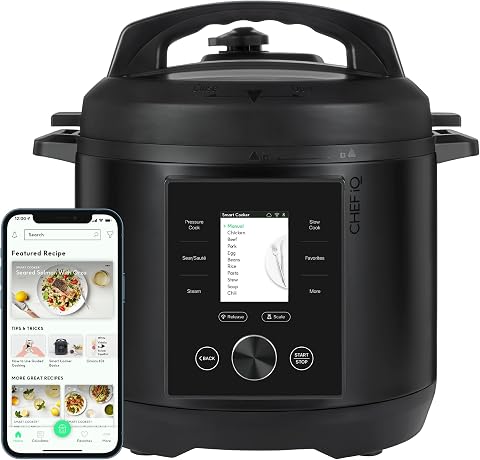
CHEF iQ Smart Pressure Cooker with WiFi and Built-In Scale, 6 Quart
- ✔ Capacity: 6 quarts
- ✔ Connectivity: Wi-Fi and Bluetooth
- ✔ Dimensions: 13 × 13 × 13 inches

Etekcity Food Kitchen Scale with Nutritional Calculator, Smart App, 11lb
- ✔ Maximum capacity: 5,000 g / 11 lb
- ✔ Measurement range: 3 g to 5,000 g
- ✔ Increment: 1 g

Amazon Echo Show 15 (2nd Gen) 15.6-inch Full HD Smart Display with Fire TV
- ✔ Display: 15.6-inch Full HD, 1920 × 1080
- ✔ Dimensions: 16.1 × 10.1 × 1.4 inches
- ✔ Weight: 4.96 pounds
This comparison looks at both approaches across useful features, daily convenience, setup, compatibility, privacy, reliability, and value. Choose connected gadgets if automation or remote access solves a recurring problem in your kitchen. Choose simple electric gadgets if you want dependable task performance without another account, app, or device to maintain.
At a Glance
| Criteria | Connected smart kitchen gadgets | Simple electric kitchen gadgets | Winner |
|---|---|---|---|
| Core cooking or task performance | Can add useful presets, sensors, or guided settings, depending on the appliance | Focused controls and features for the main task | Depends |
| Automation and remote access | App controls, alerts, scheduling, or voice commands may be available | Manual controls; no remote access or connected alerts | A |
| Setup and ease of use | Requires setup and sometimes an account, Wi-Fi, and app updates | Usually ready to use with fewer setup steps | B |
| Smart home compatibility | Varies by brand, platform, and product; features may not work across ecosystems | No app or ecosystem compatibility needed | B |
| Privacy and data | May collect usage or account data; policies vary by manufacturer | No connected service required for normal operation | B |
| Reliability and maintenance | Depends on the product; software support and connectivity add possible failure points | Fewer software dependencies, though ordinary parts can still wear or fail | B |
| Upfront value | Usually costs more; worth it when connected features see regular use | Usually cheaper for similar basic functionality | Depends |
CHEF iQ Smart Pressure Cooker with WiFi and Built-In Scale, 6 Quart
The CHEF iQ makes the strongest case for a smart kitchen gadget because its technology is tied to preparing food, not simply putting a screen or app nearby. Its built-in scale weighs ingredients and can indicate the required liquid amount, helping us follow recipes with fewer separate measuring steps. Through Wi-Fi and Bluetooth, the app adds guided recipes, videos, ingredient presets, and remote monitoring. These features make it more of an integrated cooking system than the Etekcity scale, which concentrates on nutrition data after we weigh ingredients.Pressure management is another point of difference. The cooker offers quick, pulse, and natural release methods, with automatic pressure release designed to take some guesswork out of finishing a recipe. A steamer rack and basket also broaden the ways we can use the six-quart pot. Compared with the Echo Show 15, this is the pick that actively cooks; the Echo can display information and control compatible devices, but it is not a substitute for an appliance.The tradeoff is dependence on the connected experience for some of its appeal. Wireless updates and connected cooking features require the app, so buyers who prefer self-contained controls may find the extra layer unnecessary. It is also specified for use in the United States and Canada, limiting its fit elsewhere. For households that want one appliance to combine guided pressure cooking and ingredient weighing, those constraints are easier to justify than they would be for a basic cooker.
Pros:
- Built-in scale weighs ingredients and can indicate required liquid amounts.
- App provides guided recipes, videos, ingredient presets, and remote monitoring.
- Automatic pressure release offers quick, pulse, and natural methods.
- Six-quart capacity and included steamer rack and basket support varied meals.
Cons:
- Connected cooking features and wireless updates require the app.
- Use outside the United States and Canada is not recommended.
- Its connected features may be more involved than needed for cooks who want a basic pressure cooker.
Best for: Home cooks who want guided pressure-cooker recipes, integrated ingredient weighing, and remote monitoring in one appliance.
Not ideal for: Buyers outside the United States and Canada, or cooks who want connected features without relying on an app.
Bottom line: We rank the CHEF iQ first because its connected tools directly support cooking, while its app dependence and regional limitation are clear tradeoffs.
“We rank the CHEF iQ first because its connected tools directly support cooking, while its app dependence and regional limitation are clear tradeoffs.”
Etekcity Food Kitchen Scale with Nutritional Calculator, Smart App, 11lb
When the goal is to understand portions and what goes into a meal, the Etekcity scale has a more focused job than either of the other picks. It weighs food from 3 g to 5,000 g in 1 g increments, then connects with the VeSync app to track up to 19 nutrition data points and create daily, weekly, and monthly reports. The supplied description says its food database is supported by Nutritionix and contains about one million items; users can also add or customize food data.This makes Etekcity a better fit for routine portion logging than the CHEF iQ. The cooker’s scale helps with ingredients as part of a recipe, while Etekcity’s app is aimed at nutrition summaries and trends. Compared with the Echo Show 15, it is much less versatile as a household device, but its measurement task is more specific and immediate. Tare, multiple units, and a wipe-clean stainless-steel platform make it practical for weighing ingredients in bowls or directly on the surface.Buyers should keep the limits of food logging in mind. The scale’s smart value depends on the app and its food data, and barcode scanning is currently available only in the United States. It does not cook food or provide the broad shared-screen functions of the Echo Show. We would choose it when weighing and tracking are the point; for recipe guidance and pressure cooking, the CHEF iQ is the more complete kitchen appliance.
Pros:
- Tracks up to 19 nutrition data points through the VeSync app.
- Weighs from 3 g to 5,000 g in 1 g increments.
- Tare and unit options support common ingredient-measuring tasks.
- Food-grade 304 stainless-steel platform is designed for easy cleaning.
Cons:
- Nutrition insights and reports require the VeSync app.
- Barcode scanning is currently available only in the United States.
- It is a specialized scale, not a cooking appliance or shared kitchen display.
Best for: People who regularly weigh ingredients and want app-based nutrient tracking and reports to support meal planning.
Not ideal for: Cooks seeking an appliance that prepares food, or buyers outside the United States who expect barcode scanning.
Bottom line: We recommend Etekcity for buyers who want nutrition tracking attached to everyday weighing, with app reliance and a narrow role as the main compromises.
“We recommend Etekcity for buyers who want nutrition tracking attached to everyday weighing, with app reliance and a narrow role as the main compromises.”
Amazon Echo Show 15 (2nd Gen) 15.6-inch Full HD Smart Display with Fire TV
The Echo Show 15 earns its place in a smart-kitchen roundup by making shared information visible. Its 15.6-inch Full HD display can show calendars, to-do lists, video calls, entertainment, and smart-home controls, in either portrait or landscape orientation. Fire TV and voice control extend it beyond cooking, while support for Zigbee, Matter, and Thread lets it act as a hub for compatible smart-home devices. In contrast to Etekcity’s single-purpose scale, this is a room-level device that can serve several people and routines.For kitchen organization, the large display may help keep plans and tasks in view while we cook. Its 13 MP auto-framing camera includes a physical privacy shutter, and the included wall mount makes placement part of the setup. The CHEF iQ remains the stronger choice when we want a device to weigh ingredients and cook under pressure; Echo Show is better suited to coordinating the room around those activities. It can complement an appliance, but it does not replace one.That broad role comes with practical limits. It needs Wi-Fi, does not support ad-hoc Wi-Fi networks, and some services or skills may involve subscriptions or other fees. Its large footprint and wall-mounted format also make it less suitable for kitchens without a convenient viewing spot. Buyers choosing between it and the other two should ask whether they need a shared display and smart-home hub; if the priority is food preparation or nutrition measurement, the dedicated picks deliver a closer match.
Pros:
- Large Full HD screen supports portrait and landscape orientations.
- Combines Fire TV, voice-controlled controls, and a smart-home hub.
- Supports Zigbee, Matter, and Thread devices.
- Auto-framing camera has a physical privacy shutter.
Cons:
- Requires Wi-Fi and does not support ad-hoc Wi-Fi networks.
- Some skills and services may require a subscription or other fees.
- Its large wall-oriented format takes more planning than a countertop scale.
Best for: Households that want a large, shared kitchen screen for calendars, entertainment, video calls, and compatible smart-home controls.
Not ideal for: Buyers who want a dedicated cooking or weighing tool, lack a suitable Wi-Fi connection, or have limited wall space.
Bottom line: We choose Echo Show 15 when the kitchen needs a shared information and device-control hub, while its Wi-Fi requirement and lack of specialized cooking tools keep it third.
“We choose Echo Show 15 when the kitchen needs a shared information and device-control hub, while its Wi-Fi requirement and lack of specialized cooking tools keep it third.”
As an Amazon Associate we earn from qualifying purchases.
Key Differences
The largest practical difference is what happens around the cooking task. Connected models can send a notification when a cycle finishes, let a user check status from another room, or guide settings through an app. Those features matter if they fit a routine, such as monitoring a long cook while handling other tasks. They matter much less if the appliance is already within sight and its controls are easy to use. For the core task, compare capacity, heat control, cooking modes, cleaning, and performance claims for the specific models rather than assuming connectivity improves results.
Simple electric gadgets usually make a stronger case on cost and friction. They can be easier to operate straight from the box and do not depend on a particular app, wireless network, or manufacturer support window. Connected products bring more options, but also more decisions: account requirements, data settings, app permissions, software support, and smart home compatibility. Paying extra makes sense when one or more connected features will be used often enough to justify that added complexity. Otherwise, the simpler tool is commonly the better buy.
Detailed Comparison
Core cooking or task performance (moderate difference)
Neither category wins by default. A connected device may have guided programs or sensors, while a simple model may offer the same essential heating or mixing function with straightforward controls. This is a moderate, model-specific difference: compare capacity, temperature range, power, included accessories, and cleaning requirements. Buy for the task performance you need; treat connectivity as an additional feature, not proof of better results.
Automation and remote access (Connected smart kitchen gadgets wins — major)
Connected gadgets win by a major margin when the feature works as advertised and remote access solves a real problem. Timers, progress alerts, scheduling, and voice commands can reduce check-ins or fit into a busy routine. Simple gadgets cannot send updates or accept commands from an app. If you rarely leave the kitchen while cooking, though, the advantage is small in practice and may not justify a price premium.
Setup and ease of use (Simple electric kitchen gadgets wins — moderate)
Simple electric gadgets win by a moderate margin for getting started: plug in, select a setting, and use the appliance. Connected models can require pairing, permissions, Wi-Fi, an account, and occasional app updates before their extra features are available. Some users will find guided app controls easier after setup; others will prefer physical controls every time. Choose based on who will use the gadget and how comfortable they are with its setup.
Smart home compatibility (Simple electric kitchen gadgets wins — minor)
Simple gadgets win by a minor margin for avoiding compatibility questions. They work without a voice assistant or a particular smart home platform. Connected products can be more convenient when they support the systems already used at home, but compatibility varies by model and may change with software updates. Check the exact product and the specific features supported before paying for a connection that may not integrate as expected.
Privacy and data (Simple electric kitchen gadgets wins — moderate)
Simple gadgets win by a moderate margin because their normal operation does not require a connected account or app. Connected devices may process account, device, or usage data, depending on the manufacturer and features. The practical difference depends on the product’s data policy and settings. If data collection is a concern, read the policy, check whether app access is optional, and favor a device that can perform its basic task offline.
Reliability and maintenance (Simple electric kitchen gadgets wins — moderate)
Simple gadgets win by a minor to moderate margin in long-term simplicity: there is no Wi-Fi pairing or app support to troubleshoot. Both kinds can have ordinary mechanical or electrical failures, and a connected product may still work as a basic appliance if its software service changes—or it may lose some features. Check warranty terms, replacement parts, software support, and whether essential controls remain available without internet access.
Upfront value (moderate difference)
Simple gadgets usually win on upfront price for the same basic task, a moderate difference when connected features are not needed. A connected model can still be better value for someone who routinely uses scheduling, alerts, or guided programs. Judge the premium against expected use: if the app feature saves time or prevents missed steps several times a week, the extra cost may earn its place; if it stays unused, it is wasted spend.
Connected smart kitchen gadgets: Pros and Cons
Pros:
- Remote alerts and controls can reduce repeated checks.
- Scheduling and guided settings may suit routines that benefit from automation.
- Can integrate with a supported smart home setup.
Cons:
- Often costs more than a simpler tool for the same basic task.
- May require an app, account, wireless network, and setup.
- Compatibility, data practices, and software support vary by product.
Simple electric kitchen gadgets: Pros and Cons
Pros:
- Usually costs less for core task performance.
- Often works without an account, app, or wireless network.
- Simple controls avoid compatibility and software questions.
Cons:
- No remote alerts, app scheduling, or voice control.
- May offer fewer guided programs or automation features.
- Requires manual checks and adjustments.
Who Should Choose What
Choose Connected smart kitchen gadgets if:
- You regularly need cooking alerts or remote status checks while away from the kitchen.
- A supported app or voice feature solves a recurring task, rather than sounding appealing only in theory.
- You are comfortable maintaining an app and checking the product’s privacy and support terms.
Choose Simple electric kitchen gadgets if:
- You want a gadget for one core task at a lower cost.
- You prefer direct controls and want it to work without Wi-Fi or an account.
- You do not expect to use remote monitoring, scheduling, or smart home features.
Skip both if: Skip both if you need a specialized cooking result neither model supports, or if countertop space, cleaning effort, or capacity makes either gadget a poor fit.
Value for Money
Pay more for a connected gadget only when its connected features match a routine you already have. Frequent remote checks, useful completion alerts, or scheduling that genuinely changes how you prepare meals can make the premium worthwhile. If you mainly need the appliance to heat, blend, weigh, or toast, a simpler model often offers better value because you pay for the task instead of features you may ignore. Compare the actual models’ capacity, warranty, parts, and cleaning demands; prices and feature sets vary widely by gadget and brand.
Final Verdict
For most people buying a kitchen gadget to perform one familiar task, start with a simple electric model: it is typically cheaper, easier to set up, and free of app dependencies. Choose a connected model when remote access, scheduling, or app guidance will solve a repeated inconvenience and the specific device supports the platforms and offline functions you need. The deciding factor is not how many smart features a product lists, but whether you will use them often enough to justify their added cost and upkeep.
Frequently Asked Questions
Are smart kitchen gadgets better at cooking?
Not automatically. Connectivity may add guided programs or alerts, but compare the specific models’ core features, capacity, controls, and cleaning requirements. An app connection by itself does not establish better cooking performance.
Are connected kitchen gadgets worth the extra cost?
They can be if you regularly use remote status checks, scheduling, or guided settings. If you mainly want the basic cooking or prep function, a simpler gadget is usually better value.
Do smart kitchen gadgets work without Wi-Fi?
It depends on the model. Some retain their main physical controls and basic functions offline, while others rely more heavily on an app. Check the manufacturer’s instructions for the exact product before buying.
What should I check before buying a smart kitchen gadget?
Check whether the app features you want are supported in your region, whether an account or Wi-Fi is required, what data the product collects, and how its warranty and software support work. Also compare the appliance’s core capacity, controls, and cleaning needs.