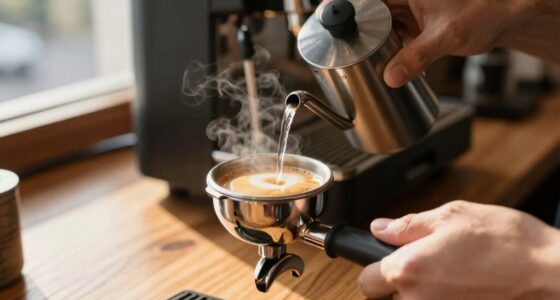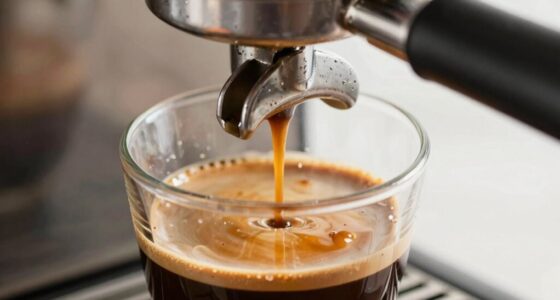

To pick a pre-infusion start point without guessing, observe your coffee bloom for consistency—steady bubbles indicating proper saturation. Adjust grind size or pour technique based on bloom speed: a quick bloom suggests coarser grounds, while a slow one calls for finer. Conduct small tests, noting flavor and aroma changes, and keep detailed records. By customizing your approach based on bean and equipment cues, you’ll steadily improve accuracy—more insights are right ahead.

Get kitchen gear delivered free with Prime
- Fast, free delivery on millions of items
- Prime Video, Amazon Music and more included
- Member-only deals all year
Key Takeaways
- Observe the bloom: steady, even bubbles indicate optimal pre-infusion start timing.
- Adjust grind size: coarser grounds bloom faster; finer grounds need longer pre-infusion.
- Use visual cues: rapid bloom suggests coarser grind; slow bloom indicates finer grind.
- Conduct incremental tests: vary pre-infusion duration, record results, and identify the best timing.
- Develop a consistent routine: standardize pour technique and timing, then refine based on flavor and aroma.
Products Worth Considering

Ninja PB051 Single-Serve Coffee Maker for Pods and Grounds

Ninja Luxe Café Mini Plus Espresso and Coffee Maker with AutoFroth, Bone & Champagne

Cuisinart SS-10P1 Single-Serve Coffee Maker, 72 oz, Silver
As an affiliate, we earn on qualifying purchases.
Why Pre-Infusion Timing Matters for Coffee Quality
Pre-infusion timing plays an essential role in determining the overall quality of your coffee because it directly influences how evenly water interacts with the grounds. Consistent grind size ensures water flows through the coffee uniformly, preventing over-extraction or under-extraction. If your grind is too coarse or inconsistent, water may bypass some grounds or extract too quickly, leading to uneven flavors. Water quality also impacts pre-infusion effectiveness; clean, mineral-balanced water promotes better wetting and extraction. When pre-infusion is timed correctly, it allows the coffee grounds to fully saturate, releasing gases and flavors evenly. This step enhances extraction, resulting in a richer, more balanced cup. Paying attention to grind consistency and water quality helps you optimize pre-infusion timing and improve your coffee’s overall flavor. Additionally, understanding the home theatre projector technology involved can help you select the ideal setup to enjoy your coffee time with immersive visuals. Proper pre-infusion techniques can further refine the brewing process and ensure consistent results each time you brew, especially when considering grind uniformity as a key factor. Developing an awareness of water chemistry can also significantly improve pre-infusion outcomes.
Key Factors That Affect Your Pre-Infusion Time
Your pre-infusion time depends on several key factors you can control. The freshness of your coffee beans impacts how quickly flavors develop, while your chosen brew method and equipment temperature settings also play vital roles. Understanding these elements helps you optimize your pre-infusion for the best coffee extraction. Additionally, using quality coffee products can make a significant difference in achieving consistent results. Properly managing cookie consent ensures that your browsing experience remains smooth and personalized, which can be important when researching or purchasing coffee equipment online.
Coffee Bean Freshness
Fresh coffee beans start to lose their ideal flavor and aroma soon after harvesting, which directly impacts how quickly they release gases during pre-infusion. The roast level influences freshness; lighter roasts tend to retain their gases longer, requiring a different pre-infusion approach than darker roasts, which release gases faster. Your grind size also plays a role—finer grinds have more surface area, causing gases to escape more quickly, while coarser grinds slow the process. If your beans are fresh, they may need a shorter pre-infusion to avoid over-extraction. Conversely, older beans may benefit from a longer pre-infusion to help gases escape and improve extraction. Understanding these factors helps you tailor pre-infusion timing to match your beans’ freshness, ensuring a balanced, flavorful brew.
Brew Method Choice
Choosing the right brew method substantially influences how you should time your pre-infusion. Different methods, like pour-over, AeroPress, or espresso, require varied pre-infusion approaches. For instance, pour-over relies on even grind consistency to ensure uniform water flow, affecting how quickly water saturates the grounds. Water temperature also matters; hotter water extracts flavor faster, shortening pre-infusion time, while cooler water needs longer contact. Here’s a quick comparison:
| Brew Method | Grind Consistency | Water Temperature | Typical Pre-Infusion Time |
|---|---|---|---|
| Pour-over | Fine and even | 195-205°F | 30-45 seconds |
| AeroPress | Medium, uniform | 175-205°F | 20-30 seconds |
| Espresso | Very fine, consistent | 190-200°F | 5-10 seconds |
| French Press | Coarse, consistent | 195-205°F | 10-20 seconds |
Adjust your timing based on these factors for ideal extraction.
Equipment Temperature Settings
Equipment temperature settings play a vital role in determining how quickly your coffee grounds release flavors during pre-infusion. Proper temperature calibration ensures consistent results, so your machine heats water to the ideal range for extraction. If your equipment isn’t well-maintained, temperature fluctuations can occur, delaying or speeding up pre-infusion. Regular equipment maintenance, including descaling and checking sensors, helps maintain accurate temperature control. When your machine is properly calibrated and maintained, you can better predict how quickly your coffee will start to develop flavor, allowing for more precise timing. Adjusting temperature settings based on your specific equipment and bean type can maximize flavor extraction and improve your overall brewing consistency. Keep your equipment in top shape to avoid guesswork and achieve better pre-infusion results. Consistent temperature control is essential for predictable and optimal extraction performance.
How to Observe the Coffee Bloom and Find Your Starting Point
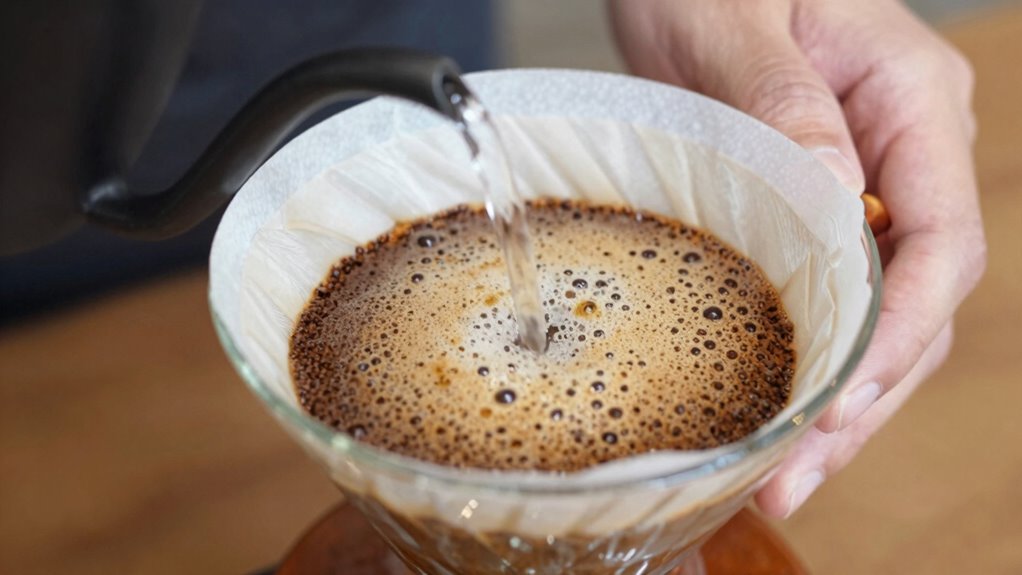
Watch how the coffee bloom expands during the initial pour, paying attention to its size and shape. Note how the timing of the bloom changes with different grind sizes and pouring techniques. This observation helps you identify the right moment to start your pre-infusion. Additionally, understanding technological integration in brewing tools can support more precise timing and consistency. Recognizing the history of brewing innovations can also inform your approach to timing and technique. Incorporating halal-certified brewing equipment can further enhance the reliability and safety of your brewing process. Modern electric brewing systems offer advanced features that can assist in achieving more accurate pre-infusion timing, especially when combined with smart technology for improved control.
Watch Bloom Expansion
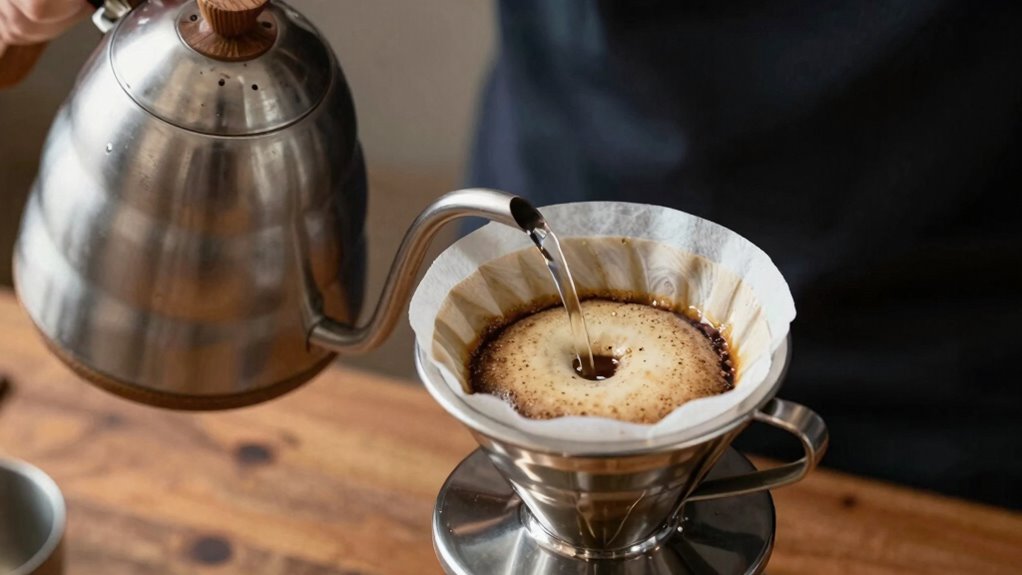
As the coffee begins to bloom, you’ll notice a rapid expansion of bubbles and a frothy surface forming on the grounds. This is the flowering phase, where gases escape and the coffee starts releasing trapped carbon dioxide. Pay close attention to how quickly the bloom expands; a faster expansion often indicates a coarser grind, while a slower one suggests a finer grind. The goal is to observe a steady, even bloom without excessive bubbling or slow progression. Watching the bloom helps you identify the right starting point for your pre-infusion, ensuring consistent extraction. By understanding how the bloom expands, you can adjust your grind size or pour timing to optimize flavor and achieve a balanced brew. This visual cue is your guide for precise, confident pre-infusion timing. Additionally, recognizing the natural processes occurring during bloom can help you better interpret the visual signals and refine your brewing technique.
Note Timing Changes
Paying close attention to how the bloom expands allows you to identify the most favorable timing for your pre-infusion. As you observe the coffee, note any timing changes like slower or quicker bloom development. These shifts can indicate how your bean storage affects extraction or if your grinder calibration needs adjustment. To refine your process:
- Track the bloom’s expansion rate over multiple attempts to notice patterns.
- Adjust your grinder calibration if bloom timing consistently varies, ensuring uniform grind size.
- Reassess bean storage—moisture or age can influence bloom behavior, requiring timing tweaks.
Simple Tests to Discover Your Ideal Pre-Infusion Duration
To find your ideal pre-infusion duration, simple tests can provide clear insights. Start by adjusting pre-infusion times and tasting your coffee. Focus on flavor balance and aroma enhancement; slight changes can make a big difference. Record each trial’s duration and results. Use the following table to compare options:
| Duration (seconds) | Flavor Profile | Aroma Enhancement |
|---|---|---|
| Short | Bright, acidic | Mild aroma |
| Moderate | Well-rounded, balanced | Rich aroma |
| Long | Over-extracted, bitter | Intense aroma |
Repeat tests, noting which timing offers the best flavor and aroma. This process helps you identify when pre-infusion optimizes your coffee’s full potential without guesswork.
How to Set a Reliable Pre-Infusion Routine Without Guesswork
Establishing a reliable pre-infusion routine guarantees guesswork and secures consistent coffee quality. To achieve this, focus on creating a routine that promotes flavor balance and extraction consistency every time. Here are three key steps:
- Standardize your pre-infusion time: Use a set duration based on your beans and equipment, avoiding guesswork and maintaining flavor clarity.
- Maintain consistent water temperature: Hot water aids in even extraction, ensuring balanced flavors without over or under-extraction.
- Use a repeatable technique: Apply the same pressure and flow rate during pre-infusion to keep extraction consistent and prevent flavor discrepancies.
Adjusting Pre-Infusion Time Based on Beans and Equipment
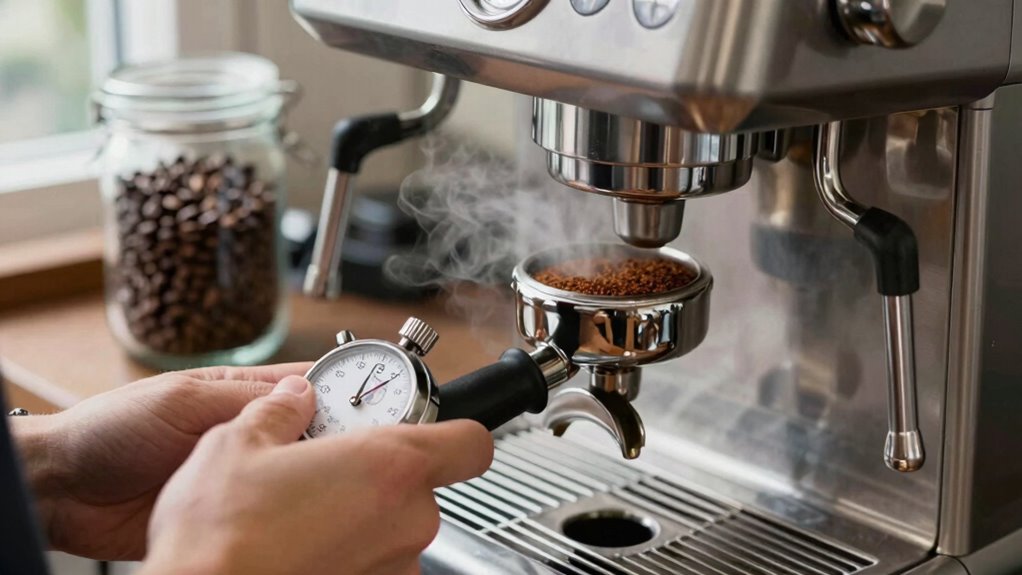
Adjusting pre-infusion time is essential because different beans and equipment respond uniquely to extraction parameters. Your bean selection influences how quickly water penetrates and extracts flavor—some beans require longer pre-infusion to release their full potential, while others need less time. Consistent grind size is equally critical; a uniform grind ensures even water flow, preventing under- or over-extraction during pre-infusion. If you’re using coarser beans or equipment with less pressure, extend the pre-infusion to allow proper saturation. Additionally, understanding the impact of pressure profiling can help you optimize pre-infusion settings for different machines. Recognizing how extraction variables interact with your equipment setup can further refine your process. Conversely, finer grounds or high-pressure machines might need shorter pre-infusion to avoid over-extraction. Pay attention to how your beans and machine behave, and adjust pre-infusion timing accordingly, guaranteeing optimal extraction without guesswork. Fine-tuning based on these factors leads to a more balanced, flavorful shot. Additionally, understanding how your specific brew method interacts with pre-infusion can help you tailor the process for the best possible results. Recognizing the importance of consistent technique can also help ensure reliable and satisfying brews over time.
Common Pre-Infusion Problems and How to Fix Them
Pre-infusion can sometimes lead to issues that affect the quality of your espresso shot. Common problems include uneven extraction, which results from inconsistent grind size, or water pressure that’s too high or too low. To fix these issues:
- Ensure grind consistency—use a burr grinder and adjust until particles are uniform, preventing uneven flow. Proper grind size is crucial for a balanced extraction.
- Check water pressure—aim for steady, moderate pressure; too much can cause over-extraction, too little results in under-extraction.
- Observe your pre-infusion time—adjust it based on your machine’s response, making sure water saturates the grounds evenly without rushing or stalling.
- Maintain proper tool and accessory to ensure your setup supports consistent extraction and reduces variability. Regularly inspecting and cleaning your equipment can also prevent common issues.
Frequently Asked Questions
Can Pre-Infusion Timing Vary Between Different Coffee Brewing Methods?
Yes, pre-infusion timing can vary between different brew methods due to pre infusion variation. For example, pour-over methods may require a shorter pre-infusion to avoid over-extraction, while espresso often benefits from a longer pre-infusion to evenly saturate the grounds. You should adjust your pre-infusion timing based on your specific brew method, paying attention to the coffee’s response to guarantee ideal extraction and flavor development.
How Does Ambient Temperature Influence Pre-Infusion Timing Decisions?
Ambient temperature can substantially influence your pre-infusion timing decisions. When it’s cold, your coffee may take longer to extract, risking uneven infusion, while warm environments accelerate extraction, risking over-extraction. Adjust your pre-infusion duration to maintain infusion consistency, considering the ambient temperature. By doing so, you guarantee your brew remains balanced, regardless of external conditions, turning unpredictable environments into an opportunity for precise control.
Is There an Optimal Pre-Infusion Duration for Specialty Coffee Beans?
You should aim for a pre-infusion duration of about 10 to 15 seconds for specialty coffee beans. Fresh beans often require slightly longer pre-infusion to fully develop flavors, while grind size influences how quickly water penetrates. If your grind is finer, reduce the pre-infusion time slightly to avoid over-extraction. Adjust based on taste, but generally, this range helps unleash the best flavors without overdoing it.
How Do I Calibrate My Grinder for Consistent Pre-Infusion Results?
To calibrate your grinder for consistent pre-infusion results, start by adjusting the grind size until you get a steady, even extraction. Use consistency tips like weighing your beans and maintaining the same dose each time. Run test shots and note any variations in flow or flavor. Fine-tune your grinder in small increments, then record your settings. Regular calibration guarantees reliable, repeatable pre-infusion performance every time.
Can Pre-Infusion Timing Affect Extraction and Flavor Balance?
Sure, pre-infusion timing can totally make or break your flavor balance and extraction, even if it feels like a small detail. By dialing in consistent pre-infusion, you guarantee even flavor extraction and prevent over- or under-extraction. Ironically, rushing or guessing can lead to inconsistent results, so take the time to fine-tune your timing. This small tweak assures your coffee’s flavor profile stays balanced and delicious every single time.
Conclusion
Now that you know how to observe, test, and adjust your pre-infusion timing, your perfect cup is within reach. But remember, every bean and machine is different—small tweaks can make a big difference. Are you ready to experiment and reveal new flavors? The secret to mastering pre-infusion is just a step away. Keep refining, stay curious, and watch as your coffee transforms before your eyes. The next great sip is waiting—are you prepared to find it?