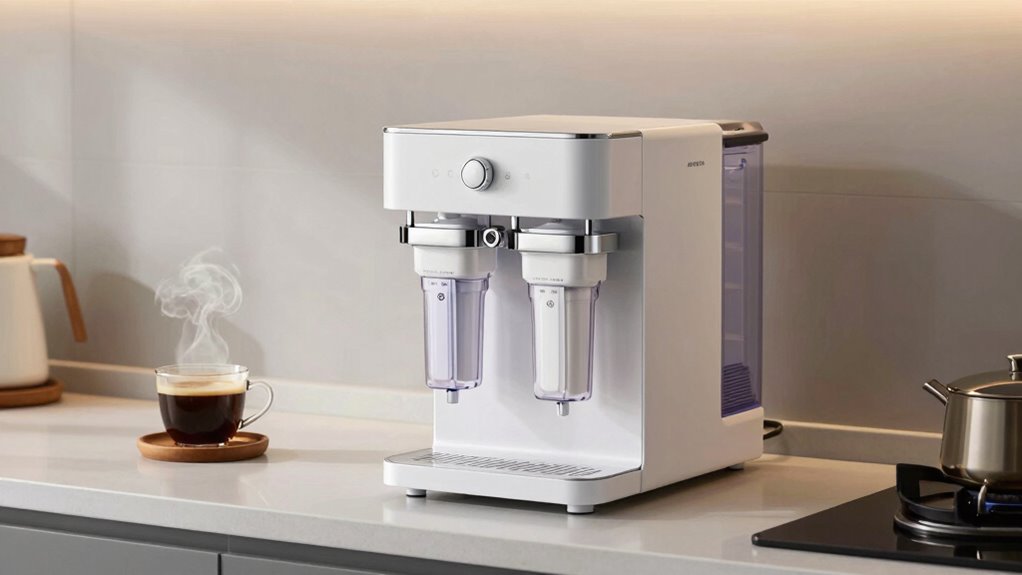
For a reverse osmosis system for coffee under $500, my best overall pick is the iSpring RO5004F-AK for its tankless design, UV treatment, and alkaline remineralization. The Waterdrop T3-T is a strong alternative for buyers who want remineralization in a faster-flow system, while the Bluevua RO100ROPOT suits renters who prefer countertop placement over plumbing work. The main tradeoffs are mineral control versus convenience, along with flow rate, installation demands, and ongoing filter upkeep. Coffee brewing also depends on the water’s mineral content, so a system that strips nearly everything may call for a separate mineral strategy. Read on for how these 15 options compare and which setup best fits your kitchen and coffee routine.

Get kitchen gear delivered free with Prime
- Fast, free delivery on millions of items
- Prime Video, Amazon Music and more included
- Member-only deals all year
Complete the kit


Key Takeaways
- The iSpring RO5004F-AK stands out as the most balanced under-sink option in this lineup, combining tankless filtration with UV treatment and alkaline remineralization.
- Several Waterdrop models offer higher stated production capacities, but flow figures alone do not tell you how quickly a cup is ready or whether the system suits your installation.
- Countertop choices such as the Bluevua RO100ROPOT and Waterdrop M6SL avoid under-sink plumbing, trading a simpler setup for counter space and hands-on water handling.
- The APEC ROES-50 and the tanked five-stage system favor conventional storage-based filtration over high-capacity tankless designs, which can suit buyers who prioritize a familiar setup.
- Coffee-focused buyers should compare remineralization options and water profile needs, not just filtration stages: RO water can taste flat when brewed without suitable minerals.



| reverse osmosis system for coffee under 500 | Dimensions | Pure-to-drain ratio |
|---|---|---|
| iSpring RO5004F-AK UV Alkaline | 15.2 × 6.1 × 16.6 inches | — |
| Waterdrop T3-T Remineralizatio | 12.6 × 6.1 × 14.69 inches | 2:1 |
| SimPure T2-600T UV Reverse Osm | 15.5 × 5.3 × 16.3 inches | — |
| Waterdrop G2 Reverse Osmosis S | 17.3 × 5.9 × 14 inches | 1:1 |
| Waterdrop M6SL Mineral Reverse | 15.9 × 9.3 × 14.5 inches | 3:1 |
| Bluevua RO100ROPOT Countertop | 10.9 x 15.4 x 14.3 inches | — |
| Waterdrop G5P500A Reverse Osmo | 16.69 x 5.69 x 13.9 inches | 2:1 |
| GLACIER FRESH GFU03 Electric-F | 13.58 x 8.27 x 16.54 inches | 3:1 |
| UV Reverse Osmosis System | — | 2:1 |
| Waterdrop G6A6 Compact Alkalin | 15.94 x 5.31 x 9.61 inches | 2:1 |
| APEC Water ROES-50 5-Stage Und | 15.5 × 5.25 × 17 in | — |
| [Dual Flow] Waterdrop WD-T4-A | 16.54 × 6.22 × 17.95 in | 2:1 |
| Waterdrop G3P600 Tankless Reve | 18.12 × 5.67 × 17.72 in | 2:1 |
| Philips Tankless Reverse Osmos | 12.3 × 4.3 × 15.8 in | — |
| 5-Stage Reverse Osmosis System | 19 × 18 × 16 in | — |
More Details on Our Top Picks
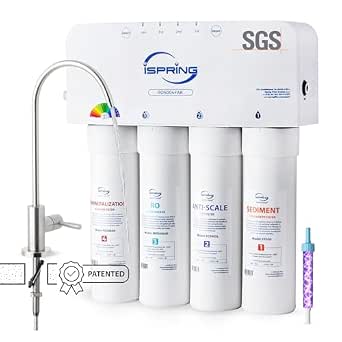
iSpring RO5004F-AK UV Alkaline Reverse Osmosis Water Filter, 500 GPD Tankless Remineralization System, Under Sink, Filter Life Monitor
For coffee drinkers who want remineralized RO water plus an extra treatment stage, the iSpring RO5004F-AK combines UV treatment, a filter-life monitor, and a tankless design. Its stated 500 GPD capacity is more than enough for regular brewing and household drinking-water demand, while the added minerals offer a taste-oriented alternative to near-zero-TDS water. Compared with the Waterdrop G2, this iSpring adds UV and remineralization, but the G2 has a stated 1:1 pure-to-drain ratio and a simpler twist-and-pull filter change. That makes the iSpring a better fit for buyers prioritizing treatment features over straightforward maintenance. The tradeoff is a more involved setup, with professional installation recommended, and the UV lamp has a finite service life. Coffee drinkers should also note that remineralization changes the water profile; it is not a guarantee of a particular brew taste.
Pros:- Remineralization gives coffee water a different taste profile from near-zero-TDS RO output.
- Built-in UV adds a treatment stage beyond reverse osmosis.
- Tankless format uses less under-sink space than a traditional storage-tank system.
- Filter-life monitor helps track when maintenance is due.
Cons:- Complex setup may call for professional installation.
- The UV lamp has a stated lifespan limit of up to 8,000 hours.
- Remineralization may not suit buyers who prefer low-mineral water for brewing.
Best for: Coffee drinkers who want an under-sink tankless system with remineralization, UV treatment, and a filter-life monitor.
Not ideal for: Renters or hands-off buyers who cannot accommodate a complex under-sink installation or UV lamp upkeep.
- Flow rate:500 GPD
- Filtration:Reverse osmosis and ultraviolet
- Remineralization:Yes
- Design:Tankless, under-sink
- Dimensions:15.2 × 6.1 × 16.6 inches
- Weight:15 pounds
- Filter-life monitor:Yes
Our verdict“Choose the iSpring if you want remineralized RO water with UV treatment and can manage a more involved under-sink installation.”
Waterdrop T3-T Remineralization Reverse Osmosis System, 220 GPD Faster Flow
The Waterdrop T3-T suits coffee drinkers who want an under-sink RO system without giving up the taste contribution of minerals. Its seven-stage filtration and potassium, calcium, sodium, and magnesium remineralization make it a more taste-focused pick than the Waterdrop G2, which emphasizes tankless output and a 1:1 pure-to-drain ratio rather than mineral addition. The T3-T’s 220 GPD flow rating is ample for routine household brewing, though it is below the 400 GPD G2 and far below the 600 GPD SimPure T2-600T. Its compact 12.6-inch length can help in tighter cabinets, and the 2:1 pure-to-drain ratio gives buyers a stated efficiency figure to compare. The all-in-one filter design simplifies changes, but filter life varies from six to 24 months, and faucet installation requires countertop drilling.
Pros:- Adds potassium, calcium, sodium, and magnesium to the filtered water.
- Compact under-sink dimensions can suit a crowded cabinet.
- All-in-one replacement design makes filter changes simpler.
- Stated 2:1 pure-to-drain ratio supports comparison with less efficient systems.
Cons:- 220 GPD is lower than the listed output of the Waterdrop G2 and SimPure T2-600T.
- Faucet installation requires drilling a countertop hole.
- Filter replacement intervals vary by cartridge, from six to 24 months.
Best for: Home coffee brewers with limited cabinet space who want remineralized RO water and manageable filter changes.
Not ideal for: Households seeking the highest stated output, or renters unable to drill for the dedicated faucet.
- Flow rate:220 GPD
- Filtration stages:7
- Remineralization:Potassium, calcium, sodium, and magnesium
- Pure-to-drain ratio:2:1
- Maximum TDS:500 ppm
- Dimensions:12.6 × 6.1 × 14.69 inches
- Operating pressure:43.5–87 psi
- Filter life:CF: 6 months; CBM: 12 months; TRO: 24 months
Our verdict“Pick the T3-T for compact under-sink installation and mineralized coffee water, not for maximum flow or a no-drill setup.”
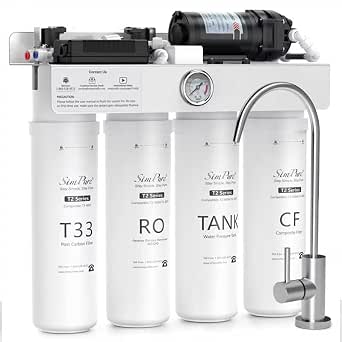
SimPure T2-600T UV Reverse Osmosis Water Filter 600 GPD Built-in Tank
The SimPure T2-600T is the high-output choice here, with a stated 600 GPD capacity, UV sterilization, and a built-in pressure tank intended to support steadier delivery. For households that brew repeatedly throughout the day, that combination is more compelling than the Waterdrop T3-T, whose 220 GPD rating and remineralization make it better suited to moderate use and taste customization. The SimPure instead emphasizes near-zero-TDS output, so it may appeal to coffee drinkers who want a low-mineral starting point and plan to adjust brew water separately. Tool-free filter replacement can reduce maintenance friction, but it does not erase the added complexity of under-sink installation or UV upkeep. Its listed 0.42 gpm maximum flow gives a more practical reference than the headline daily capacity alone, and buyers should check cabinet space before choosing it.
Pros:- Stated 600 GPD capacity suits higher household demand.
- Built-in pressure tank is intended to support steadier water delivery.
- UV sterilization adds another treatment method.
- Tool-free filter replacement can simplify routine servicing.
Cons:- Under-sink installation and initial setup may be demanding.
- UV treatment adds another component to maintain.
- Near-zero-TDS output does not provide the remineralization offered by the iSpring RO5004F-AK or Waterdrop T3-T.
Best for: Busy households that brew multiple pots or make frequent drinks and prefer low-TDS RO water with UV treatment.
Not ideal for: Small kitchens with little under-sink clearance, or buyers who specifically want remineralized water without additional water adjustment.
- Flow rate:600 GPD
- Maximum flow:0.42 gpm
- Purification:Reverse osmosis and ultraviolet
- Supported maximum TDS:500 ppm
- Installation:Under sink
- Dimensions:15.5 × 5.3 × 16.3 inches
- Standard:NSF 58
- Filter replacement:Tool-free
Our verdict“Choose the SimPure for high-volume, low-TDS water and UV treatment if you have room for installation and are prepared to maintain the system.”
Waterdrop G2 Reverse Osmosis System, 400 GPD Tankless RO Water Filtration
The Waterdrop G2 earns its place for coffee drinkers who want tankless RO filtration with a stated 1:1 pure-to-drain ratio and quick, twist-and-pull filter changes. At 400 GPD, its listed capacity sits between the Waterdrop T3-T and the higher-output SimPure T2-600T, making it a practical middle ground for regular home brewing. Unlike the T3-T and iSpring RO5004F-AK, the G2 does not list remineralization, so its appeal is a simpler, low-mineral output profile rather than mineral-adjusted taste. The stated NSF/ANSI 372 certification covers lead-free materials, not a blanket claim about every contaminant or coffee performance. Its tankless build saves cabinet room compared with tank-based designs, but operation needs an under-sink electrical outlet and faucet installation requires drilling. Buyers also need to stick with its specified replacement filters.
Pros:- Stated 1:1 pure-to-drain ratio is more efficient than many conventional RO configurations.
- Tankless design frees cabinet space otherwise used by a storage tank.
- Twist-and-pull filter changes are designed for quick replacement.
- 400 GPD rating provides a middle ground between the T3-T and 600 GPD systems.
Cons:- Requires a powered under-sink electrical outlet.
- Faucet installation requires drilling.
- Uses specified G2CF and G2MRO replacement filters and does not list remineralization.
Best for: Coffee drinkers who want a tankless under-sink RO system, efficient stated drainage, and straightforward cartridge changes.
Not ideal for: Renters without permission to drill or buyers who want remineralized water, UV treatment, or an outlet-free installation.
- Flow rate:400 GPD
- Filtration stages:7
- Pure-to-drain ratio:1:1
- Certification:NSF/ANSI 372
- Design:Tankless, under-sink
- Dimensions:17.3 × 5.9 × 14 inches
- Operating pressure:14.5–87 psi
- Warranty:1 year manufacturer
Our verdict“Choose the G2 if you want an efficient, tankless RO system for everyday brewing and do not need remineralization or UV.”
Waterdrop M6SL Mineral Reverse Osmosis Water Filter Countertop
The Waterdrop M6SL is the most flexible choice for coffee drinkers who cannot or do not want to install an under-sink unit. This countertop RO system needs no plumbing connection and includes a detachable glass pitcher, five preset volumes, and mineral addition—features that separate it from the under-sink Waterdrop G2, which offers a higher stated daily flow but requires an outlet, drilling, and cabinet space. The M6SL’s 3:1 pure-to-drain ratio is a stated advantage for a countertop unit, while its 185-ounce tank capacity reduces how often the feed reservoir needs filling. The tradeoff is hands-on operation: someone must refill that reservoir, and the 40-ounce pitcher may need repeated filling for larger brewing sessions. Its footprint is also substantial for a countertop, and glass calls for careful handling.
Pros:- Installation-free format works where under-sink plumbing changes are not practical.
- Mineral addition can provide a taste profile different from near-zero-TDS RO water.
- Detachable glass pitcher avoids relying on a plastic serving pitcher.
- Stated 3:1 pure-to-drain ratio and five volume presets support convenient daily use.
Cons:- Feed-water tank requires manual filling.
- Countertop footprint is larger than many compact appliances.
- Glass pitcher can break and holds 40 ounces, which may require multiple fills for larger batches.
Best for: Renters, office users, and RV owners who want mineralized RO water without plumbing or permanent installation.
Not ideal for: Households with limited counter space, high-volume brewing needs, or no interest in regularly refilling a feed-water tank.
- Filtration stages:8
- Purification:Reverse osmosis
- Tank capacity:185 oz (135 oz tap water / 50 oz waste)
- Pure-to-drain ratio:3:1
- Pitcher:40 oz detachable glass
- Dimensions:15.9 × 9.3 × 14.5 inches
- Certifications:NSF/ANSI 58; NSF/ANSI/CAN 372
- Filter life:12 months
Our verdict“Pick the M6SL if a no-plumbing countertop system matters more than an under-sink unit’s continuous convenience and smaller visible footprint.”
Bluevua RO100ROPOT Countertop Reverse Osmosis Water Filter System
The Bluevua RO100ROPOT is the easiest fit here for renters or anyone who wants RO water near a coffee setup without changing plumbing. Its countertop format needs no installation, and the borosilicate glass carafe gives you a dedicated vessel for brewing water rather than routing it through a new faucet. Five-stage filtration includes remineralization, a useful distinction for coffee drinkers who want more than very low-mineral RO water. Compared with the under-sink Waterdrop G5P500A, though, it trades fast, continuous dispensing for portability and a simpler setup: its listed flow rate is only 0.26 liters per minute. The 12-liter capacity and filter monitor add convenience, but the footprint is substantial for a countertop unit, and replacement-filter costs are not specified. Choose it for a compact household or coffee corner, not heavy simultaneous demand.
Pros:- No plumbing or permanent installation is required, making it easier to use in rentals.
- Borosilicate glass carafe provides a dedicated water container for coffee preparation.
- Five-stage filtration includes remineralization, unlike RO systems that provide no stated mineral-restoration stage.
- Filter-life monitor helps track maintenance.
Cons:- The 0.26-liter-per-minute maximum flow rate can make repeated brewing or filling slow.
- Its 10.9-by-15.4-by-14.3-inch footprint uses meaningful counter space.
- Filter replacement costs and exact replacement intervals are not detailed in the supplied specifications.
Best for: Renters, apartment dwellers, and coffee-focused households that want remineralized RO water without under-sink installation.
Not ideal for: Large households or anyone who needs rapid, continuous filling; its stated flow rate is modest and the countertop unit takes up space.
- Installation:Countertop
- Purification method:Reverse osmosis
- Filtration:5 stages with remineralization
- Maximum flow rate:0.26 liters per minute
- Capacity:12 liters
- Maximum supported TDS:1000 PPM
- Dimensions:10.9 x 15.4 x 14.3 inches
- Carafe material:Borosilicate glass
Our verdict“Pick the Bluevua if you want a no-plumbing countertop RO option with remineralization for a personal coffee station, and skip it if speed or counter space matters most.”
Waterdrop G5P500A Reverse Osmosis System, 8-Stage RO Filtration, Alkaline
For a coffee routine that uses several pots or serves a busy household, the Waterdrop G5P500A prioritizes quick access over portability. Its listed 500 GPD capacity and 1.31-liter-per-minute maximum flow rate make filling a kettle or carafe less of a wait than with the countertop Bluevua RO100ROPOT. Eight-stage filtration includes an RO membrane and alkaline mineralization, so it is better aligned with buyers who want mineral-restored water after filtration. The tankless body also saves cabinet space compared with traditional tank systems, though this is still an under-sink installation: the faucet requires a drilled countertop hole. Its 2:1 pure-to-drain ratio is useful, but the product needs electricity and plumbing connections, unlike the GLACIER FRESH GFU03. Coffee flavor depends on the source water and recipe, so the alkaline stage is not a guarantee of a preferred cup profile.
Pros:- High stated flow capacity supports frequent kettle and carafe filling.
- Alkaline mineralization adds minerals after RO filtration for buyers who prefer remineralized brewing water.
- Tankless design uses less under-sink space than a separate storage-tank setup.
- The 2:1 pure-to-drain ratio limits wastewater compared with less efficient ratios.
Cons:- Faucet installation requires drilling a countertop hole, which may rule it out for rentals.
- Requires an electrical connection and under-sink plumbing work.
- Its alkaline mineral profile may not match every coffee recipe or water preference.
Best for: Busy households that brew coffee frequently and want fast, remineralized RO water from a dedicated under-sink faucet.
Not ideal for: Renters or DIY-averse buyers who cannot drill for a faucet or connect a powered under-sink system.
- Installation:Under sink
- Filtration:8 stages with alkaline mineralization
- RO membrane precision:0.0001 μm
- Maximum flow rate:1.31 liters per minute
- Pure-to-drain ratio:2:1
- Dimensions:16.69 x 5.69 x 13.9 inches
- Power source:Corded electric
Our verdict“Choose the G5P500A for quick, high-volume under-sink dispensing with mineralization, provided you can accommodate the installation and power requirements.”
GLACIER FRESH GFU03 Electric-Free Reverse Osmosis Water Filter 800 GPD
The GLACIER FRESH GFU03 is the distinctive choice for buyers who want an under-sink RO system without an electrical connection. Its water-powered design runs quietly, while its 3:1 pure-to-drain ratio produces less wastewater than the 2:1 ratios listed for the Waterdrop G5P500A and G6A6. The stated 800 GPD capacity and 0.6-gallon-per-minute flow rate suit households that fill several coffee vessels, although real output depends on inlet pressure; the listing recommends at least 40 PSI. Unlike the countertop Bluevua, installation is not optional: this system needs an under-sink connection and a drilled faucet hole. Its five-stage setup has no stated remineralization stage, which may matter to coffee drinkers who want minerals restored after RO filtration. Pick it for quiet, water-efficient operation, not for a plug-and-play or mineral-tuned coffee setup.
Pros:- Water-powered operation avoids an electrical connection and operating noise.
- The stated 3:1 pure-to-drain ratio is more water-efficient than the 2:1 ratios listed for several alternatives here.
- 800 GPD capacity and a 0.6-gallon-per-minute maximum flow rate support repeated filling.
- Pull-out cartridges are designed for quick replacement.
Cons:- The listed flow rate depends on inlet pressure, with at least 40 PSI recommended.
- Installation requires under-sink plumbing and drilling a faucet hole.
- No remineralization stage is specified, so buyers seeking mineral-restored water should compare it with the Bluevua or Waterdrop alkaline models.
Best for: Homeowners seeking a high-capacity, non-electric under-sink system with a better stated pure-to-drain ratio for regular coffee and household use.
Not ideal for: Renters, low-pressure homes, and coffee drinkers specifically seeking post-RO mineral restoration.
- Installation:Under sink
- Power:Water-powered; no electric drive
- Filtration:5 stages
- RO membrane precision:0.0001 μm
- Maximum flow rate:0.6 gallons per minute
- Pure-to-drain ratio:3:1
- Dimensions:13.58 x 8.27 x 16.54 inches
Our verdict“The GFU03 suits buyers who value quiet, electricity-free operation and lower stated wastewater, but not those who need countertop portability or mineralized RO water.”
UV Reverse Osmosis System, Stainless Steel 500GPD RO Water Filter
This stainless steel 500 GPD system stands apart from the plastic-bodied Waterdrop G5P500A and G6A6 through its listed metal construction. That may appeal to buyers who prioritize a more robust-feeling under-sink unit, while the tankless layout keeps a storage tank out of the cabinet. Its eight-stage process includes alkaline remineralization, making it more directly suited to those who want mineral-restored water for coffee than the five-stage GLACIER FRESH GFU03. The stated 0.26 GPM flow rate is less brisk than the G5P500A’s listed maximum, so high-volume brewing may take longer than the 500 GPD headline suggests. Installation requires under-sink space and power, and the filter schedule varies by cartridge: some need replacement in six to eight months, while the RO membrane is listed for 12 to 24 months. The supplied data does not identify a UV stage despite the product title.
Pros:- Stainless steel construction differentiates it from the plastic-material descriptions for the Waterdrop under-sink models.
- Eight-stage filtration includes alkaline remineralization for buyers who prefer mineral-restored water.
- Tankless design avoids a separate storage tank beneath the sink.
- A 2:1 pure-to-drain ratio is specified.
Cons:- The listed 0.26 GPM flow rate is slower than the G5P500A’s stated maximum flow rate.
- It requires under-sink installation and a power source.
- The title mentions UV, but the supplied description and specifications do not detail a UV stage.
Best for: Homeowners who want a tankless under-sink RO system with alkaline remineralization and a stainless steel exterior.
Not ideal for: Buyers who need a verified UV feature, want an easy countertop setup, or prioritize the fastest stated dispensing rate.
- Model:OM-ROF03
- Installation:Under sink
- Filtration:8 stages, including alkaline remineralization
- Flow rate:0.26 GPM
- Pure-to-drain ratio:2:1
- Material:Stainless steel
- Filter lifespan:PP: 6–8 months; CTO and ALK: 12 months; RO: 12–24 months
Our verdict“Consider this model if stainless steel construction and alkaline remineralization matter more than a faster listed flow rate or a clearly documented UV feature.”
Waterdrop G6A6 Compact Alkaline Mineral Reverse Osmosis System, 600 GPD
If cabinet space is the deciding factor, the Waterdrop G6A6 is the most targeted fit in this group: its listed dimensions are only 15.94 x 5.31 x 9.61 inches, and the design is described as saving up to 81.8% of under-sink space. It also increases rated output to 600 GPD, compared with the G5P500A’s 500 GPD, while retaining an 8-stage process, alkaline mineral infusion, and a 2:1 pure-to-drain ratio. That combination makes it a stronger cabinet-space choice than the larger Bluevua countertop unit, but it does not offer the Bluevua’s portability or glass carafe. Filter upkeep is the main compromise: the mineral filter is listed for replacement every six months, much sooner than the RO filter’s 24-month interval. The supplied specifications also do not state a flow rate in liters or gallons per minute, so GPD alone does not settle filling speed.
Pros:- Compact 15.94 x 5.31 x 9.61-inch dimensions help fit tighter cabinets.
- 600 GPD rated output exceeds the G5P500A’s stated 500 GPD capacity.
- Eight-stage filtration includes a mineral infusion layer and a stated pH around 7.5.
- The 2:1 pure-to-drain ratio and twist-and-pull filter design support efficient operation and maintenance.
Cons:- The mineral filter is listed for replacement every six months, adding recurring upkeep.
- The product is an under-sink installation, unlike the no-installation Bluevua countertop option.
- A maximum flow rate is not supplied, making direct comparison of dispensing speed harder.
Best for: Homeowners with crowded under-sink cabinets who want a compact tankless RO system and mineralized water for coffee.
Not ideal for: Buyers avoiding recurring filter changes or anyone who needs a portable system that does not require under-sink installation.
- Installation:Under sink
- Filtration:8 stages with mineral infusion
- Dimensions:15.94 x 5.31 x 9.61 inches
- Pure-to-drain ratio:2:1
- RO filter lifespan:24 months
- Mineral filter lifespan:6 months
- Certifications and testing:IAPMO R&T, NSF/ANSI/CAN 372, SGS tested
Our verdict“Choose the G6A6 when cabinet clearance is tight and you want mineralized RO water, but account for the six-month mineral-filter replacement schedule.”
APEC Water ROES-50 5-Stage Under Sink Reverse Osmosis System 50 GPD
The APEC ROES-50 is the straightforward choice here for buyers who want reverse-osmosis water for coffee without relying on an electrical outlet under the sink. Its 50 GPD rating is modest beside the tankless Waterdrop G3P600, but the included storage tank holds treated water ready for use, so the rated production speed matters less for occasional coffee brewing than it might for a busy household. APEC describes removal of common impurities including chlorine, lead, fluoride, and arsenic; reducing chlorine can help avoid tap-water flavors that distract from coffee. The tradeoff is a conventional, plastic under-sink setup with a six-month filter cycle and a slow stated flow rate. Choose this over the G3P600 for a simpler, non-electric arrangement; skip it if you need rapid, high-volume dispensing or a tankless footprint.
Pros:- Five-stage RO filtration is described as reducing chlorine, lead, fluoride, arsenic, and other impurities that can affect water taste.
- Includes a storage tank, filter set, and installation components for a complete under-sink setup.
- Quick-connect fittings make the system more approachable for DIY installation.
- Does not list an electrical connection as a requirement, unlike the tankless Waterdrop G3P600.
Cons:- The stated 0.03 gpm flow rate is slow for filling multiple vessels in quick succession.
- Filters require replacement every six months.
- Plastic construction and a tank take up cabinet space and may feel less robust than a compact tankless unit.
Best for: Coffee drinkers who want an under-sink RO system with a storage tank and no stated electrical requirement.
Not ideal for: High-volume households or buyers short on cabinet space who want fast, tankless dispensing and fewer storage components.
- Filtration stages:5
- Daily production capacity:50 gallons
- Flow rate:0.03 gpm
- Maximum feed-water TDS:2000 ppm
- Operating pressure:40–85 psi
- Water temperature range:40–100°F
- Dimensions:15.5 × 5.25 × 17 in
- Filter life cycle:6 months
Our verdict“Choose the APEC ROES-50 if you want tank-buffered, non-electric RO water for home coffee and can accept slower dispensing and regular filter changes.”
[Dual Flow] Waterdrop WD-T4-A Alkaline pH+ Reverse Osmosis Water Filter, 10-Stage, 450GPD Tankless Undersink RO Filtration System
Waterdrop WD-T4-A Alkaline pH+ Reverse Osmosis Water Filter, 10-Stage, 450GPD Tankless Undersink RO Filtration System” image=”https://m.media-amazon.com/images/I/41Sikz7z1SL._SX342_SY445_QL70_ML2_.jpg” link=”0″]Best for Choosing Between RO and Mineralized Water
View on AmazonThe Waterdrop WD-T4-A is the lineup’s clearest fit for coffee drinkers who want to compare plain RO water with a mineral-enhanced option from the same system. Its dual-flow design supplies both streams, giving you a practical way to choose which water suits brewing and which you prefer for drinking. That flexibility is unusual beside the single-output APEC ROES-50, while the tankless design and stated 450 GPD capacity favor frequent use and preserve cabinet space. The tradeoffs are installation demands: it needs under-sink power, and the faucet requires a countertop hole. The listing gives a 2:1 pure-to-drain ratio and filter reminders, but does not provide the same detailed flow-rate specification as the Waterdrop G3P600. Pick it for selectable water profiles, not for a simpler installation.
Pros:- Dual-flow output lets buyers choose between standard RO water and a mineral-enhanced alkaline stream.
- Tankless design saves under-sink space compared with the tank-based APEC ROES-50.
- 450 GPD capacity and a stated 2:1 pure-to-drain ratio suit regular household use.
- Filter reminders and specified replacement intervals help make upkeep more predictable.
Cons:- Requires an electrical connection under the sink.
- Faucet installation requires drilling a countertop hole.
- The provided product information does not specify a flow rate, making direct dispensing-speed comparisons difficult.
Best for: Coffee enthusiasts who want separate RO and mineral-enhanced alkaline water streams and have an outlet and faucet-drilling access.
Not ideal for: Renters or DIY beginners who cannot drill a countertop or add an under-sink electrical connection.
- Filtration stages:10
- Daily production capacity:450 gallons
- Pure-to-drain ratio:2:1
- Design:Tankless, under-sink
- Dimensions:16.54 × 6.22 × 17.95 in
- Weight:10.98 kg
- CF filter replacement interval:6 months
- RO membrane replacement interval:24 months
Our verdict“Pick the WD-T4-A if you want the flexibility to brew with either standard RO or mineral-enhanced water and can accommodate its electrical and drilling requirements.”
Waterdrop G3P600 Tankless Reverse Osmosis Water Filter System, 600 GPD
For households brewing several pots or regularly filling kettles, the Waterdrop G3P600 offers a stronger throughput case than the 50 GPD APEC ROES-50. Its 600 GPD rating, stated 0.42 gpm maximum flow, and claim of filling an eight-ounce cup in eight seconds point to less waiting at the dedicated faucet. Third-party certifications listed for TDS reduction, chlorine taste and odor, and lead-free materials give this model a clearer specification trail than the Philips system’s supplied details. A smart faucet reports TDS and filter life, useful for tracking water and upkeep, though a TDS reading does not identify every contaminant. The costs in convenience are an under-sink power requirement and a taller, more complex setup than a basic tank system. Choose it for quick access and monitoring, not for a non-electric installation.
Pros:- 600 GPD capacity and a stated 0.42 gpm maximum flow support frequent kettle and coffee-water filling.
- NSF/ANSI 58, 42, and 372 certifications are listed for specific performance and material claims.
- Smart faucet displays TDS information and filter-life status.
- Tankless design saves cabinet space compared with the APEC ROES-50’s storage-tank arrangement.
Cons:- Requires an under-sink electrical connection.
- At 18.12 inches long and 17.72 inches high, it may not fit every cabinet.
- A displayed TDS value is not a complete measure of all water contaminants.
Best for: Busy coffee and tea households that want fast, on-demand RO water, a TDS display, and stated third-party certifications.
Not ideal for: Buyers without an under-sink outlet, or those who prefer a simpler tank-based installation with fewer electronic components.
- Filtration stages:8
- Daily production capacity:600 gallons
- Maximum flow rate:0.42 gpm
- Pure-to-drain ratio:2:1
- Maximum feed-water TDS:1500 ppm
- Operating pressure:87 psi
- Dimensions:18.12 × 5.67 × 17.72 in
- Certifications listed:NSF/ANSI 42, 58, and 372
Our verdict“Choose the G3P600 if fast, frequently available RO water and a monitoring faucet matter more than avoiding power and electronic installation requirements.”
Philips Tankless Reverse Osmosis System, 600 GPD, Self-Cleaning RO System
The Philips Tankless RO System stands out for fitting a high-capacity design into a smaller stated footprint than the Waterdrop G3P600: it measures 12.3 × 4.3 × 15.8 inches, which may leave more room for other items under the sink. Its 600 GPD rating and 0.41 gpm flow rate are close to the G3P600’s listed capacity and 0.42 gpm maximum, so the choice is less about headline speed than cabinet fit and maintenance features. Self-flushing is intended to help maintain membrane performance, while Aquaporin Inside technology is a distinct filtration approach. The product details supplied here offer fewer certification and contaminant-reduction specifics than Waterdrop’s listing, and the stated maximum feed-water TDS is only 500 ppm. It also needs power, and filters are sold separately.
Pros:- Compact stated dimensions make it smaller than the Waterdrop G3P600.
- 600 GPD capacity and 0.41 gpm flow rate support regular coffee and kettle use.
- Self-flushing feature is designed to help maintain membrane performance.
- 70% water recovery is specified.
Cons:- Requires an under-sink power outlet.
- Maximum stated feed-water TDS is 500 ppm, lower than the APEC ROES-50’s listed 2000 ppm limit.
- Replacement filters are sold separately, and the supplied details give less certification information than the Waterdrop G3P600 listing.
Best for: Coffee drinkers with limited under-sink space who want a high-capacity tankless system and have an electrical outlet nearby.
Not ideal for: Buyers whose feed water may exceed 500 ppm TDS, or those who want detailed certification claims and included replacement filters.
- Daily production capacity:600 gallons
- Flow rate:0.41 gpm
- Dimensions:12.3 × 4.3 × 15.8 in
- Weight:22 lb
- Water recovery:70%
- Maximum feed-water TDS:500 ppm
- Operating pressure:14.5–58 psi
- Self-flushing:Yes
Our verdict“Choose the Philips if cabinet space is tight and your feed water is within its stated TDS limit, but favor the G3P600 if certification detail is a higher priority.”
5-Stage Reverse Osmosis System, Under Sink Water Filter, WQA Gold Seal Certified NSF/ANSI 58 & 372
This five-stage system is the certification-focused, tank-based alternative in this group: its product data lists WQA Gold Seal and NSF/ANSI 58 and 372, plus a lead-content-certified faucet and wetted components. That gives buyers specific credentials to compare with the APEC ROES-50, whose supplied details emphasize contaminant reduction and DIY fittings instead. A tank, faucet, installation kit, and leak detector are included, so the package covers the main parts needed for an under-sink setup. For coffee, its purpose is familiar: RO treatment reduces dissolved solids and contaminants, while the supplied information does not describe mineral remineralization or a coffee-specific water profile. Its 50-gallon capacity is modest beside the tankless Waterdrop G3P600, and its 19 × 18 × 16-inch dimensions call for careful cabinet measurement.
Pros:- Product data lists WQA Gold Seal and NSF/ANSI 58 and 372 certifications.
- Includes a storage tank, faucet, installation kit, and leak detector.
- Lead-content-certified wetted components are specified.
- Twelve-month filter life is longer than the APEC ROES-50’s stated six-month cycle.
Cons:- 50-gallon capacity is far below the tankless Waterdrop G3P600’s 600 GPD rating.
- The 19 × 18 × 16-inch dimensions may take substantial under-sink space.
- Installation may require plumbing knowledge, and the provided details do not specify a flow rate.
Best for: Buyers who want a tank-based RO package with stated WQA and NSF/ANSI certifications, a leak detector, and included installation hardware.
Not ideal for: Households needing high daily throughput or small cabinets; its 50-gallon capacity and listed dimensions make it less suited to those needs.
- Filtration stages:5
- Capacity:50 gallons
- Certifications:WQA Gold Seal; NSF/ANSI 58 and 372
- Filter life cycle:12 months
- Dimensions:19 × 18 × 16 in
- Maximum feed-water TDS:1000 ppm
- Water temperature range:40–100°F
- Model number:V21RS5S01
Our verdict“Choose this system if listed certifications and an included leak detector matter more than compact dimensions or high-volume, fast dispensing.”

How We Picked
I ranked these systems for coffee use by weighing mineral strategy, practical usability, and installation fit rather than treating the largest gallon-per-day figure as an automatic win. Remineralization options matter because coffee extraction responds to water composition; tankless production claims, built-in storage, and countertop formats matter because they affect how a household gets water day to day. I also considered filtration design, stated certifications, monitoring or leak-related features where listed, and the likely burden of replacing filters.
The ranking favors products that pair a plausible coffee-water approach with useful everyday features and a clear fit for a buyer type. That puts the iSpring RO5004F-AK first as a balanced under-sink pick, while the Waterdrop T3-T and selected higher-capacity models appeal to buyers prioritizing flow or compactness. Countertop units rank for convenience rather than built-in kitchen integration; conventional tank systems remain relevant for buyers who prefer that format. Product names and specifications alone cannot establish a finished cup’s mineral profile, so I treat remineralization as a feature to investigate, not proof that the output matches every coffee recipe.
Factors to Consider When Choosing Reverse Osmosis System For Coffee Under 500
Choosing RO for coffee is less about collecting the most filtration stages and more about matching the system to your water, brewing habits, and kitchen. These broader checks can help you avoid paying for capacity you will not use or choosing an installation that complicates an otherwise simple coffee routine.
Start With the Water You Want in the Cup
Reverse osmosis reduces many dissolved substances, but coffee flavor depends on what remains as well as what is removed. If your source water is hard or has a strong taste, RO may be useful, yet very low-mineral water can produce a thin or unbalanced brew. Remineralization cartridges add convenience, but their output may not match the water profile you prefer for espresso or filter coffee. Check whether the system’s mineral stage can be bypassed or whether you can adjust the final water with a separate recipe. A common mistake is assuming an alkaline label guarantees ideal brewing water. If coffee consistency matters more than one-touch convenience, plan to check the finished water rather than relying on marketing terms alone.
Match Production and Storage to Your Coffee Routine
GPD is a production-capacity specification, not a promise that a full carafe appears instantly at the tap. Tankless units make water on demand, while tanked systems store treated water and can provide a ready supply when the tank is filled. A single coffee drinker may not need the same daily output as a household that also uses RO water for cooking and drinking. Think about how often you brew back-to-back pots and whether you can wait for production between uses. Do not pay extra for a high capacity figure without checking storage, stated flow, and household demand together. A countertop reservoir can be convenient, but it also needs regular refilling and a place to sit.
Choose a Format That Fits Your Kitchen and Permission to Install
Under-sink systems generally keep the counter clear, but they require cabinet space, plumbing connections, and often a dedicated faucet or compatible connection. Tankless designs may free room that a storage tank would occupy, yet still need power when the product specifies a plug-in connection. Countertop units reduce plumbing work and can suit renters, though they take up visible space and may involve manual filling. Before ordering, measure cabinet clearance and check outlet access, drain routing, and faucet-hole requirements. Buyers often focus on the filter body and overlook the space needed for tubing or replacement cartridges. If you cannot modify plumbing, a countertop model may be a better practical choice even if an under-sink system looks neater.
Treat Mineral Stages and Filter Replacements as a Long-Term Choice
Remineralization can make RO water more appealing for drinking and coffee, but it adds another consumable and another specification to track. Compare the replacement schedule and availability for every cartridge, not just the membrane. Proprietary filter sets can make maintenance straightforward when replacements are easy to source, while less familiar formats may require extra checking before purchase. A filter-life monitor can help with reminders, but it does not remove the need to follow the manufacturer’s replacement guidance. Ask whether changing the mineral cartridge separately is possible or whether it is bundled with other stages. The lowest-effort system is not always the one with the fewest stages; access and replacement cost over time matter too.
Read Certification Claims at the Component and System Level
Certification marks can help compare claims, but check which standard applies and whether it covers the whole system or a particular material or component. A certification for lead-free materials is not the same as a performance certification for contaminant reduction. The Waterdrop WD-T4-A lists NSF/ANSI 372, while the five-stage tank system lists WQA Gold Seal and NSF/ANSI 58 and 372; those claims should be read according to their stated scope. If your concern is a specific contaminant, compare the system’s documentation with your water report and the contaminant claim you need. Do not infer coffee flavor or mineral balance from a certification label. For uncertain source water, testing the tap first can help you choose a system for an actual problem rather than a broad promise.
Decide Whether You Need UV, Monitoring, or a Simpler Setup
Extra features can solve a real household need, but each can add complexity. UV treatment may appeal to buyers seeking an additional treatment step, while a leak detector or filter-life monitor can make under-sink ownership easier to manage. Those additions do not automatically improve extraction or make the water taste better in coffee. If your priorities are a straightforward installation and basic RO treatment, a simpler system may be easier to maintain. Conversely, households that want added monitoring may value features that reduce the chance of missed maintenance or unnoticed leaks. Choose add-ons based on the risk or inconvenience they address, not on the assumption that more stages always mean better coffee.
Frequently Asked Questions
Does reverse osmosis water need minerals added before I brew coffee?
Not every brewer needs the same mineral profile, but RO water with very little mineral content can make coffee taste flat or poorly balanced. A remineralization stage is a convenient starting point, not a guarantee that the water matches your preferred recipe. If your system lets you bypass the mineral stage, you can compare both outputs or adjust water separately. For repeatable results, check the water guidance for your brewing equipment and use a consistent source. The important decision is whether you want built-in remineralization or more control outside the system.
Is a higher GPD rating worth choosing for a coffee setup?
Only if the system’s real output and storage arrangement match your household’s use. GPD describes stated production capacity under specified conditions; it does not directly tell you how quickly water will reach your cup in every home. A tankless system can make water on demand, while a tanked model holds a reserve that may be ready when you need it. If you brew only a few cups daily, other factors such as mineral handling, filter access, and installation may matter more. Check the product’s flow and storage details before using GPD as your deciding measure.
Should I choose a countertop RO system or an under-sink model?
A countertop system is often the simpler choice when you rent, cannot alter plumbing, or want to avoid installing a dedicated faucet. Its tradeoffs are counter space, manual filling, and a more visible appliance. Under-sink systems keep the work area clearer and can suit regular household use, but they need cabinet room and may require plumbing and power access. Consider how often you brew and whether other people in the home will use the filtered water. The best format is the one you can install and maintain comfortably, not simply the one with the most discreet appearance.
Can I connect an RO system directly to an espresso machine or coffee maker?
Do not assume a system is compatible with a coffee machine’s inlet, pressure needs, or water-quality requirements. Many RO products are designed to supply a faucet, not to connect directly to an appliance. Check both manufacturers’ instructions before using a direct line, and confirm that the water’s mineral content is suitable for the brewer. Some machines need minerals in the water for performance or warranty reasons. If direct connection is not supported, fill the machine’s reservoir from the RO faucet or countertop unit instead.
What should I check before buying an under-sink system for a rental kitchen?
Check whether the installation needs a new faucet hole, a drain connection, a power outlet, or any permanent changes to the plumbing. Ask your landlord before drilling or altering fixtures, and measure the cabinet for the system, storage tank if included, and tubing. A plug-in tankless unit may be a poor fit if there is no nearby outlet. A countertop model can avoid many installation hurdles, although it needs room and regular refilling. Keep the product’s installation requirements and your lease conditions in view before choosing a format.
Conclusion
For most buyers who want a built-in system with coffee-friendly mineral support, my best overall pick is the iSpring RO5004F-AK. The best value direction is a simpler conventional tank system such as the APEC ROES-50, especially if you do not need tankless flow or multiple add-ons; compare its stated capacity with your household demand. For a more feature-rich under-sink setup, the best premium-style choice is the Waterdrop WD-T4-A, which pairs alkaline remineralization with a dual-flow design and specified certifications. Beginners who want to avoid plumbing work should look at the Bluevua RO100ROPOT, while the Waterdrop M6SL is another countertop option to compare. For buyers seeking high stated capacity in a compact tankless format, the SimPure T2-600T or Waterdrop G3P600 merit a closer look; choose between them by installation details and maintenance fit. The final decision comes down to whether you value mineral handling, counter convenience, or a ready supply more: match that priority to your brewing habits and verify the system’s requirements before buying.
Fall Picks
fall essentials
As an affiliate, we earn on qualifying purchases.