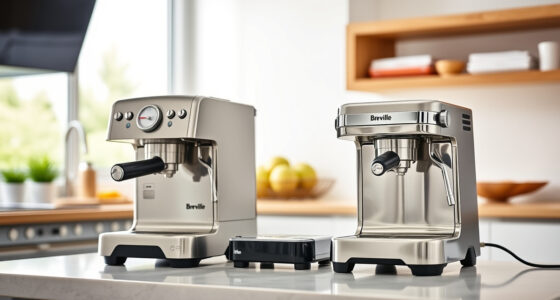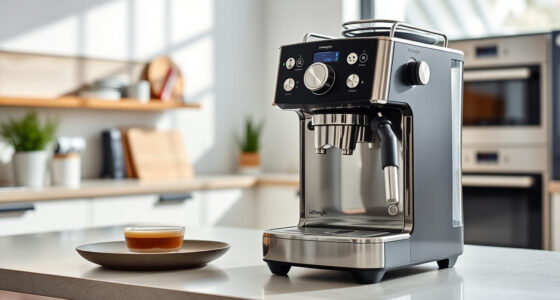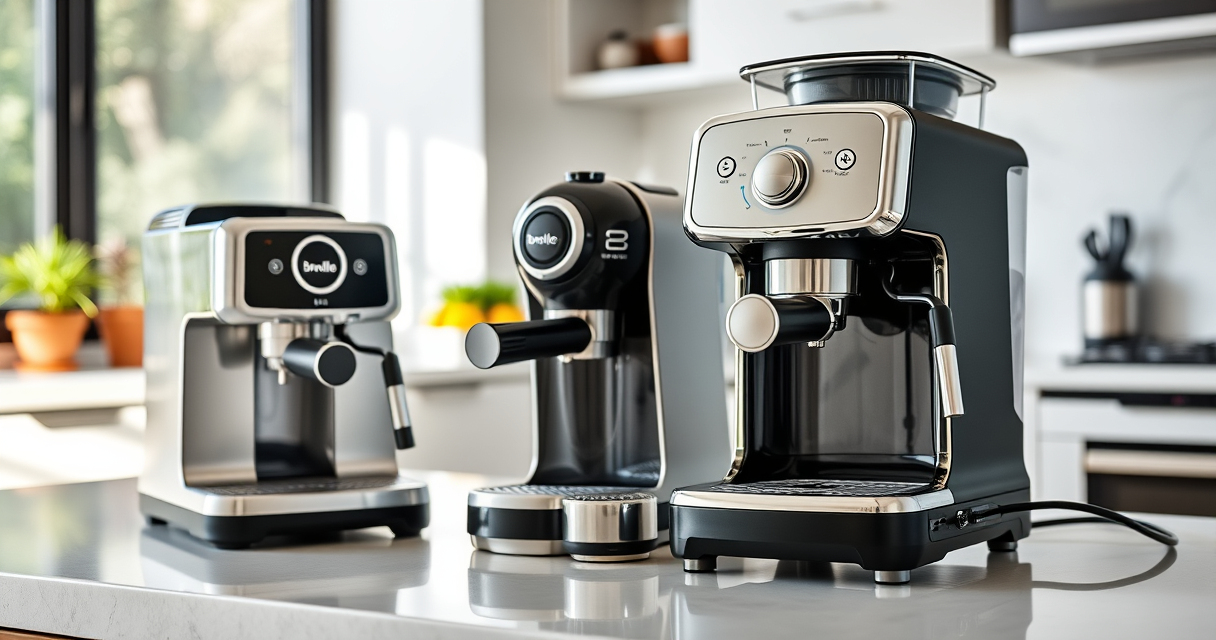
Breville has quietly become the default answer to the question “which espresso machine should I actually buy for my kitchen?” — and for good reason. The brand sells machines at nearly every seriousness level, from a compact starter unit to touchscreen-driven bean-to-cup machines that do most of the work for you. But that range creates a real decision problem: several of these machines look nearly identical in photos, cost within shouting distance of each other, and promise the same “café-quality espresso at home.”

Get kitchen gear delivered free — and shop member deals
- Fast, free delivery on millions of items
- Access to Prime Big Deal Days deals on October 6–7
- Prime Video, Amazon Music and more included
After comparing the lineup side by side, my top pick is the Breville Barista Express Impress, which automates the hardest part of manual espresso — dosing and tamping — without turning the whole process into a button push. If convenience matters more than craft, the Barista Touch is the strongest alternative, thanks to its touchscreen interface and automatic milk texturing. And for anyone with limited counter space (or a limited budget) who already owns a grinder, the Bambino delivers the same core extraction technology in a far smaller footprint.
The main tradeoff you are negotiating across this entire lineup is control versus convenience. The Barista Express models ask you to learn the craft; the Impress and Touch models coach you through it or handle it outright. A secondary tradeoff is size and grinder integration: machines with built-in grinders save money and counter clutter compared with buying separately, but they lock you into a grinder you cannot upgrade. I walk through exactly who each machine suits — and who should skip it — below.
Complete the kit


Key Takeaways
- The Barista Express Impress is my best overall pick because its assisted tamping and intelligent dosing remove the two biggest failure points for home baristas while preserving hands-on control.
- The Barista Touch is the most convenient machine here, with a touchscreen and automatic milk texturing, but it costs the most and offers the least room to grow as a barista.
- The Bambino is the only machine in this lineup without a grinder, which makes it the cheapest entry point — but only if you already own or plan to buy a quality separate grinder.
- The BES870XL and its Black Truffle sibling are the same machine in different finishes: a proven, dial-driven classic for buyers who want to learn espresso manually at a lower price than the Impress.
- All five machines share PID temperature control and low-pressure pre-infusion, so the real differences come down to dosing assistance, milk automation, footprint, and interface — not raw espresso quality.
| Breville BES876BSS Barista Express Impress, Brushed Stainless Steel |  | Best Overall | Grinder: Integrated conical burr, 25 settings | Heating system: Thermocoil with PID control | Bean hopper capacity: 250g (about 1/2 lb) | VIEW ON AMAZON | See Our Full Breakdown |
| Breville BES880BSS Barista Touch Espresso Machine, Brushed Stainless Steel |  | Best for Convenience | Interface: Touchscreen with drink customization | Heating system: ThermoJet, ~3 second heat-up | Drink memory: 5 presets, 8 saved custom drinks | VIEW ON AMAZON | See Our Full Breakdown |
| Breville BES450BSS Bambino Espresso Machine, Brushed Stainless Steel | 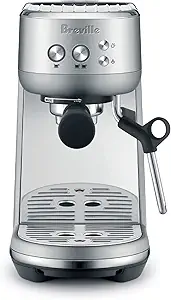 | Best Compact / Best for Small Kitchens | Grinder: None (ground coffee only) | Heating system: ThermoJet, ~3 second heat-up | Water tank: 47 oz | VIEW ON AMAZON | See Our Full Breakdown |
| Breville BES870XL Barista Express Espresso Machine, Brushed Stainless Steel |  | Best Value Bean-to-Cup | Grinder: Integrated conical burr, grind size dial | Heating system: Thermocoil with PID | Bean hopper capacity: 1/2 lb | VIEW ON AMAZON | See Our Full Breakdown |
| Breville BES870BTR Barista Express Espresso Machine, Black Truffle |  | Best Design Pick (Same Guts, Bolder Finish) | Finish: Black Truffle | Grinder: Integrated conical burr, grind size dial | Heating system: Thermocoil with PID | VIEW ON AMAZON | See Our Full Breakdown |
| Breville | Heating system | Water tank | Dimensions | Grinder |
|---|---|---|---|---|
| Breville BES876BSS Barista Exp | Thermocoil with PID control | 2L (67 oz) | 12.5"D x 14.5"W x 16.5"H | Integrated conical burr, 25 settings |
| Breville BES880BSS Barista Tou | ThermoJet, ~3 second heat-up | 67 oz | 12.7"D x 15.5"W x 16"H | — |
| Breville BES450BSS Bambino Esp | ThermoJet, ~3 second heat-up | 47 oz | 13.7"D x 6.3"W x 12"H | None (ground coffee only) |
| Breville BES870XL Barista Expr | Thermocoil with PID | 67 oz | 13.8"D x 12.5"W x 15.9"H | Integrated conical burr, grind size dial |
| Breville BES870BTR Barista Exp | Thermocoil with PID | 67 oz | 13.8"D x 12.5"W x 15.9"H | Integrated conical burr, grind size dial |
More Details on Our Top Picks
Breville BES876BSS Barista Express Impress, Brushed Stainless Steel
The Barista Express Impress earns my top spot because it solves the problem that ruins most beginners’ espresso: inconsistent dose and tamp. The Impress Puck System automatically calculates the coffee dose, corrects it for the next shot if it was off, and then applies an assisted tamp at a consistent pressure with a subtle “barista twist” finish. That combination replaces the two skills that normally take months to develop, and it does so without taking the portafilter out of your hands.
Compared with the standard Barista Express (BES870XL), the differences are about forgiveness rather than fundamentals. Both machines share the same 54mm portafilter, PID temperature control, and Thermocoil heating, but the BES870XL leaves dosing and tamping entirely to you — which means more waste and more frustration while you learn. The Impress also steps up to 25 grind settings versus the older machine’s coarser dial, giving you finer control when you chase a specific extraction time. The tradeoff is price and a slightly bulkier footprint, and the manual steam wand still demands practice for latte art, so this is not a fully automated machine by any stretch.
Against the Barista Touch, the Impress gives up the touchscreen and automatic milk texturing but keeps you engaged in the process — which is exactly the point if you want to improve over time rather than press a saved drink profile. This pick makes the most sense for someone who wants café results on day one and the room to grow into genuine barista technique.
Pros:- Assisted tamping with 10kg of consistent pressure removes the hardest beginner skill
- Intelligent dosing with auto-correction means fewer wasted shots
- 25 grind settings offer real fine-tuning headroom
- Built-in grinder and included jug, baskets, and trimming tool make it a complete package
Cons:- Manual steam wand has a learning curve for quality microfoam
- Larger and heavier than the Bambino, and demands permanent counter space
- Costs more than the standard Barista Express for what is, mechanically, a similar core machine
Best for: Beginners and intermediate home baristas who want guided, consistent shots without giving up hands-on control
Not ideal for: Buyers who want one-touch, hands-off drinks — the Barista Touch handles that job better
- Grinder:Integrated conical burr, 25 settings
- Heating system:Thermocoil with PID control
- Bean hopper capacity:250g (about 1/2 lb)
- Water tank:2L (67 oz)
- Portafilter:54mm stainless steel
- Dimensions:12.5″D x 14.5″W x 16.5″H
- Weight:23.7 lbs
- Wattage:1600W
Our verdict“The Barista Express Impress is the best balance of guidance and growth in Breville’s lineup — forgiving enough for week one, capable enough for year three.”
Breville BES880BSS Barista Touch Espresso Machine, Brushed Stainless Steel
If the Impress is a coach, the Barista Touch is a personal assistant. The touchscreen walks you through every drink in three steps — grind, brew, milk — and lets you save up to eight personalized drink profiles with your preferred strength, milk temperature, and texture. Households with multiple coffee drinkers, or anyone whose mornings do not allow for technique, will get more day-to-day value from this interface than from any manual dial arrangement.
The hardware backs up the software. The ThermoJet heating system reaches extraction temperature in about three seconds, a meaningful upgrade over the Thermocoil in the Barista Express models, which takes noticeably longer between power-on and first shot. The automatic steam wand textures milk to your set temperature and texture level on its own — compared with the manual wands on both Barista Express machines, this is the single biggest lifestyle difference in the lineup, because milk texturing is the skill most home users never master.
The compromises are real, though. This is the most expensive machine here, and its automation cuts both ways: you can adjust grind size and dose, but the machine deliberately narrows how deep you can go. An experienced user will eventually bump against its ceilings in a way they would not on the Impress. The touchscreen also means more electronics that can eventually fail, where the dial-based machines are simpler machines through and through. This model is better suited to convenience-focused households than to hobbyists chasing the perfect shot.
Pros:- Touchscreen with 5 café presets and 8 customizable drink profiles
- Automatic milk texturing produces consistent microfoam with no skill required
- ThermoJet heat-up in roughly 3 seconds
- Fully integrated grinder keeps the workflow to one machine
Cons:- Highest cost in this lineup
- Automation limits how far you can develop as a barista
- More electronic components than the dial-based models, with less tactile feedback
Best for: Busy households and multiple-drink families who want saved, repeatable drinks with automatic milk texturing
Not ideal for: Espresso hobbyists who want maximum manual control and room to grow
- Interface:Touchscreen with drink customization
- Heating system:ThermoJet, ~3 second heat-up
- Drink memory:5 presets, 8 saved custom drinks
- Bean hopper capacity:About 1/2 lb
- Water tank:67 oz
- Steam wand:Automatic, adjustable temp and texture
- Dimensions:12.7″D x 15.5″W x 16″H
- Warranty:2 year limited
Our verdict“The Barista Touch is the machine to buy when repeatable, low-effort drinks matter more than the craft of making them.”
Breville BES450BSS Bambino Espresso Machine, Brushed Stainless Steel
The Bambino proves that Breville’s extraction quality does not depend on size. At just 6.3 inches wide and under 11 pounds, it disappears next to machines like the 14.5-inch-wide Barista Express Impress, yet it shares the same fundamentals: PID temperature control, low-pressure pre-infusion, the same 54mm portafilter standard, and the fast ThermoJet heater. In a small apartment, a dorm, or an office nook, this is the Breville that actually fits.
What separates it from every other machine here is what it leaves out: no grinder. That is a genuine tradeoff, not just a cost cut. With the Bambino you must buy ground coffee or a separate burr grinder, which adds expense and clutter — but it also means you can pair it with a better grinder than anything built into a bean-to-cup machine, and upgrade it independently later. Compared with the Barista Express, the Bambino plus a quality standalone grinder can out-extract it for similar total money, at the cost of two appliances instead of one.
The automatic steam wand is a pleasant surprise at this size, delivering hands-free microfoam that beginners can achieve on the first try — arguably easier milk than the manual wand on the pricier Barista Express Impress. The honest downsides are the tiny 47 oz water tank that needs frequent refills, the shorter 1-year warranty, and a basic button interface with no shot customization to grow into.
Pros:- Genuinely compact footprint at 6.3 inches wide
- ThermoJet 3-second heat-up matches machines costing far more
- Automatic steam wand produces beginner-friendly microfoam
- Same PID-controlled extraction quality as larger Breville models
Cons:- No built-in grinder — an extra purchase is required
- Small 47 oz water tank needs frequent refills
- Button interface offers little room for customization or growth
Best for: Small-space dwellers, offices, and buyers who already own (or will buy) a separate grinder
Not ideal for: Anyone wanting a one-machine, beans-to-cup setup without buying a grinder
- Grinder:None (ground coffee only)
- Heating system:ThermoJet, ~3 second heat-up
- Water tank:47 oz
- Portafilter:54mm
- Steam wand:Automatic
- Dimensions:13.7″D x 6.3″W x 12″H
- Weight:10.9 lbs
- Warranty:1 year limited
Our verdict“The Bambino is the smart small-kitchen entry into real espresso — provided you already have a grinder plan.”
Breville BES870XL Barista Express Espresso Machine, Brushed Stainless Steel
The Barista Express is the machine that built Breville’s home-espresso reputation, and it remains the value anchor of this lineup. You get the full bean-to-cup workflow — integrated conical burr grinder, grind-on-demand dosing into the portafilter, PID temperature control, and a manual steam wand — for less than the Impress or Touch. Compared with the Impress, you give up assisted tamping and intelligent dose correction, which means your first weeks will include some genuinely bad shots while you learn to dial in grind size and tamp pressure by feel.
That learning curve is the defining characteristic, and I think it is a feature for the right buyer. If you want to understand espresso — why grind size changes extraction, why tamp consistency matters — this machine teaches it the hard way, and there is a large community of users sharing settings and techniques for it. Compared with the Bambino, the built-in grinder and larger 67 oz tank make it a complete one-appliance solution, but it occupies more than double the counter width.
The weaker points are dated rather than fatal. The Thermocoil heats slower than the ThermoJet in the Bambino and Touch, the interface is analog dials and buttons, and the grinder’s adjustment range is coarser than the Impress’s 25 settings. This model is better suited to a patient learner on a budget than to someone who wants reliably good shots from the first morning.
Pros:- Complete built-in grinder workflow at a lower price than the Impress or Touch
- Proven, widely documented design with a huge user community for troubleshooting
- Manual controls teach real espresso fundamentals
- Large 67 oz water tank and full accessory bundle included
Cons:- No assisted tamping or dose correction — steeper learning curve and more waste
- Thermocoil heats slower than ThermoJet models
- Analog interface with fewer fine adjustments than newer models
Best for: Budget-conscious beginners who want a complete bean-to-cup machine and enjoy learning manually
Not ideal for: Impatient buyers or anyone who wants help with dosing and tamping — the Impress is worth the upgrade
- Grinder:Integrated conical burr, grind size dial
- Heating system:Thermocoil with PID
- Bean hopper capacity:1/2 lb
- Water tank:67 oz
- Portafilter:54mm stainless steel
- Dimensions:13.8″D x 12.5″W x 15.9″H
- Weight:22.1 lbs
- Warranty:1 year limited
Our verdict“The Barista Express remains the best-value path into manual, bean-to-cup espresso — as long as you accept a longer learning curve.”
Breville BES870BTR Barista Express Espresso Machine, Black Truffle
Full transparency: mechanically, the Barista Express in Black Truffle is the same machine as the BES870XL above — same grinder, same Thermocoil and PID pairing, same 67 oz tank, same manual steam wand and accessory kit. I am including it as a separate entry for one reason: finish matters more than most roundups admit. Espresso machines live on the countertop in plain view all day, and the Black Truffle colorway offers a darker, warmer aesthetic than brushed stainless for kitchens where silver appliances would clash.
Because the internals are identical, all of my BES870XL analysis applies: this is a manual, dial-driven machine with a real learning curve, a proven grinder workflow, and slower heat-up than the ThermoJet models. Compared with the Barista Touch, it is far less convenient but considerably cheaper and more mechanically simple. Compared with the Impress, it lacks the assisted tamping that makes that machine my top pick — so the honest framing is that you are choosing this model for budget or looks, not capability.
One practical caution: color-matched finishes can be harder to replace or match with accessories if Breville later changes its palette, and limited editions occasionally carry a small premium over the standard stainless version for zero functional gain. If the finish genuinely suits your kitchen, that premium is a reasonable design decision; if you are indifferent, the stainless model is the more rational buy.
Pros:- Identical proven performance to the BES870XL with a distinctive Black Truffle finish
- Complete bean-to-cup package with grinder and full accessories
- Manual controls that reward developing technique over time
- Same large 67 oz tank and 1/2 lb hopper as the stainless version
Cons:- No functional advantage over the cheaper-styled stainless equivalent
- Same steep learning curve with no assisted dosing or tamping
- Finish may carry a premium with no performance benefit
Best for: Buyers who want the proven Barista Express workflow in a distinctive dark finish that suits a warmer kitchen palette
Not ideal for: Anyone choosing purely on specs — the stainless BES870XL does the identical job, and the Impress does it better
- Finish:Black Truffle
- Grinder:Integrated conical burr, grind size dial
- Heating system:Thermocoil with PID
- Water tank:67 oz
- Portafilter:54mm stainless steel
- Dimensions:13.8″D x 12.5″W x 15.9″H
- Weight:22.1 lbs
- Warranty:1 year limited
Our verdict“This is the Barista Express for design-led kitchens — buy it for the look, or buy the stainless version and save.”
How We Picked
My approach to ranking these five machines started with a simple premise: Breville’s lineup is a ladder, not a scatter plot. Each model occupies a distinct rung defined by how much of the espresso-making process the machine handles for you, and my job was to figure out which rung suits which buyer.
I compared the machines across four dimensions. First, skill demand: how much technique does the machine require to pull a good shot, and how forgiving is it when you get things wrong? The Impress’s assisted tamping and auto-dose correction score highly here; the classic Barista Express models demand more practice. Second, milk workflow: manual steam wands reward skill but punish beginners, while automatic wands trade a little control for consistency. Third, footprint and counter reality: a 23-pound machine with a hopper is a permanent countertop resident, while the Bambino can live beside other appliances. Fourth, growth potential: whether the machine will still satisfy you in two years once your palate and technique improve.
I also factored in value logic. Two of these machines — the BES870XL and BES870BTR — are functionally identical apart from finish, so I treated them as one design evaluated for two different buyers rather than pretending they are separate products. Throughout, I favored machines whose features translate into real outcomes: fewer wasted shots, less mess, faster mornings, and drinks that taste the same on Tuesday as they did on Sunday.
| Breville | Grinder | Heating system |
|---|---|---|
| Breville BES876BSS Barista Exp | Integrated conical burr, 25 settings | Thermocoil with PID control |
| Breville BES880BSS Barista Tou | — | ThermoJet, ~3 second heat-up |
| Breville BES450BSS Bambino Esp | None (ground coffee only) | ThermoJet, ~3 second heat-up |
| Breville BES870XL Barista Expr | Integrated conical burr, grind size dial | Thermocoil with PID |
| Breville BES870BTR Barista Exp | Integrated conical burr, grind size dial | Thermocoil with PID |
Factors to Consider When Choosing Breville
Choosing between Breville espresso machines comes down to a handful of decisions that have nothing to do with espresso quality — because across this lineup, the espresso quality is largely a given. These are the questions I would answer before clicking buy.Do you want a built-in grinder?
Three of the five machines here (both Barista Express models and the Impress, plus the Touch) grind beans on demand; the Bambino does not. A built-in grinder saves money and counter space versus buying separately, and grinding fresh is the single biggest factor in shot quality. The counterargument: the grinder inside a $700 machine will never match a dedicated $300 burr grinder, and you cannot upgrade it without replacing the whole machine. If you already own a good grinder or aspire to one, the Bambino plus standalone grinder is the enthusiast path. If you want one appliance and one purchase, go bean-to-cup.
How much help do you want with dose and tamp?
This is the real dividing line between the Barista Express and the Barista Express Impress. Dosing correctly and tamping evenly are the two skills beginners fail at most, and they are the two things the Impress automates. If you enjoy practice and experimentation, the standard Barista Express will teach you more and cost less. If you want good shots this weekend, pay the difference for the Impress. There is no wrong answer — only a mismatch between machine and temperament.
Manual or automatic milk texturing?
The Barista Express models (both finishes) use manual steam wands, which reward skill and allow full latte-art-level control once mastered. The Bambino, Impress path aside, and especially the Barista Touch use automatic wands that texture milk to a set temperature and texture with no technique required. If your household drinks mostly lattes and cappuccinos and nobody wants to practice steaming, automatic milk is worth real money. If milk texture is part of the craft you are buying into, manual is more satisfying.
How much counter space do you have, honestly?
The Bambino is 6.3 inches wide; the Barista Express machines are 12.5 inches wide and nearly 16 inches tall with the hopper, plus you need clearance to remove the water tank and grind into the portafilter. Measure your counter before choosing, not after. A bean-to-cup machine that does not fit is a worse purchase than a compact machine paired with a separate grinder that does.
Think about who you will be in two years
Buy for your future self, not just your current one. The Touch is delightful on day one but ceilings out for hobbyists. The Barista Express and Impress grow with you. The Bambino is the most flexible of all, since upgrading the grinder later upgrades the whole system. Match the machine to the trajectory, not the starting point.
Frequently Asked Questions
What is the difference between the Breville Barista Express and the Barista Express Impress?
The core brewing hardware is very similar — both use a 54mm portafilter, PID temperature control, and an integrated conical burr grinder — but the Impress adds intelligent dosing and assisted tamping. On the standard Barista Express, you judge the dose yourself and tamp by feel, which produces inconsistent shots while you are learning. The Impress calculates the dose, corrects the next shot if the previous one was off, and applies a machine-controlled tamp at consistent pressure. In practice, the Impress gets beginners to good espresso weeks faster, while the standard model teaches more fundamentals at a lower price. The Impress also offers 25 grind settings versus the coarser dial on the original.
Can the Breville Bambino make good espresso without a built-in grinder?
Yes, and in some configurations it can outperform the bigger machines. The Bambino shares the same PID-controlled extraction, low-pressure pre-infusion, 54mm portafilter, and fast ThermoJet heating as its larger siblings — the only missing piece is grinding. If you feed it freshly ground coffee from a quality standalone burr grinder, the ceiling is actually higher than the built-in grinders in the Barista Express line, because dedicated grinders simply grind better and more consistently. The catch is that pre-ground coffee from a bag will taste noticeably flatter, so the Bambino only makes sense as part of a two-piece setup.
Is the Barista Touch worth the extra cost over the Barista Express models?
It depends entirely on how you value convenience. The Touch brings a touchscreen interface with eight saved drink profiles, automatic milk texturing, and the ThermoJet heater that reaches brewing temperature in about three seconds instead of the Thermocoil’s longer warm-up. For a multi-drinker household where people want their exact drink with one tap and no practice, those features justify the premium. For a single user who enjoys the process of making coffee, the Touch’s automation becomes a limitation rather than a benefit, and the Barista Express or Impress delivers more engagement and more growth potential for less money.
How much counter space do I need for a Breville espresso machine?
It varies more than the product photos suggest. The Bambino is the outlier at just 6.3 inches wide and about 12 inches tall, fitting almost anywhere. The Barista Express and Barista Express Impress are roughly 12.5 to 14.5 inches wide, 15.9 to 16.5 inches tall with the bean hopper, and over 22 pounds — effectively permanent fixtures. Beyond the footprint, budget working clearance: you need to remove the water tank for filling, slide the drip tray out for cleaning, and fit a milk jug under the steam wand. As a rule, leave at least the machine’s width again in free space around it for a sane daily routine.
Are the Black Truffle and Brushed Stainless Steel Barista Express machines different performance-wise?
No — they are the same machine in different finishes. The BES870BTR (Black Truffle) and BES870XL (Brushed Stainless Steel) share identical grinders, heating systems, tanks, portafilters, dimensions, and accessories. The decision is purely aesthetic and financial: the Black Truffle suits kitchens with darker or warmer palettes where silver would stand out, and it may carry a small price difference depending on availability. If the finish does not matter to you, choose whichever version costs less that day, because the espresso in the cup will be indistinguishable.
Conclusion
The right Breville depends less on specs and more on what kind of coffee maker you want to be. If you want the best all-around machine that forgives beginner mistakes but still lets you develop real technique, buy the Barista Express Impress — it is my top pick because it removes the two hardest failure points without dumbing down the craft.
If convenience rules your mornings, or several people with different drink orders share your kitchen, the Barista Touch and its saved drink profiles plus automatic milk texturing are worth every extra dollar. Tight on space, or already own a good grinder? The Bambino delivers identical extraction fundamentals in a 6.3-inch frame and pairs beautifully with a standalone burr grinder.
Patient learners on a budget should choose the classic Barista Express BES870XL — it teaches espresso the traditional way, with a huge community behind it — while the Black Truffle edition is the same machine for buyers whose decision is led by the kitchen’s look. Whatever you choose, all five share the extraction quality that made Breville the default home-espresso brand; the difference is simply how much of the journey the machine does for you.
Fall Picks
fall essentials
As an affiliate, we earn on qualifying purchases.