To set a baseline espresso recipe quickly, start by dosing 18-20 grams of coffee on a scale for accuracy. Use a medium-fine grind and tamp evenly. Brew while timing the shot, aiming for 25-30 seconds extraction. Adjust the grind finer if it’s too quick or coarser if it’s too slow, observing the flow and crema. Make tiny tweaks and track results, helping you develop a fast, reliable process—if you keep exploring, you’ll master it even faster.

Get kitchen gear delivered free — and shop member deals
- Fast, free delivery on millions of items
- Access to Prime Big Deal Days deals on October 6–7
- Prime Video, Amazon Music and more included
Key Takeaways
- Use a precise scale to measure 18-20 grams of coffee for consistency.
- Start with a medium-fine grind and brew, then observe extraction time.
- Adjust grind size incrementally to aim for a 25-30 second extraction.
- Watch shot flow and crema to fine-tune grind adjustments quickly.
- Record changes and maintain a steady rhythm to establish a reliable baseline fast.
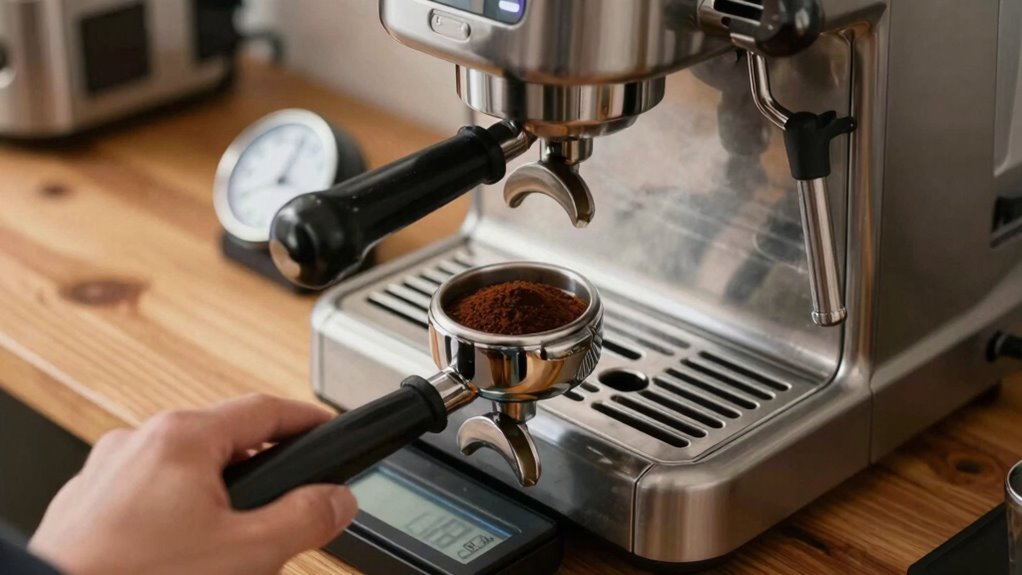
Creating a great espresso begins with establishing a solid baseline recipe, which allows you to consistently reproduce your ideal shot. The first step is to focus on your coffee grind. You want it to be just right—not too coarse or too fine—so that water flows evenly through the coffee bed. A medium-fine grind is usually a good starting point, but you’ll need to fine-tune it based on your machine and beans. When you adjust your coffee grind, you’re directly influencing your extraction time, which should ideally fall between 25 to 30 seconds. This window gives you a good chance to extract the rich flavors and oils without over-extracting bitterness or under-extracting sourness.
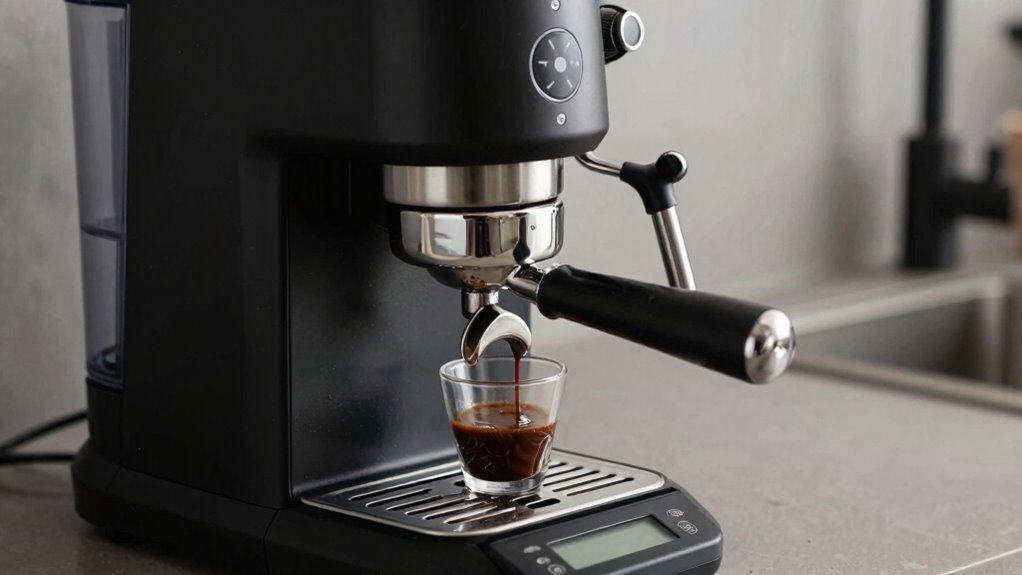
To set your baseline quickly, start by measuring a standard dose, typically around 18 to 20 grams of coffee for a double shot. Use a scale to ensure consistency because even slight variations can alter your extraction time and flavor. Once you’ve measured your coffee, grind it to your chosen consistency and tamp it evenly with moderate pressure. Now, brew the shot and observe the extraction. If the shot pulls too quickly—say, under 20 seconds—you’ll want to make the grind slightly finer to slow down the water flow. Conversely, if it takes longer than 30 seconds, coarsen the grind. The goal is to hit that sweet spot where the shot extracts within 25-30 seconds, delivering a balanced flavor profile.
While pulling the shot, keep an eye on the flow rate and the crema. A steady, honey-like flow indicates good extraction. If the coffee drips out in a thin stream or sputters, your grind needs adjustment. The key is that your extraction time and coffee grind are tightly linked. Making small adjustments to your coffee grind will help you control how long water spends interacting with the coffee grounds, ensuring your shot is neither under- nor over-extracted. Additionally, understanding the extraction time and its impact on flavor can help you make more precise adjustments in the future. Incorporating consistent dosing techniques can also improve your ability to replicate ideal shots more quickly. Recognizing the importance of grind size in relation to your espresso quality is fundamental to developing a reliable process.
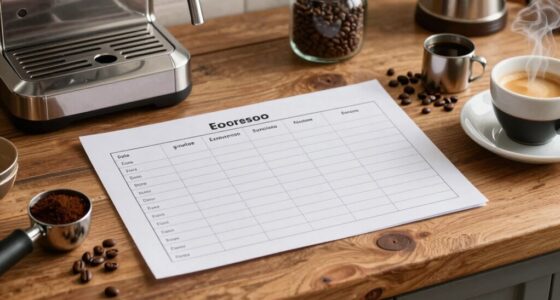
A helpful tip is to monitor your shot closely and develop a rhythm that allows quick adjustments, which can save you time during the process. Within five minutes, you should be able to establish a reliable baseline recipe by fine-tuning your coffee grind and monitoring your extraction time. Remember, consistency is king. Once you find that perfect grind size and timing, you can replicate it every time, turning your daily espresso routine into a precise craft. Keep notes on your adjustments, and over time, you’ll develop a quick, intuitive process for dialing in your espresso shot every morning.
digital coffee scale for espresso
As an affiliate, we earn on qualifying purchases.
As an affiliate, we earn on qualifying purchases.
Frequently Asked Questions
What Equipment Is Necessary for Quick Espresso Baseline Setup?
To set a quick espresso baseline, you’ll need a reliable espresso machine, a burr grinder, and a scale. Make certain your coffee is fresh for the best flavor, and calibrate your machine to maintain consistent temperature and pressure. Use the scale to measure your coffee and water precisely. With these tools, you can efficiently adjust your grind size and extraction time, achieving a consistent espresso shot in under five minutes.
How Can I Adjust the Recipe for Different Coffee Beans?
To adjust your recipe for different coffee beans, start by considering the flavor profile and roast level. For lighter roasts, you might need a slightly longer extraction time to bring out brightness and acidity. Darker roasts often require a shorter brew to prevent bitterness. Experiment with grind size, dose, and extraction time, tasting each shot to find the perfect balance that highlights each bean’s unique characteristics.
What Water Temperature Is Ideal for a Quick Baseline?
You should aim for a water temperature of around 200°F (93°C) for a quick baseline, as this optimizes coffee flavor while maintaining brewing consistency. Too hot, and the coffee may taste burnt; too cool, and it’ll lack extraction. Using this temperature helps you quickly dial in your espresso, ensuring consistent results and balanced flavor in less than five minutes. Always verify your machine’s temperature accuracy for best results.
How Do I Measure the Perfect Coffee Grind Size?
Think of measuring your grind size like tuning a musical instrument—precision creates harmony. To find the perfect coffee flavor, use a scale to measure your grind consistency, aiming for a texture like fine sand. Adjust the grinder in small increments, then taste and observe extraction time. Consistent grind size guarantees even extraction, so your espresso bursts with balanced flavor and richness, turning every shot into a symphony.
Can I Modify the Recipe for a Longer or Shorter Shot?
Yes, you can modify your espresso shot length to suit your taste, but keep in mind that it may affect flavor consistency. For a longer shot, extend the extraction time gradually, and for a shorter shot, reduce it carefully. Use consistent extraction techniques to maintain flavor balance. Experiment with small adjustments, tasting each time, so you can find the perfect balance between shot length and flavor.
medium-fine espresso grind coffee beans
As an affiliate, we earn on qualifying purchases.
As an affiliate, we earn on qualifying purchases.
Conclusion
Think of your espresso journey as tuning a fine instrument—you want every note to sing perfectly. Setting a baseline recipe in under five minutes gives you a solid foundation to craft your perfect shot. With a little practice, you’ll become the maestro of your espresso symphony, effortlessly adjusting and refining until every cup hits the right note. Remember, every great performance starts with a confident tuning—your baseline recipe is just that. Cheers to flavorful mornings ahead!
As an affiliate, we earn on qualifying purchases.
As an affiliate, we earn on qualifying purchases.
Fall Picks
fall essentials
As an affiliate, we earn on qualifying purchases.