To quickly rebalance your coffee recipe, adjust your grind size and brew time together, since they’re closely connected. If your brew is too bitter, coarsen the grind slightly and reduce brew time; if it’s weak or sour, refine the grind and extend the brew. Small tweaks in these variables can fine-tune extraction fast. Mastering these adjustments will lead to better flavor, strength, and clarity—discover how all these factors work in harmony for perfect coffee.

Get kitchen gear delivered free with Prime
- Fast, free delivery on millions of items
- Prime Video, Amazon Music and more included
- Member-only deals all year
Key Takeaways
- Adjust grind size to change extraction speed, then modify brew time accordingly for quick rebalancing.
- Coarser grind requires longer brew time; finer grind needs shorter extraction to prevent over-extraction.
- Fine-tuning grind size often yields faster results than altering brew time alone.
- Combine small adjustments in grind and brew time to efficiently correct flavor imbalances.
- Monitor extraction closely; rapid changes in either variable can swiftly restore desired flavor profile.
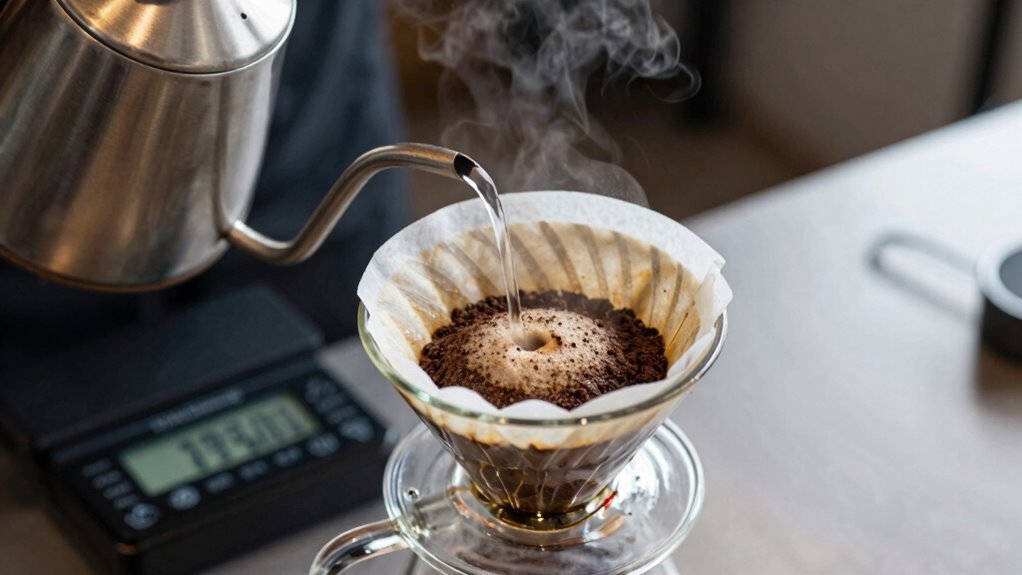
When it comes to brewing great coffee, understanding the relationship between brew time and grind size is vital. These two factors directly influence how your coffee extracts, affecting flavor, strength, and overall quality. If your brew tastes off—either too bitter or too weak—adjusting grind size or brew time can often fix the problem quickly. But to do this effectively, you need to grasp how water temperature and extraction time interact with grind size to produce the desired results.
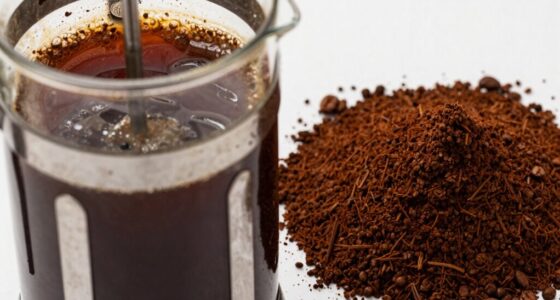
Your grind size determines how quickly water passes through the coffee grounds. A finer grind increases surface area, leading to faster extraction, while a coarser grind slows things down. When you change grind size, you’re also changing how long the water needs to be in contact with the grounds—the extraction time—to pull out the flavors you want. If your coffee is over-extracted (bitter, harsh), you’re likely brewing too long or using too fine a grind, causing water to extract too many compounds. Conversely, under-extraction (sour, weak) often results from too coarse a grind or too short a brew time, meaning the water isn’t extracting enough flavor.
Finer grind speeds up extraction; coarser grind slows it down, affecting flavor and strength.
Water temperature plays a critical role here. Hotter water accelerates extraction, so if you’re using high temperature, you might need a coarser grind or shorter brew time to prevent over-extraction. Cooler water slows extraction, requiring finer grind or longer brew times to achieve the same flavor profile. Striking the right balance between water temperature and extraction time is key to controlling how much flavor is extracted during brewing. Typically, for most brewing methods, maintaining a water temperature between 195°F and 205°F is ideal, but even small adjustments can have significant impacts on extraction efficiency. Optimal water temperature is crucial for achieving consistent and desirable extraction results.
When you’re trying to rebalance your coffee recipe quickly, start by adjusting the grind size to influence extraction time. If your brew is too bitter, try coarsening the grind slightly and reducing brew time or lowering the water temperature a bit. If it’s too weak or sour, go for a finer grind and increase the extraction time or slightly raise the water temperature. Remember, these adjustments are interconnected: changing one often requires tweaking the others to find that perfect harmony. Monitoring your water temperature is vital, as it directly impacts how quickly your coffee extracts, ultimately shaping the flavor profile.
coffee grinder for precise grind size
As an affiliate, we earn on qualifying purchases.
As an affiliate, we earn on qualifying purchases.
Frequently Asked Questions
How Does Altitude Affect Brew Time and Grind Size?
Altitude effects your brew time and grind size because lower atmospheric pressure causes water to boil at a lower temperature, which can make extraction uneven. You should make brew adjustments by grinding finer to compensate for quicker extraction and extending brew time slightly at higher altitudes. These small tweaks help you maintain consistent flavor, ensuring your coffee tastes just right despite altitude changes.
Can Different Coffee Bean Origins Require Unique Adjustments?
Ever wondered if different coffee bean origins need unique tweaks? Absolutely! You should adjust brew time and grind size based on the bean’s freshness and roast level. Light roasts from Africa might need a finer grind, while darker roasts from South America could benefit from a coarser grind. Paying attention to these factors guarantees ideal extraction, highlighting each origin’s unique flavors and maintaining consistency across your brews.
How Do Temperature Fluctuations Influence Grind Size Effectiveness?
Temperature fluctuations can greatly influence grind size effectiveness by affecting temperature stability and grind consistency. When the water temperature varies, it can cause uneven extraction, making your grind less effective. To maintain ideal results, keep your brewing environment stable and use a consistent grind size. This ensures better temperature stability and grind consistency, helping you achieve a balanced and flavorful cup every time, regardless of external temperature changes.
What Are the Signs of Over-Extraction Versus Under-Extraction?
You notice over-extraction when your brew tastes overly bitter, harsh, or astringent, indicating too much extraction of tannins and undesirable compounds. Under-extraction presents as weak, sour, or flat flavors, showing insufficient brew strength and poor flavor balance. To fix this, adjust grind size, brew time, or temperature. Recognizing these signs allows you to fine-tune your process for ideal flavor and balanced brew strength in every cup.
How Often Should I Recalibrate My Grinder for Optimal Results?
You should recalibrate your grinder every 1 to 2 months for ideal results, depending on usage. Regular grinder maintenance helps guarantee consistent grind size, which affects extraction and flavor. Keep an eye on your coffee quality and adjust calibration frequency if you notice changes like uneven extraction or underwhelming taste. Consistent calibration and maintenance prevent flavor inconsistencies, making your brew better and more reliable over time.
automatic coffee brewing machine with adjustable brew time
As an affiliate, we earn on qualifying purchases.
As an affiliate, we earn on qualifying purchases.
Conclusion
Think of your coffee recipe as a delicate dance between brew time and grind size, like tuning a musical instrument. Adjust one note, and the melody shifts—finding harmony takes patience and finesse. When you tweak grind size or brew time, you’re fundamentally fine-tuning your flavor symphony. Master this balance, and your perfect brew becomes a masterpiece, revealing the depth and complexity hidden in every cup—your personal concerto of coffee.
As an affiliate, we earn on qualifying purchases.
As an affiliate, we earn on qualifying purchases.
Halloween Picks
halloween
As an affiliate, we earn on qualifying purchases.