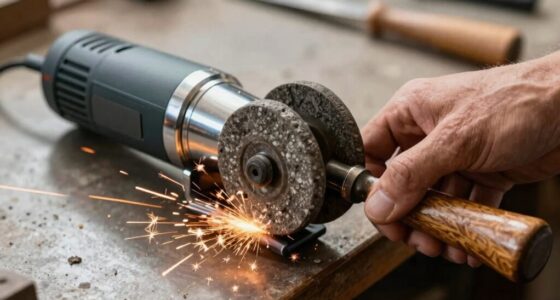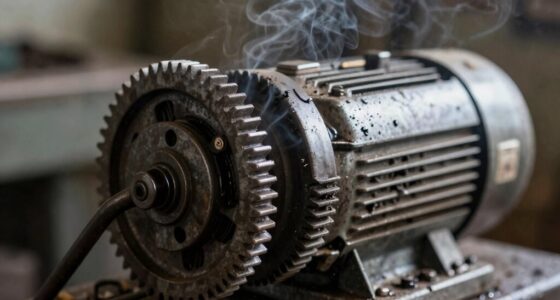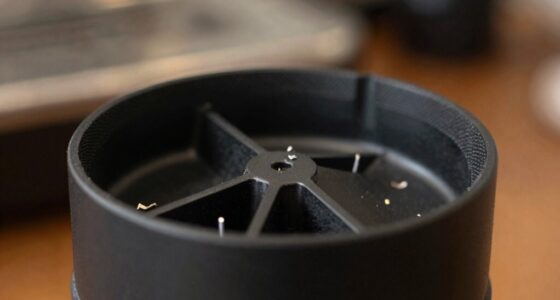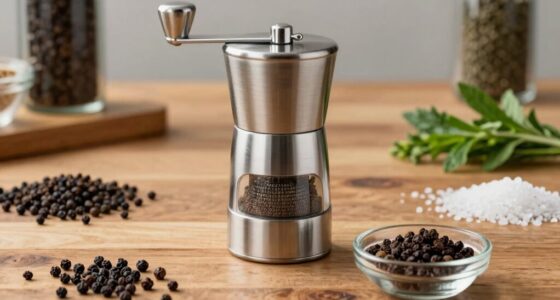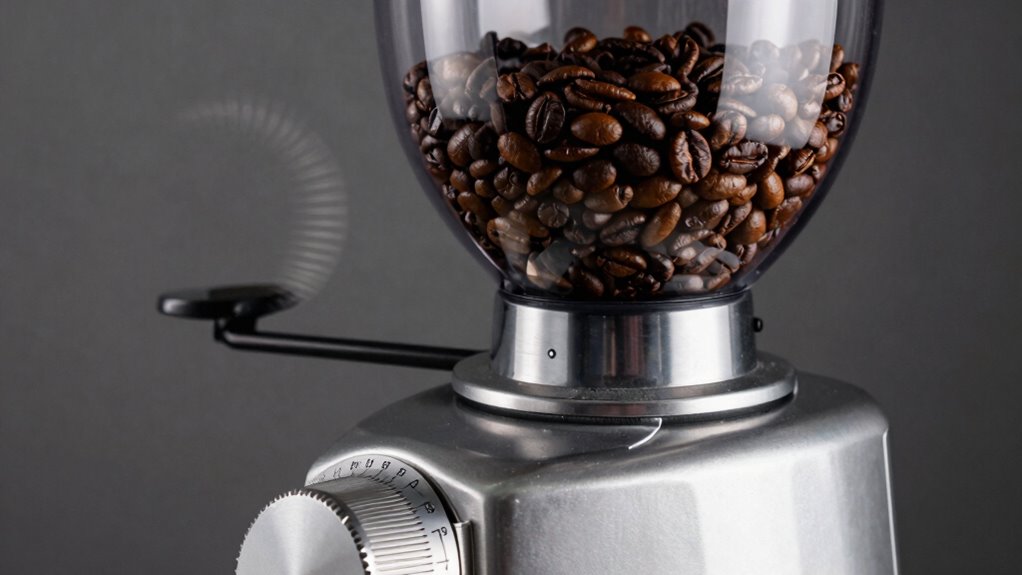

Variable RPM mainly impacts the consistency and size of your coffee particles, controlling how fine or coarse your grind becomes. It also influences heat generation, which can affect flavor preservation, and impacts how evenly your grounds are extracted, reducing channeling. Adjusting RPM helps you fine-tune your espresso for the perfect shot, balancing flavor and crema. If you want detailed insights into these changes, keep exploring how RPM shapes your grinding process.

Get kitchen gear delivered free with Prime
- Fast, free delivery on millions of items
- Prime Video, Amazon Music and more included
- Member-only deals all year
Key Takeaways
- It alters the particle size and uniformity of the coffee grounds.
- It influences heat generation, affecting flavor preservation during grinding.
- It impacts grind consistency, which affects water flow and extraction quality.
- It adjusts the grind profile, making tamping and brewing easier or more precise.
- It enables customization of flavor, crema, and overall espresso quality through precise control.
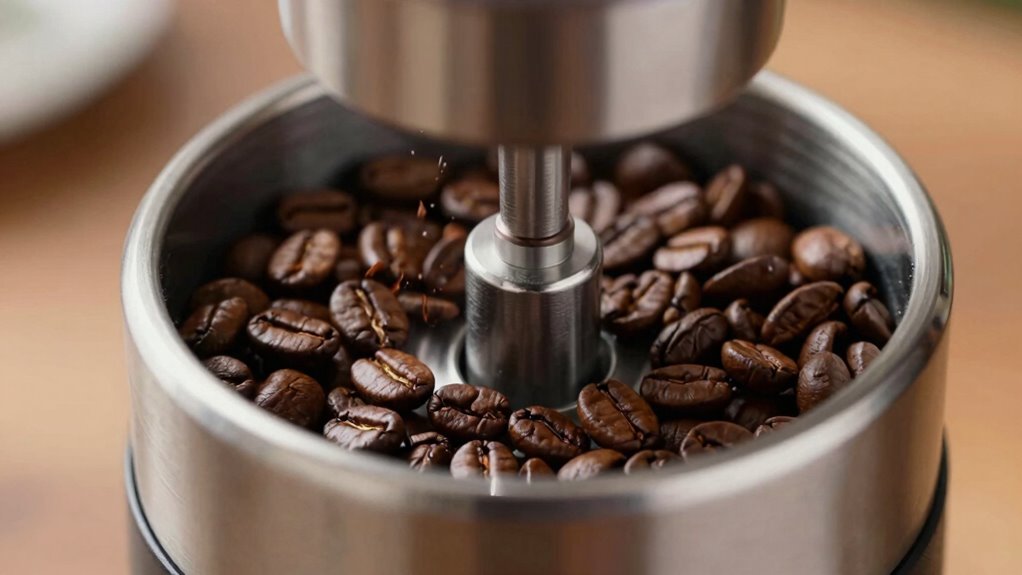
When grinding espresso beans, adjusting the RPM (revolutions per minute) of your grinder can markedly influence the consistency and quality of your shot. RPM directly impacts how evenly the beans are processed, affecting both grind consistency and particle size. Higher RPMs tend to produce finer, more uniform particles because the beans are ground more quickly and with greater force. This rapid processing can lead to a more consistent grind, which is essential for achieving a balanced extraction. However, if the RPM is set too high, it might generate excessive heat, risking slight alterations to the coffee’s flavor profile and potentially causing uneven particle sizes due to inconsistent grinding.
Conversely, lower RPMs generally result in a slower, gentler grind. This slower pace allows the burrs or blades to process the beans more carefully, often producing a coarser grind with larger, more varied particles. The benefit here is a reduction in heat buildup, preserving the beans’ aromatic qualities and guaranteeing particles are more uniform in size. A consistent particle size is critical because it directly influences how water flows through the coffee bed. If the particles are too varied, water will find the path of least resistance, leading to channeling and uneven extraction. Maintaining a steady particle size ensures that water interacts uniformly with the grounds, producing a more flavorful and balanced espresso shot.
Adjusting the RPM isn’t just about speed; it’s about controlling how the beans are broken down. When you turn down the RPM, you often get a coarser, more uniform grind that’s easier to manage during tamping and extraction. Higher RPMs, on the other hand, can create an ultra-fine grind suitable for certain espresso styles but require careful attention to prevent over-extraction or bitterness. The key is finding a balance that suits your grinder’s design and your preferred espresso profile.
In essence, variable RPM settings allow you to fine-tune the grind quality by controlling grind consistency and particle size distribution. This control helps you produce shots with ideal extraction, full flavor, and perfect crema. Whether you’re aiming for a precise, fine grind or a more forgiving coarser one, understanding how RPM influences these factors is essential. Small adjustments in RPM can make a significant difference in the final espresso, giving you greater mastery over your brewing process and the ability to tailor your coffee to your taste preferences. Additionally, controlling RPM also influences grind uniformity, which is crucial for optimizing extraction and flavor.
espresso grinder with variable RPM
As an affiliate, we earn on qualifying purchases.
As an affiliate, we earn on qualifying purchases.
Frequently Asked Questions
How Does RPM Affect Espresso Extraction Time?
Higher RPM speeds up espresso extraction time because it results in a finer grind size, increasing surface area for water contact. With fresher beans, the grind needs to be adjusted to prevent over-extraction; RPM influences this by controlling grind consistency. As RPM increases, you’ll notice a quicker extraction, but you must balance it with grind size and bean freshness to avoid bitterness or under-extraction.
Can Variable RPM Improve Espresso Flavor Consistency?
Think of variable RPM as the conductor of your espresso orchestra. It can improve flavor consistency by fine-tuning grind particle size, ensuring each shot hits the same high note. When your beans are fresh, adjusting RPM helps maintain uniform extraction, preventing over- or under-extraction. By mastering RPM control, you create a symphony of rich, balanced espresso, where bean freshness and grind size harmonize perfectly for an exceptional taste every time.
What Equipment Allows for RPM Adjustments in Grinding?
You can adjust RPM on grinders equipped with variable motor stability and gear mechanisms. These grinders feature adjustable speed controls or digital interfaces that let you fine-tune motor RPM. Look for models with precise gear mechanisms, which guarantee consistent RPM changes without sacrificing grind stability. By choosing equipment with these features, you can optimize espresso extraction and improve flavor consistency, giving you more control over your grind size and extraction process.
Does RPM Influence Coffee Bean Heat During Grinding?
Yes, RPM influences bean temperature during grinding. Higher RPMs generate more heat, which can raise bean temperature and affect grind stability. When beans heat up, oils may become volatile, impacting flavor extraction. Maintaining a consistent RPM helps control heat build-up, ensuring uniform grind size and preventing overheating. This consistency is essential for achieving ideal extraction and flavor clarity in your espresso.
How Do Baristas Typically Adjust RPM for Different Beans?
Baristas typically adjust RPM by changing the burr speed to match different beans. For coarser grind sizes, they often decrease burr speed to prevent overheating and preserve flavor. Conversely, for finer grinds, they increase burr speed for consistency. You should experiment with burr speed to find the best grind size, as adjusting RPM influences extraction and flavor, ensuring each shot meets your desired taste profile.
coffee grinder for espresso beans
As an affiliate, we earn on qualifying purchases.
As an affiliate, we earn on qualifying purchases.
Conclusion
So, when you dial up or down that variable RPM, you’re basically controlling the universe of your espresso grind—making it so fine it could almost whisper secrets or so coarse it could walk away! It’s like wielding a magic wand that transforms your brew from meh to mind-blowingly perfect. Remember, this tiny tweak isn’t just a setting; it’s the secret sauce to revealing espresso greatness, turning every cup into a masterpiece that’ll make your taste buds do backflips!
As an affiliate, we earn on qualifying purchases.
As an affiliate, we earn on qualifying purchases.
Halloween Picks
halloween
As an affiliate, we earn on qualifying purchases.