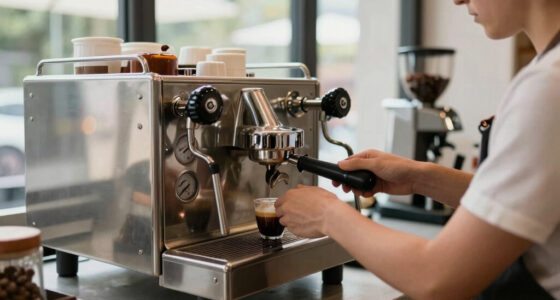
For an office that needs espresso and milk drinks moving without a long wait, a dual boiler espresso machine can brew and steam at the same time. My best overall pick is the Breville Dynamic Duo, a separate-machine bundle that pairs the Dual Boiler with a dedicated grinder for a flexible shared setup. The Breville Oracle stands out for teams seeking more automation, while the AMZCHEF 9 Bar OPV offers automatic milk frothing for offices that prioritize simpler drink preparation. The main tradeoffs are footprint, staff skill, cleaning workload, and how much control the team wants over grinding and steaming. Read on for the full comparison and advice on choosing a machine that fits your office routine.

Get kitchen gear delivered free with Prime
- Fast, free delivery on millions of items
- Prime Video, Amazon Music and more included
- Member-only deals all year
Complete the kit


Key Takeaways
- The Dynamic Duo is the strongest all-around office fit in this lineup because its separate grinder and espresso machine give teams flexibility without requiring an all-in-one workflow.
- The Oracle and automatic-frothing models favor convenience, while traditional control-focused machines make more sense when several staff members can dial in coffee and steam milk.
- Built-in grinders save counter space but create a shared point of failure; separate grinders, as in the Dynamic Duo bundle, are easier to treat as independent parts of an office coffee station.
- Dual boilers do not remove the office bottleneck by themselves. Grinder speed, drink customization, milk cleanup, and access to the machine can matter just as much during busy breaks.
- Several product names describe closely related versions, including the Gevi and Meraki grinder-and-scale models; verify the exact model and included features before choosing between listings.
| Gevi Dual Boiler Espresso Machine with Built-In Grinder & 58mm Portafilter |  | Best Value for a Shared Office | Operation: Semi-automatic | Heating system: Dual boiler | Grinder: Built-in, 31 grind levels | VIEW ON AMAZON | See Our Full Breakdown |
| Breville Dynamic Duo Espresso Machine Bundle | Dual Boiler + Smart Grinder Pro | Stainless Steel |  | Best for Espresso-Focused Offices | Heating system: Dual boiler | Boiler material: Stainless steel | Grinder: Smart Grinder Pro, 60 settings | VIEW ON AMAZON | See Our Full Breakdown |
| Meraki Dual Boiler Espresso Machine with Grinder and Built-In Dual Scales |  | Best for Recipe Consistency | Operation: Semi-automatic | Heating system: Dual boilers | Boiler capacities: 350 ml brew; 550 ml steam | VIEW ON AMAZON | See Our Full Breakdown |
| AMZCHEF 9 Bar OPV Espresso Machine with Automatic Milk Frother and Dual Boiler |  | Best for Milk-Drink Teams | Operation: Semi-automatic | Heating system: Dual boiler | Pressure: 9-bar OPV regulation; 15-bar output pressure listed | VIEW ON AMAZON | See Our Full Breakdown |
| AIRMSEN 20 Bar Espresso Machine with Automatic Milk Frother, Dual Boiler, Touchscreen, Stainless Steel |  | Best Compact Option for Shared Counters | Operation: Semi-automatic | Heating system: Dual boiler | Coffee input: Ground coffee | VIEW ON AMAZON | See Our Full Breakdown |
| Chefman Crema Deluxe Espresso Machine with Double Boiler, Milk Frother, and 30-Setting Grinder |  | Best for a Ready-to-Start Office Setup | Boiler type: Double boiler | Grinder settings: 30 | Water reservoir capacity: 3 liters | VIEW ON AMAZON | See Our Full Breakdown |
| Gevi Dual Boiler Espresso Machine With Built-In Burr Grinder |  | Best for a Compact, Control-Focused Office | Operation mode: Semi-automatic | Coffee input: Ground coffee and whole beans | Grinder settings: 31 levels | VIEW ON AMAZON | See Our Full Breakdown |
| Breville Oracle Dual Boiler Espresso Machine, Stainless Steel |  | Best Premium Pick for Shared Use | Boiler and heating system: Dual stainless-steel boilers; triple-heating system | Display: 5.7-inch touchscreen | Capacity: 77 fluid ounces | VIEW ON AMAZON | See Our Full Breakdown |
| Meraki Dual Boiler Espresso Machine with Grinder and Dual Built-In Scales |  | Best for Precise, Repeatable Office Recipes | Brew boiler: 350 ml | Steam boiler: 550 ml | Grinder: 45 marked settings with micro-adjustment | VIEW ON AMAZON | See Our Full Breakdown |
| Breville BES920XL Dual Boiler Espresso Machine, Brushed Stainless Steel |  | Best for a Dedicated Office Barista | Boilers: Dual stainless-steel | Power: 1700 watts | Voltage: 110 volts | VIEW ON AMAZON | See Our Full Breakdown |
| Tuni E2 Gen3 Dual Boiler Espresso Machine with Super+ Steam Power, Ivory |  | Best for Fast Milk-Drink Service | Boiler configuration: Dual boiler | Operation: Semi-automatic | Power: 1500 watts | VIEW ON AMAZON | See Our Full Breakdown |
| dual boiler espresso machine for office | Dimensions |
|---|---|
| Gevi Dual Boiler Espresso Mach | 13.8 in D × 12.6 in W × 16.5 in H |
| Breville Dynamic Duo Espresso | — |
| Meraki Dual Boiler Espresso Ma | — |
| AMZCHEF 9 Bar OPV Espresso Mac | 16.4 in D × 10 in W × 14.4 in H |
| AIRMSEN 20 Bar Espresso Machin | — |
| Chefman Crema Deluxe Espresso | — |
| Gevi Dual Boiler Espresso Mach | 18.85 inches deep × 15.66 inches wide × 18.85 inches high |
| Breville Oracle Dual Boiler Es | 18 inches deep × 18 inches wide × 22.5 inches high |
| Meraki Dual Boiler Espresso Ma | 14.57 inches deep × 14.57 inches wide × 16.33 inches high |
| Breville BES920XL Dual Boiler | 14.7 inches deep × 14.8 inches wide × 14.7 inches high |
| Tuni E2 Gen3 Dual Boiler Espre | — |
More Details on Our Top Picks
Gevi Dual Boiler Espresso Machine with Built-In Grinder & 58mm Portafilter
For an office that wants fresh-ground espresso without adding a separate grinder, the Gevi combines a dual boiler and 31-setting grinder in one machine. Independent heating lets someone prepare espresso while another person steams milk, a practical advantage during busy coffee breaks. Its 58mm portafilter also gives more room to work with standard-style accessories than the compact, touchscreen-driven AIRMSEN. Compared with the Breville Dynamic Duo, Gevi offers a more integrated, simpler countertop setup, but the Breville’s 60-setting grinder and stated PID control offer more documented fine-tuning. Gevi still calls for hands-on dosing and milk texturing, so it suits an office with at least one willing coffee enthusiast rather than a fully self-serve station. At 15 pounds and 16.5 inches tall, it needs a stable spot with overhead clearance.
Pros:- Dual boilers allow brewing and steaming at the same time.
- Built-in grinder offers 31 grind levels without needing a separate grinder.
- 58mm portafilter supports a familiar barista-style workflow.
- 2.8-liter capacity is suited to repeated drinks between refills.
Cons:- Semi-automatic preparation requires someone to manage grinding, dosing, and milk texturing.
- At 15 pounds and 16.5 inches tall, it is not especially easy to move or tuck under low cabinets.
- The listed 1500-watt draw may need to be accounted for alongside other office appliances.
Best for: Small office teams that want freshly ground espresso and milk drinks from one machine, with a colleague willing to learn semi-automatic preparation.
Not ideal for: Workplaces seeking push-button drinks for many occasional users, or offices without room for a 16.5-inch-tall machine and its workflow.
- Operation:Semi-automatic
- Heating system:Dual boiler
- Grinder:Built-in, 31 grind levels
- Portafilter:58 mm
- Water capacity:2.8 liters
- Power and voltage:1500 watts; 120 volts
- Dimensions:13.8 in D × 12.6 in W × 16.5 in H
- Weight:15 pounds
Our verdict“Choose the Gevi if your office wants an integrated grinder and dual-boiler workflow and has a staff member willing to operate it.”
Breville Dynamic Duo Espresso Machine Bundle | Dual Boiler + Smart Grinder Pro | Stainless Steel
The Dynamic Duo is the strongest fit here for an office that treats coffee quality as a shared hobby, not just a caffeine stop. Its dual stainless-steel boilers support simultaneous brewing and steaming, while PID temperature regulation and selectable volumetric, manual, or timed shots give a skilled operator meaningful control. The separate Smart Grinder Pro with 60 settings also offers finer adjustment than the Gevi’s 31-level built-in grinder. That flexibility comes with a more involved setup: staff need to learn the grinder, shot controls, and milk workflow, and the two-piece bundle claims more counter space than an integrated machine. Compared with the Meraki, the Breville’s supplied grinder and stated shot modes make the controls easier to identify from the listed details, while the Meraki adds built-in weighing. This is a better shared station for trained users than a quick, unattended office coffee corner.
Pros:- Dual boilers support simultaneous espresso extraction and milk steaming.
- PID temperature regulation helps maintain controlled brew temperatures.
- Smart Grinder Pro provides 60 grind settings for dialing in different beans.
- Volumetric, manual, and timed shot options suit different levels of user control.
Cons:- Separate machine and grinder require more counter space than integrated options such as the Gevi.
- The range of controls and setup can be a learning hurdle for occasional users.
- A hands-on grinder-and-portafilter workflow is less convenient for unattended, high-turnover use.
Best for: Offices with a designated coffee enthusiast or small group of trained users who want adjustable espresso recipes and a separate grinder.
Not ideal for: Busy workplaces where many inexperienced staff need simple drinks, or counters that cannot accommodate a machine and separate grinder.
- Heating system:Dual boiler
- Boiler material:Stainless steel
- Grinder:Smart Grinder Pro, 60 settings
- Portafilter:58 mm
- Maximum dose:22 g
- Pump pressure:15 bar
- Steam temperature:266°F
- Shot controls:Volumetric, manual, and timed
Our verdict“Pick the Dynamic Duo for an office with counter space and coffee-minded users who will make use of its grinder and shot controls.”
Meraki Dual Boiler Espresso Machine with Grinder and Built-In Dual Scales
The Meraki’s defining office advantage is not just simultaneous brewing and steaming; it is built-in weighing for both dose and espresso yield. That can help a team repeat a recipe across shifts without relying on one person’s visual judgment. The listed scale accuracy is within 0.2 g, and PID control plus a heated grouphead target thermal consistency. Its 45 marked grinder settings with micro-adjustment and near-zero-retention design further suit offices rotating between coffees. Compared with the Breville Dynamic Duo, Meraki folds weighing into the machine rather than relying on a separate scale, but the supplied details describe a more enthusiast-oriented process, not one-touch service. The 350 ml brew and 550 ml steam boilers are specified, yet no overall footprint or water-tank capacity is provided here, making office fit harder to judge. Choose it for recipe discipline, not the simplest handoff.
Pros:- Built-in scales measure both coffee dose and espresso yield, supporting repeatable recipes.
- Dual boilers allow extraction and milk texturing at the same time.
- PID control and a heated grouphead are specified for temperature stability.
- 45 grinder settings with micro-adjustment support fine dialing across coffees.
Cons:- The detailed controls and recipe workflow may be too involved for occasional office users.
- No dimensions or water-tank capacity are supplied in the provided product data.
- A 58mm portafilter and hands-on preparation still require staff training and cleanup.
Best for: Coffee-focused offices that rotate beans or shifts and want staff to follow repeatable dose and yield recipes.
Not ideal for: Teams seeking a low-training, one-button drink station, or buyers who need verified dimensions and water capacity before planning the counter.
- Operation:Semi-automatic
- Heating system:Dual boilers
- Boiler capacities:350 ml brew; 550 ml steam
- Temperature control:PID control; heated grouphead
- Built-in scales:Dose and yield measurement; stated accuracy within 0.2 g
- Grinder:45 marked settings with micro-adjustment
- Pump and extraction:Rotary pump; steady 9-bar extraction; controlled pre-infusion
- Portafilter:E61-compatible 58 mm
Our verdict“Choose the Meraki when recipe repeatability across office users matters more than a simple, low-training drink workflow.”
AMZCHEF 9 Bar OPV Espresso Machine with Automatic Milk Frother and Dual Boiler
For an office where cappuccinos and lattes outnumber straight espresso, AMZCHEF stands apart with a hands-free frothing station alongside dual boilers. The automatic milk feature reduces the skill needed to texture milk compared with the Gevi, while the dual PID controls, digital display, and pre-infusion give a more hands-on user room to adjust brewing and steaming. Its 58mm commercial portafilter keeps espresso preparation in a familiar format, and the product description specifies 9-bar OPV regulation. The tradeoff is a heavier, deeper machine: at 24.4 pounds and 16.4 inches deep, it asks for a dedicated counter space. It also remains semi-automatic, so automatic frothing does not make the entire drink process self-serve. Compared with the AIRMSEN, AMZCHEF emphasizes adjustable brewing controls over a compact touchscreen-led setup.
Pros:- Dual boilers support brewing and steaming at the same time.
- Hands-free milk frothing can reduce the skill burden for latte and cappuccino preparation.
- Dual PID controllers and a digital display provide adjustable temperature settings.
- Pre-infusion and a 58mm portafilter support a more hands-on espresso workflow.
Cons:- At 24.4 pounds and 16.4 inches deep, it needs a stable, dedicated counter location.
- Semi-automatic espresso preparation still requires staff involvement even with automatic milk frothing.
- The 1650-watt specification may need consideration alongside other appliances on the same circuit.
Best for: Office teams that favor milk-based drinks and want automatic frothing while retaining adjustable espresso and temperature controls.
Not ideal for: Small offices with limited counter depth, or workplaces expecting a fully automatic machine that handles every step without user input.
- Operation:Semi-automatic
- Heating system:Dual boiler
- Pressure:9-bar OPV regulation; 15-bar output pressure listed
- Portafilter:58 mm
- Temperature control:Dual PID controllers
- Power and voltage:1650 watts; 120 volts
- Dimensions:16.4 in D × 10 in W × 14.4 in H
- Weight:24.4 pounds
Our verdict“Choose AMZCHEF if your office serves many milk drinks and has room for a substantial machine with adjustable controls.”
AIRMSEN 20 Bar Espresso Machine with Automatic Milk Frother, Dual Boiler, Touchscreen, Stainless Steel
Among these five, AIRMSEN is the easiest to fit into a crowded office kitchen: its listed footprint is 7.9 by 10.2 inches, and it weighs 9.3 pounds. A touchscreen and automatic milk reservoir make it more approachable for coworkers who do not want to learn manual milk texturing. That convenience contrasts with the Breville Dynamic Duo, which offers a more explicitly adjustable grinder-and-portafilter workflow but takes more space and skill. AIRMSEN accepts ground coffee rather than including a grinder, so the office must supply grounds or a separate grinder. Its 17-ounce milk reservoir and removable water tank need routine cleaning, especially with frequent shared use. The listing gives a 20-bar pressure figure, but the provided details do not specify PID temperature control or the same recipe-focused controls described for Breville and Meraki.
Pros:- Compact listed dimensions and 9.3-pound weight suit crowded counters.
- Touchscreen operation offers a more approachable interface for occasional users.
- Automatic milk frothing supports cappuccino and latte preparation without manual steaming.
- Removable water tank and milk reservoir support refilling and cleaning.
Cons:- Uses ground coffee, so it has no built-in grinder for fresh-bean preparation.
- The 17-ounce milk reservoir needs regular cleaning in a shared office.
- The provided specifications do not list PID temperature control or detailed shot-programming options.
Best for: Small offices that prioritize a compact footprint and accessible touchscreen milk drinks over a built-in grinder or extensive manual control.
Not ideal for: Coffee enthusiasts who want to grind fresh beans in the machine, fine-tune recipes, or avoid cleaning a shared milk reservoir.
- Operation:Semi-automatic
- Heating system:Dual boiler
- Coffee input:Ground coffee
- Water tank capacity:60 oz; 1.8 liters listed
- Milk reservoir:17 oz
- Pressure:20 bar
- Power and voltage:1350W + 1000W; 120V
- Dimensions and weight:7.9 in L × 10.2 in W × 12 in H; 9.3 pounds
Our verdict“Pick AIRMSEN for a tight office counter and straightforward milk drinks, provided the team accepts ground coffee and regular reservoir cleaning.”
Chefman Crema Deluxe Espresso Machine with Double Boiler, Milk Frother, and 30-Setting Grinder
The Chefman Crema Deluxe suits an office that wants to go from whole beans to milk drinks on one machine, without sourcing a separate grinder or basic accessories. Its double boiler lets a user brew and steam at the same time, a practical advantage when colleagues are waiting for cappuccinos. The 30-setting grinder gives more control over different beans than a simple preset grinder, while the 3-liter reservoir reduces frequent refills in a shared kitchen. Compared with the Gevi, Chefman specifies reservoir capacity and includes a milk pitcher, tamper, and cleaning tools, making the initial setup clearer. The tradeoff is that multiple manual controls may slow down less experienced coworkers, and the supplied details give no dimensions for checking counter fit.
Pros:- Double boiler supports brewing and milk steaming at the same time.
- Built-in grinder offers 30 settings for adjusting to different beans.
- 3-liter reservoir can reduce refill interruptions in shared use.
- Includes a milk pitcher, tamper, grinding funnel, and cleaning tools.
Cons:- Dimensions are not provided, making office counter planning difficult.
- The range of manual features may be a learning hurdle for occasional users.
- The supplied specifications do not describe automated dosing or milk frothing.
Best for: Small office teams that want an all-in-one grinder, dual-boiler workflow, and included drink-making accessories.
Not ideal for: Workplaces with limited counter space or many first-time users who need a clearly documented footprint and especially simple operation.
- Boiler type:Double boiler
- Grinder settings:30
- Water reservoir capacity:3 liters
- Pump pressure:15 bar
- Power:1500 watts
- Voltage:120 volts
- Included accessories:Milk pitcher, stainless-steel tamper, cleaning tools, grinding funnel
Our verdict“Choose the Chefman if your office wants a self-contained espresso station with a large stated reservoir and included accessories, and can accommodate a learning curve.”
Gevi Dual Boiler Espresso Machine With Built-In Burr Grinder
The Gevi is a fit for an office that values temperature and pressure adjustment more than a large water tank or a touchscreen-led workflow. Its NTC and PID temperature systems and precise pressure control give a more control-oriented setup than the Chefman, while the 31-setting built-in grinder keeps beans and espresso preparation together. The professional steam wand supports milk drinks, and the listed 12-month warranty gives buyers a defined coverage period. Its footprint is stated, which helps when comparing it with the larger, automation-heavy Breville Oracle. Still, “compact” needs context: at 18.85 inches deep and 15.66 inches wide, it takes meaningful counter space, and its 15-pound weight makes moving it less convenient. Semi-automatic operation also asks coworkers to learn the process.
Pros:- PID and NTC temperature regulation support controlled, repeatable brewing.
- Built-in burr grinder provides 31 grind levels.
- Professional steam wand accommodates milk drinks.
- Specified dimensions and 12-month warranty help with purchase planning.
Cons:- At 18.85 inches deep, it may crowd a compact office counter.
- Semi-automatic controls can be demanding for coworkers unfamiliar with espresso.
- The 15-pound weight is less convenient to relocate than a lighter machine.
Best for: Small teams with a designated coffee lead who want adjustable extraction, an integrated grinder, and stated machine dimensions.
Not ideal for: Busy offices seeking one-touch drinks or a genuinely small countertop machine; the Gevi still needs substantial depth and hands-on operation.
- Operation mode:Semi-automatic
- Coffee input:Ground coffee and whole beans
- Grinder settings:31 levels
- Dimensions:18.85 inches deep × 15.66 inches wide × 18.85 inches high
- Weight:15 pounds
- Filter type:Reusable
- Warranty:12 months
Our verdict“Pick the Gevi when a shared office has a confident operator and wants grinder integration with temperature control, rather than touchscreen automation.”
Breville Oracle Dual Boiler Espresso Machine, Stainless Steel
The Oracle is the strongest fit here for an office that wants several people to make consistent drinks without asking one espresso enthusiast to manage every step. Its auto grind, dose, and tamp reduce technique-dependent preparation, while the 5.7-inch touchscreen and auto dial-in system make guided use more approachable than the manual workflow of the Breville BES920XL. Dual stainless-steel boilers let brewing and steaming run together, useful when a line forms during a break. Wi-Fi connectivity and dual auto/manual modes add flexibility, but they also bring more features than a low-volume office may need. The substantial 18-by-18-by-22.5-inch footprint can be awkward on a shared counter, and the listed 17.24 kg weight makes it a poor choice for an easily movable coffee station.
Pros:- Automated grinding, dosing, and tamping can make drinks more repeatable across users.
- Dual boilers support simultaneous espresso extraction and milk steaming.
- Touchscreen and auto dial-in system guide preparation.
- Offers both automatic and manual operating modes.
Cons:- Large stated footprint can take over a shared kitchen counter.
- At 17.24 kg, it is cumbersome to move or store.
- The extensive automation and connectivity may be unnecessary for occasional office use.
Best for: Offices with frequent milk-drink orders that want guided preparation, simultaneous brewing and steaming, and room for a substantial machine.
Not ideal for: Small teams with limited counter space or buyers who prefer a simpler machine without touchscreen, connectivity, and automated functions.
- Boiler and heating system:Dual stainless-steel boilers; triple-heating system
- Display:5.7-inch touchscreen
- Capacity:77 fluid ounces
- Power:1600 watts
- Voltage:120 volts
- Dimensions:18 inches deep × 18 inches wide × 22.5 inches high
- Weight:17.24 kg
- Features:Auto grind, dose, and tamp; auto dial-in; Wi-Fi; dual auto and manual modes
Our verdict“Choose the Oracle for a busy office that prioritizes guided consistency and has counter space, rather than the smaller, more hands-on Gevi.”
Meraki Dual Boiler Espresso Machine with Grinder and Dual Built-In Scales
For an office where drink consistency matters more than one-touch convenience, the Meraki makes measurement part of the machine rather than an extra step at the counter. Its dual built-in scales track both coffee dose and espresso yield, with stated accuracy within 0.2 grams; that can help different users reproduce a shared recipe more reliably than relying on the Breville Oracle’s guided automation alone. The 45-setting grinder, micro-adjustment, PID control, and heated grouphead give experienced operators room to tune extraction. Separate 350 ml brew and 550 ml steam boilers allow simultaneous work. Compared with the Chefman, it offers more specified precision features, but its semi-automatic workflow is less forgiving for casual users. The supplied data also gives no warranty details or reservoir capacity.
Pros:- Built-in scales measure both coffee dose and espresso yield, stated accurate within 0.2 grams.
- 45 marked grinder settings with micro-adjustment support detailed dialing in.
- Separate brew and steam boilers support simultaneous extraction and milk texturing.
- PID control, heated grouphead, and controlled pre-infusion support recipe consistency.
Cons:- Precision controls and semi-automatic preparation may be too involved for occasional users.
- Capacity is listed as one cup, with no water-reservoir volume supplied.
- Warranty information is not specified in the supplied product data.
Best for: Offices with a trained coffee lead who wants measurable dose and yield control and repeatable recipes across different beans.
Not ideal for: Workplaces where most users want quick, simple drinks, or buyers who need confirmed reservoir capacity and warranty details before purchase.
- Brew boiler:350 ml
- Steam boiler:550 ml
- Grinder:45 marked settings with micro-adjustment
- Built-in scale accuracy:Within 0.2 g
- Output pressure:9 bar
- Portafilter format:58 mm, E61-compatible
- Power and voltage:1600 watts; 120 volts
- Dimensions:14.57 inches deep × 14.57 inches wide × 16.33 inches high
Our verdict“Choose the Meraki if an office coffee lead wants measured, repeatable recipes and will make use of its hands-on controls.”
Breville BES920XL Dual Boiler Espresso Machine, Brushed Stainless Steel
The BES920XL is a traditional, hands-on choice for an office with a regular coffee lead who wants precise brewing and milk texturing without the Oracle’s automated grind-and-tamp system. Its dual stainless-steel boilers allow espresso extraction and steaming at once, while digital PID temperature control and a programmable LCD support repeatable setup. The included 58 mm portafilter, tamper, milk jug, and cleaning kit make it more ready for a dedicated operator than a machine whose accessory list is sparse. Compared with the Oracle, this model gives the user more direct control but less assistance for coworkers who do not know how to dose and prepare a shot. At 28.4 pounds, it is also a heavy, fixed-counter appliance, and its array of settings may slow down occasional users.
Pros:- Dual stainless-steel boilers allow brewing and steaming at the same time.
- Digital PID temperature control supports precise extraction settings.
- LCD display offers programmable controls.
- Includes a 58 mm portafilter, tamper, milk jug, and cleaning kit.
Cons:- Its 28.4-pound weight makes relocation difficult.
- Manual preparation offers less guidance than the Breville Oracle’s automated workflow.
- The learning curve may be steep for coworkers who only make occasional drinks.
Best for: Offices with a designated espresso operator who prefers manual control, precise temperature settings, and a complete accessory kit.
Not ideal for: Shared kitchens where many inexperienced coworkers need fast, guided drink preparation or where the machine must be moved regularly.
- Boilers:Dual stainless-steel
- Power:1700 watts
- Voltage:110 volts
- Water tank capacity:84 ounces
- Dimensions:14.7 inches deep × 14.8 inches wide × 14.7 inches high
- Weight:28.4 pounds
- Material:Brushed stainless steel
- Included accessories:58 mm Razor dosing tool, stainless-steel portafilter, tamper, milk jug, cleaning kit, water hardness test strip, water filter holder and filter
Our verdict“Pick the BES920XL for a fixed office coffee station with a capable operator who wants hands-on control rather than the Oracle’s automation.”
Tuni E2 Gen3 Dual Boiler Espresso Machine with Super+ Steam Power, Ivory
The Tuni E2 Gen3 is a strong fit for an office where several people want milk drinks without waiting for the machine to switch from brewing to steaming. Its dual boilers let those tasks run together, while the selectable Super Steam mode is designed to speed up milk frothing. Compared with the Gevi Dual Boiler Espresso Machine with Built-In Grinder, the Tuni puts more emphasis on steaming and temperature control rather than an integrated grinder, so plan on grinding separately. PID and NTC temperature control, a visible pressure gauge, and a 58mm portafilter offer useful control for staff willing to learn a semi-automatic workflow. The tradeoffs are a 1500-watt power draw and no built-in grinder or automatic milk system; this is less suited to offices seeking one-touch drinks or a fully specified commercial workhorse.
Pros:- Dual boilers allow espresso extraction and milk steaming at the same time.
- Selectable Super Steam mode is aimed at faster milk frothing for group drink rounds.
- PID and NTC temperature control and a visible pressure gauge give users feedback over brewing.
- Includes both pressurized and non-pressurized baskets for different coffee setups.
Cons:- No built-in grinder, so the office needs a separate grinder and counter space.
- Semi-automatic operation asks users to manage dosing, tamping, extraction, and milk steaming.
- The listed 1500-watt draw may be a factor when choosing a shared office circuit.
Best for: Small office teams that make espresso and milk drinks back-to-back and have a separate grinder plus someone comfortable managing a semi-automatic machine.
Not ideal for: Busy offices that need one-touch drink preparation, an integrated grinder, or a machine with clearly documented commercial-duty capacity.
- Boiler configuration:Dual boiler
- Operation:Semi-automatic
- Power:1500 watts
- Voltage:120 volts
- Pump pressure:20 bar
- Brew head and portafilter:58mm
- Temperature control:PID + NTC
- Controls:Buttons
- Finish:Ivory matte stainless steel exterior
Our verdict“Choose the Tuni E2 Gen3 for a small team that values simultaneous brewing and steaming and already has a grinder; skip it if the office needs automatic drinks or an all-in-one setup.”

How We Picked
I ranked these machines for shared-office practicality, not for home barista appeal alone. The main criteria were simultaneous brewing and steaming, grinder arrangement, ease of use for people with different skill levels, milk workflow, counter footprint, and the amount of cleanup a shared kitchen is likely to require. I also weighed how clearly each machine’s feature set suits an office routine: a separate grinder can offer flexibility, while automatic frothing can reduce the skills needed to prepare milk drinks.
The ranking favors machines with a convincing balance of throughput, approachable operation, and flexible setup. Premium automation and specialized features can earn a place for offices that will use them, but they do not automatically outrank a practical daily workflow. These products vary in configuration, so I treat similarly named Gevi and Meraki models as distinct listings and recommend checking the exact specifications and accessories for the version being considered.
Factors to Consider When Choosing Dual Boiler Espresso Machine For Office
Choosing an office machine starts with the way people actually make coffee, not with boiler count alone. I would map the busiest hour, the likely drink mix, and who will handle cleanup before deciding which features deserve counter space.
Estimate peak demand, not total daily cups
An office may make many cups across a day but still need only modest capacity if staff brew at different times. The real test is how many people arrive for drinks within the same short break. Dual boilers let brewing and steaming happen together, but grinding, tamping, and milk preparation still take time. If most staff drink straight espresso or batch coffee, an elaborate milk workflow may add little value. For a concentrated rush, plan for a clear queue, a shared recipe, and a place to set cups while drinks are prepared. Match machine capability to the busiest period rather than buying around an impressive daily-cup estimate.
Choose automation based on staff turnover
In a shared kitchen, the person making coffee may change from day to day. Automatic grinding or milk frothing can lower the learning curve, though each automated step may limit how much users can adjust. Manual controls suit a small group that enjoys learning a repeatable method, but they can produce inconsistent drinks when everyone changes dose, grind, or milk technique. A useful middle ground is to standardize a few recipes and mark grinder settings where staff can see them. Avoid assuming that a touchscreen makes every task simple; check how many steps still require judgment or cleanup. Prioritize automation where it removes a real bottleneck, not merely because it sounds convenient.
Decide between a built-in and separate grinder
A built-in grinder can reduce clutter and keep the coffee station visually tidy. In an office, however, a grinder that needs adjustment or service can take the whole machine out of use. A separate grinder adds another item to clean and fit on the counter, but it can be changed or maintained without sidelining the espresso machine. Consider who will replenish beans, clear grounds, and handle settings when the usual coffee enthusiast is away. Also check whether the grinder can cope with the range of beans your team buys and whether its controls are easy to reset. The best arrangement depends on whether your office values a compact footprint or more independent maintenance.
Measure the whole station, including service space
Machine dimensions alone do not show how much room an office setup needs. Leave space for a grinder, cups, a knock box, milk, and the movements involved in filling and cleaning the machine. Check the clearance beneath cabinets before choosing a unit with a tall bean hopper or water access that requires lifting. A machine that fits tightly against a wall can be awkward to refill or maintain. Think about access to a sink and a safe route for cords and water, too. A slightly smaller setup can be a better office choice if it keeps the counter usable for everyone else.
Plan cleaning and ownership before purchase
Milk residue and spent coffee build up quickly when several people use the same equipment. Decide who will empty grounds, rinse milk components, wipe the work area, and perform scheduled maintenance before the machine arrives. Automatic frothing may reduce technique demands but does not remove the need to clean milk-contact parts. A simple written routine with assigned responsibility is often more useful than extra features. Check how accessible the drip tray, water reservoir, and removable components are for the person doing the work. If no one can own regular care, favor a workflow that is easy to clean and limit the number of shared adjustments.
Spend for the bottleneck your office actually has
Paying more can make sense when it addresses a recurring problem, such as staff needing less hands-on milk preparation or a team wanting stronger control over coffee settings. It is harder to justify added complexity if most employees want a quick, familiar drink and nobody will maintain specialized features. Before choosing a premium configuration, ask whether its convenience will be used by the whole team or only one enthusiast. For offices with varied skill levels, predictable controls and an easy reset process may matter more than fine-grained customization. Consider the cost of consumables, cleaning supplies, and staff time alongside the machine’s feature list. The right spend is the one that improves daily service without creating a new maintenance job.
Frequently Asked Questions
Is a dual boiler machine worth it if the office mostly drinks milk-based coffee?
It can be, particularly when several people want milk drinks during the same break. Separate brew and steam boilers allow those tasks to happen at once, but they do not automate milk preparation or remove the time needed to pour and clean. If the office makes only a few drinks at a time, a simpler machine may meet the need with less equipment complexity. Compare the team’s peak demand and who will manage milk cleanup before treating dual boilers as a must-have. Automatic frothing may matter more than boiler design for a team with little espresso experience.
Should I choose a machine with a built-in grinder for a shared office?
A built-in grinder is attractive when counter space is tight and the office wants one compact station. The tradeoff is that grinder maintenance or a fault can affect the full espresso setup, and shared users may change settings without restoring them. A separate grinder takes more room and adds another item to clean, but it can be managed independently. Choose the integrated option if compactness and a single workflow matter most; choose separate equipment if service flexibility and adjustment control matter more. Either way, post a standard setting or recipe so the next person does not have to guess.
Can a dual boiler espresso machine keep up with a busy office rush?
It can reduce waiting between brewing and steaming, but it cannot make every part of drink preparation simultaneous. Grinding, dosing, tamping, serving, and cleaning still create a queue when many people arrive together. A dual boiler is most useful when the team regularly prepares espresso and steamed milk at the same time. For a larger rush, a clear menu with a few standard drinks can improve flow more than adding extra controls. If most people want coffee at once, consider whether another brewing option should handle simpler cups.
Does an automatic milk frother make an espresso machine better for beginners?
It can make milk drinks more approachable for staff who have not learned to steam manually. It does not automatically solve every beginner problem: users still need to choose coffee, operate the brew process, serve drinks, and clean the milk-contact parts. Automatic frothing is most useful when many different people will use the machine and consistent milk preparation matters. A manual setup may suit a small team willing to learn and share a repeatable routine. Compare the complete sequence from starting a drink to cleaning up, rather than judging by the frother alone.
How should I choose between the Breville Dynamic Duo and Oracle for an office?
The Dynamic Duo pairs a separate Dual Boiler with a Smart Grinder Pro, which suits an office that wants independent grinder and machine components. The Oracle is the stronger direction for a team prioritizing a more automated experience and fewer manual steps. That convenience may be valuable when staff have varied espresso skills, while the bundle can appeal to users who want more control over the separate parts of the station. Compare their footprint, daily cleaning tasks, and the specific features included in the listings you are considering. The best fit depends on whether your office values flexible equipment or a more guided workflow.
Conclusion
For most shared kitchens, I would start with the Breville Dynamic Duo as the best overall: its separate grinder and espresso machine create a flexible station that can serve staff with different preferences. The best premium choice is the Breville Oracle for offices that value a more guided, automated workflow and are willing to accommodate its added complexity. For beginners and teams seeking simpler milk drinks, compare the AMZCHEF 9 Bar OPV and AIRMSEN automatic-frother models, checking their exact controls and cleaning needs. The Gevi and Meraki grinder-equipped options may suit buyers who want integrated features, while the Chefman Crema Deluxe and Tuni E2 Gen3 offer different configurations worth checking against counter space and team habits. If your office cares most about grinder independence, favor the bundle; if reduced hands-on preparation is the priority, lean toward automation. Choose the machine your team can operate and maintain consistently, not simply the one with the longest feature list.
Halloween Picks
halloween
As an affiliate, we earn on qualifying purchases.