A home coffee roaster machine for specialty coffee should give you repeatable control over roast development, not just a large batch capacity. I rank the Fresh Roast SR800 bundle first for its adjustable air-roasting controls and useful starter accessories; the SR540 is a compact alternative for hands-on roasting, while the Roma Pro Smart stands out for shoppers who want a more automated approach. The main tradeoffs are batch size versus control, and convenience versus the ability to shape a roast. Read on for how all 14 options compare and which type of roaster fits your routine.

Get kitchen gear delivered free with Prime
- Fast, free delivery on millions of items
- Prime Video, Amazon Music and more included
- Member-only deals all year
Complete the kit


Key Takeaways
- The Fresh Roast SR800 bundle leads this lineup because its variable heat and airflow approach suits experimentation, and the included scale and green beans make it a more complete starting setup.
- The SR540 favors compact, hands-on roasting, while the SR800 bundle is the stronger fit for buyers who want more room to develop a repeatable process.
- Large stated capacities are not the same as specialty-roast control. Several drum-style electric options advertise 500 g to 3.3 lb batches, but buyers should verify usable batch size and roast consistency before prioritizing volume.
- Smoke handling is a practical dividing line. Models listing filters, pipes, or chaff collection may suit indoor use better, but those features do not remove the need for ventilation.
- The lineup splits between air, drum, and gas roasting. Air roasters favor active control and smaller batches; drum models may appeal to larger-batch buyers, while the DYVEE gas unit adds manual heat management and equipment needs.




| home coffee roaster machine for specialty coffee | Dimensions | Capacity | Voltage |
|---|---|---|---|
| JiawanShun 1.1 lb Electric Cof | 13 × 13 × 7 in | 800 g (1.1 lb) | 110 V |
| 1 Pound Electric Coffee Roaste | — | 1 lb | — |
| Electric Coffee Roaster 800g A | 12.6 × 4.7 in | 800 g advertised; recommended bean load 300–500 g | 110 V |
| WINB Coffee Roaster Machine fo | — | 0.75 kg | 110 V |
| 500g Automatic Coffee Roaster | 16 × 12 × 20 in | 500 g | — |
| Fresh Roast SR800 Coffee Roast | 8.5 x 8.5 x 19.5 inches | — | — |
| Kaibrite 3.3lb Electric Coffee | — | — | 110 V, 60 Hz |
| JIAWANSHUN Electric Coffee Bea | 13 x 13 x 7 inches | 1.1 lbs | 120 V |
| DYVEE KAKA-G400 Coffee Roaster | 43 x 21 x 21.5 cm | — | — |
| SR540 Automatic Coffee Bean Ro | 8.5 x 8.5 x 13.5 inches | 120 g | — |
| 750g Electric Coffee Roaster M | 13.6 x 13.6 x 5.5 inches | — | 110V |
| CAFEMASY Coffee Bean Roaster M | 9.4 x 10.8 cm | — | — |
| Coffee Roaster Machine for Hom | 12.6 x 12.6 x 4.7 inches | 1.1 pounds | 110V |
| Roma Pro Smart Home Coffee Bea | 6 x 8.3 x 18.5 inches | 300g | 120V |
More Details on Our Top Picks
JiawanShun 1.1 lb Electric Coffee Bean Roaster, 1200W
For specialty-coffee drinkers who want to roast a week’s supply at once, the 800 g capacity sets this JiawanShun apart from the 500 g NIASIA PKF-500g. Its built-in stirrer keeps beans moving across the non-stick pan, while the adjustable thermostat gives you room to explore different roast levels rather than relying on preset profiles. The transparent lid also makes visual checks straightforward as a batch develops.
The tradeoff is hands-on control: unlike the NIASIA, this model has no automatic programs, so you’ll need to monitor and manage the roast yourself. Its stated capacity is generous, but larger batches can be harder to control consistently than smaller specialty-coffee batches. The plastic construction is less substantial than a metal-bodied roaster, and the description does not specify a smoke filter, so indoor ventilation deserves attention.
Pros:- 800 g capacity accommodates larger home batches than the 500 g NIASIA PKF-500g
- Built-in stirrer moves beans during roasting
- Adjustable 0–240°C thermostat supports experimentation across roast levels
- Transparent lid allows visual monitoring
Cons:- Manual operation requires close attention and does not offer automated roast programs
- Plastic construction may feel less durable than metal-bodied alternatives
- No smoke filter is specified, which can complicate indoor use
Best for: Home roasters who want to process larger batches, adjust temperature manually, and watch beans through the lid.
Not ideal for: Beginners seeking repeatable preset profiles or people who need built-in smoke management for frequent indoor roasting.
- Power:1200 W
- Voltage:110 V
- Capacity:800 g (1.1 lb)
- Temperature range:0–240°C
- Dimensions:13 × 13 × 7 in
- Material:Plastic with non-stick interior
- Stirring:Built-in stirrer
- Control:Adjustable thermostat
Our verdict“Choose this JiawanShun if batch capacity and manual temperature control matter more to you than automation or built-in smoke handling.”
1 Pound Electric Coffee Roaster for Home Use with Smoke Filter and Chaff Collector
This one-pound roaster is the clearest fit here for someone who wants multiple levels of control without committing to fully manual roasting. Automatic, assisted, and manual modes let a newer roaster start with guidance and take more control as their process develops. Its smoke filter, chimney tube, and chaff collector also give it a more indoor-oriented setup than the JiawanShun 1.1 lb, which lists no smoke-management system.
That convenience comes with a stated limitation: this model is suited only to light roasting, narrowing its usefulness for anyone pursuing a wider range of specialty profiles. The observation window helps you follow the batch, but it does not replace control over the roast itself. Capacity is listed at one pound, yet it is not intended for commercial production; buyers wanting specified roast profiles may prefer the NIASIA PKF-500g, which lists nine.
Pros:- Automatic, assisted, and manual modes accommodate different skill levels
- Smoke filter and chimney tube support indoor roasting setup
- Chaff collector helps manage roasting debris
- Observation window allows real-time visual checks
Cons:- Description limits the machine to light roasting
- One-pound capacity is not intended for commercial production
- No wattage, temperature range, or batch-time specifications are provided
Best for: Newer home roasters who want guided and manual modes plus smoke and chaff handling for indoor batches.
Not ideal for: Roasters who want to develop medium or dark profiles, or anyone looking for commercial-scale output.
- Capacity:1 lb
- Roasting modes:Automatic, assisted, and manual
- Smoke management:Smoke filter and chimney tube
- Chaff handling:Chaff collector included
- Monitoring:Observation window
- Intended roasting:Light roasting
- Use:Home use; not recommended for commercial use
Our verdict“Pick this model for assisted light roasts and built-in smoke handling, but skip it if you need a broader roast range.”
Electric Coffee Roaster 800g Adjustable Temperature Coffee Bean Roaster
The headline capacity is 800 g, but the more useful detail for specialty-coffee buyers is the recommended 300–500 g load. That range leaves room to work with manageable batches, while the 0–240°C temperature adjustment supports experimentation beyond a preset-only approach. A vented transparent lid aids observation, and the non-stick honeycomb bottom is intended to spread heat and simplify cleanup.
Compared with the JiawanShun 1.1 lb, this model has a lower 800 W rating and a clearer recommended load below its advertised maximum; it may suit smaller, more controlled home batches rather than capacity-first roasting. It can also handle nuts and popcorn, but those extra uses matter less if coffee is your main focus. The fixed 110 V supply may limit compatibility, and the listing does not specify automated modes or smoke filtration, so buyers wanting those conveniences should look at the NIASIA PKF-500g instead.
Pros:- Adjustable 0–240°C temperature range supports roast experimentation
- Transparent ventilated lid helps with visual monitoring
- Non-stick honeycomb bottom is designed for heat distribution and easier cleanup
- Recommended 300–500 g load suits smaller home batches
Cons:- Recommended load is below the advertised 800 g capacity
- 110 V specification may not match outlets in some regions
- No automated programs or smoke filter are specified
Best for: Home specialty-coffee roasters who prefer 300–500 g batches and want adjustable heat with a viewing lid.
Not ideal for: Buyers who need smoke filtration, automated roast profiles, or reliable use outside a 110 V power supply.
- Capacity:800 g advertised; recommended bean load 300–500 g
- Power:800 W
- Voltage:110 V
- Temperature range:0–240°C
- Dimensions:12.6 × 4.7 in
- Lid:Transparent with ventilation
- Roasting surface:Non-stick honeycomb bottom
- Additional uses:Nuts and popcorn
Our verdict“Choose this roaster for adjustable heat and moderate specialty-coffee batches, not for automation or smoke control.”
WINB Coffee Roaster Machine for Home Use, 110V Electric Coffee Bean Roaster with Timer
The WINB’s standout distinction is its 0–60 minute timer paired with adjustable heat from 100–240°C. That gives home roasters a way to set a planned roasting interval, while the transparent lid keeps the beans visible during the process. At up to 750 g per batch, it sits between the 800 g JiawanShun and the smaller 500 g NIASIA PKF-500g on stated capacity, making it a practical middle ground for home quantities.
Unlike the NIASIA, however, the WINB description does not list automatic profiles or a smoke purifier, so the timer should not be mistaken for a fully automated roasting workflow. Roast time can vary with bean type and size, which means the timer is a planning aid rather than a guarantee of a particular result. Its plastic construction and 110 V requirement are further limits; buyers who prioritize guided profiles and smoke handling may prefer the NIASIA.
Pros:- 0–60 minute timer adds control over roasting duration
- Adjustable 100–240°C temperature range supports varied roast plans
- 750 g stated capacity suits larger household batches
- Transparent lid permits visual monitoring
Cons:- Timer does not replace monitoring because roasting time varies by bean type and size
- Plastic construction may raise durability concerns
- 110 V supply may require a suitable converter in some regions
Best for: Home roasters who want to set a roasting interval, adjust temperature, and monitor a medium-to-large batch.
Not ideal for: Buyers seeking automatic roast profiles, integrated smoke filtration, or a metal-bodied machine.
- Model:WINBCR
- Power:1200 W
- Voltage:110 V
- Capacity:0.75 kg
- Temperature range:100–240°C
- Timer:0–60 minutes
- Material:Plastic
- Features:Transparent lid and non-stick base
Our verdict“Choose the WINB if a timer and 750 g capacity matter more than automatic profiles or built-in smoke management.”
500g Automatic Coffee Roaster Machine for Home Use with Smoke Filter, Smoke Pipes, and Chaff Collector
For buyers who want a defined starting point for specialty-roast experiments, the NIASIA PKF-500g pairs manual and automatic modes with nine listed roast profiles. That makes it more guided than the manual JiawanShun 1.1 lb, while still offering a manual route for people who want to adjust their approach. A smoke purifier, smoke pipes, and chaff collector give it a more complete indoor setup than the WINB, which lists no smoke filtration.
The compromise is batch size: 500 g maximum is well below the JiawanShun’s 800 g, so frequent or high-volume roasting will take more batches. The description also cautions against excessive roasting frequency because it may shorten machine life, and green beans need careful handling to avoid jams. Its listed 16 × 12 × 20 in dimensions call for dedicated counter or storage space; this is a more feature-led choice than a compact one.
Pros:- Nine roasting profiles provide guided options for different roast levels
- Manual and automatic modes offer flexibility as skills develop
- Smoke purifier, pipes, and chaff collector support indoor operation
- Quick cooling system is included to help cool roasted beans
Cons:- 500 g batch limit is smaller than the JiawanShun 1.1 lb’s stated capacity
- Frequent roasting may reduce machine lifespan
- Green beans require careful handling to avoid jams
Best for: Home roasters who want preset profile options, a manual mode, and dedicated smoke and chaff handling.
Not ideal for: People roasting large batches frequently, or buyers who need a compact machine with minimal operating care.
- Brand and model:NIASIA PKF-500g
- Capacity:500 g
- Power:1000 W
- Dimensions:16 × 12 × 20 in
- Material:Carbon steel and stainless steel
- Control:Manual and automatic
- Roast profiles:9
- Included features:Smoke purifier, smoke pipes, chaff collector, and quick cooling system
Our verdict“Pick the NIASIA for guided profiles and smoke management in moderate batches, provided you can accept its capacity and handling limits.”
Fresh Roast SR800 Coffee Roaster Bundle – Includes Glass Extension Tube, Digital Coffee Scale, 2 lbs Green Coffee Beans & Chaff Brush
For a specialty-coffee beginner who wants the tools to start roasting rather than a roaster alone, this SR800 bundle is the most complete entry here. The included digital scale helps make batch sizes repeatable, while the green beans, extension tube, sample trays, and chaff brush give a new roaster a practical starting kit. Compared with the SR540, it is the better fit for someone who values a bundled setup and a larger counter footprint is acceptable; the SR540 is the simpler choice when small batches and compact storage matter more. The tradeoff is that the 8.5-by-8.5-by-19.5-inch package needs room, and the added components may make setup feel less straightforward than buying a single roaster. The supplied data describes home roasting and grinding, but does not specify a grinder as an included component.
Pros:- Includes 2 pounds of green coffee beans for getting started with fresh roasting.
- Digital scale supports more repeatable batch measurements.
- Extension tube, sample trays, and chaff brush add useful roasting accessories.
- More of a complete starter package than the SR540 roaster-only setup.
Cons:- The 19.5-inch height and 8.5-inch footprint call for dedicated storage or counter space.
- Multiple accessories can add setup steps for a first-time roaster.
- The listed included components do not name a grinder, despite the description mentioning grinding.
Best for: New home roasters who want green beans, weighing tools, and roasting accessories together, and have room for a taller countertop appliance.
Not ideal for: Apartment dwellers with very limited counter or storage space, or buyers seeking a minimal, ready-to-use appliance with little setup.
- Brand:Fresh Roast
- Model number:RM
- Dimensions:8.5 x 8.5 x 19.5 inches
- Package weight:5.42 kg
- Included green coffee:2 lbs
- Included accessories:Digital scale, SR540/800 extension tube, sample trays, chaff brush
Our verdict“Choose this bundle if you want a stocked starting kit for home roasting and can accommodate its larger footprint.”
Kaibrite 3.3lb Electric Coffee Bean Roaster Home Cafe DIY Kitchen Tool
The Kaibrite is the capacity pick for buyers who want to roast more at once than the small air-roaster format allows. Its stated maximum capacity of 1,500 g is far above the SR540’s 120 g, which can mean fewer roasting cycles when supplying several coffee drinkers. For specialty coffee, though, the recommended working range of 300–500 g matters more than the headline maximum: it gives you room for useful batches without treating maximum load as the everyday target. Adjustable temperature and an even-heating pan offer a more hands-on approach than the SR540’s variable heat and convection-fan controls, so buyers should not assume the two offer the same style of roast control. The 800 W unit runs for up to 35 minutes and has hot surfaces that demand careful handling. Its polypropylene construction and broad, non-stick pan are less focused on small-batch profiling than the DYVEE’s visible drum.
Pros:- 300–500 g best-capacity range suits larger home batches than the SR540.
- Adjustable temperature offers control over the heating process.
- Non-stick pan is described as easy to clean.
- Safety functions and straightforward controls are listed.
Cons:- The 1,500 g maximum should not be confused with the stated 300–500 g best capacity.
- Hot surfaces require careful handling during and after roasting.
- The pan-style setup offers less direct visual bean monitoring than the DYVEE’s quartz drum.
Best for: Households, coffee clubs, or small café operators who want to roast several hundred grams per batch and can manage a hot countertop appliance.
Not ideal for: Roast-profile experimenters who want small, repeatable batches or close visual monitoring of bean color; its capacity and pan format are less suited to that routine.
- Maximum capacity:1,500 g / 3.3 lb
- Best capacity:300–500 g
- Power:800 W
- Voltage:110 V, 60 Hz
- Maximum operating time:35 minutes
- Bottom diameter:8.9 inches
- Material:Polypropylene
Our verdict“Pick the Kaibrite when batch size matters more than compactness or close visual control of a small roast.”
JIAWANSHUN Electric Coffee Bean Roaster Machine for Home Use, 1.1lb Capacity
The JIAWANSHUN suits a buyer who wants to watch a roast develop without opening the lid. Its transparent glass lid and automatic stirrer make bean movement and color changes easier to follow than in a setup that hides the beans; the DYVEE KAKA-G400 also offers a clear view, but uses a smaller recommended 200–300 g drum batch and a gas burner. JIAWANSHUN’s 1.1 lb stated capacity and electric 120 V power make it a different fit for home kitchens, while its 100–240°C temperature range and built-in timer give users basic roast adjustments. The tradeoff is that the product lists only two settings and two programs, so those controls do not imply detailed profile automation. Beans that obstruct the stirrer may need to be removed manually, and roast timing can vary by bean and target level.
Pros:- Transparent lid lets you monitor roast color without lifting the cover.
- Automatic stirrer helps keep beans moving during the roast.
- Temperature range of 100–240°C and a built-in timer support hands-on adjustment.
- Electric 120 V operation avoids the separate gas burner required by the DYVEE.
Cons:- Only two listed settings and two programs limit the depth of preset control.
- Beans may need manual removal if they interfere with stirring.
- Roast duration varies with bean type and the desired roast level.
Best for: Home users who want to monitor beans through a clear lid and adjust temperature and timing while roasting modest batches.
Not ideal for: Buyers seeking detailed programmable roast profiles, or anyone who wants to avoid sorting beans that may interfere with the stirrer.
- Capacity:1.1 lbs
- Temperature range:100–240°C
- Power:1,200 W
- Voltage:120 V
- Dimensions:13 x 13 x 7 inches
- Weight:6 pounds
- Settings and programs:2 settings; 2 programs
Our verdict“Choose this electric roaster if a visible, stirred roast and basic temperature adjustment matter more than advanced profile controls.”
DYVEE KAKA-G400 Coffee Roaster with Gas Burner – 400 g Capacity, Quartz Glass Drum, Stainless Steel Frame
The DYVEE is the most tactile choice in this group for someone who wants to watch beans change color through a quartz glass drum and adjust heat at the burner. Its recommended 200–300 g batch is smaller than the JIAWANSHUN’s stated 1.1 lb capacity, but the drum format makes the roasting action visible rather than relying on a lidded pan. Gas heat also gives this setup a different workflow from electric models such as the Fresh Roast SR540: it is better suited to a dedicated roasting spot with a suitable gas source, not a quick plug-in session. The 304 stainless steel frame and 12 V motor are useful design details, but they do not remove the need to manage an open heat source. Its 400 g maximum is also a firm limit for anyone hoping to roast larger batches.
Pros:- Quartz glass drum gives a clear view of bean color during roasting.
- Adjustable gas burner provides direct heat control.
- Recommended 200–300 g batches suit focused, smaller roast runs.
- 304 stainless steel frame and 12 V motor are specified for the assembly.
Cons:- Requires a gas burner as well as electrical power for the motor.
- 400 g maximum capacity limits output compared with the Kaibrite.
- At 17 lbs, it is less convenient to move or store than the SR540.
Best for: Hands-on home roasters with a suitable gas setup who want to observe beans through a drum and adjust heat directly.
Not ideal for: Small-space users who need a plug-in-only appliance, or households that prefer to avoid operating a gas burner indoors.
- Maximum capacity:400 g
- Recommended batch size:200–300 g
- Drum material:Quartz glass
- Frame material:304 stainless steel
- Motor voltage:12 V
- Power source:Gas burner and electricity
- Dimensions:43 x 21 x 21.5 cm
- Weight:17 lbs
Our verdict“Choose the DYVEE if you value visible drum roasting and hands-on gas control more than convenience or batch size.”
SR540 Automatic Coffee Bean Roaster with Variable Heat and Convection Fan Control
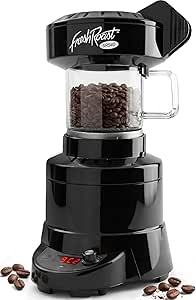
For a specialty-coffee drinker who wants to roast a small amount often, the Fresh Roast SR540 is the compact, straightforward choice in this set. Its 120 g capacity favors frequent, fresh batches and controlled experimentation over stocking up; the Kaibrite is better when output matters, while the DYVEE offers a visible drum and gas adjustment at the cost of a more involved setup. The SR540’s variable heat and convection-fan controls let users adjust how a small roast develops, and the glass roasting chamber makes the beans visible. The product states that a roast can finish in under 10 minutes, but beginners still need to learn how bean choice and roast level affect timing. Its capacity is a real ceiling for households serving many people, and plastic components may be a durability concern compared with the DYVEE’s stainless steel frame.
Pros:- Small 120 g capacity supports frequent, fresh batches.
- Variable heat and convection-fan controls allow hands-on roast adjustment.
- Glass roasting chamber provides a view of the beans.
- Compact 8.5 x 8.5-inch footprint is easier to place than the SR800 bundle.
Cons:- 120 g capacity is limiting for group use or bulk roasting.
- Roasting still requires learning how timing and roast preferences interact.
- Plastic components may raise durability concerns compared with the DYVEE’s stainless steel frame.
Best for: Solo coffee drinkers or couples who want frequent small-batch roasting, a compact footprint, and adjustable heat and fan controls.
Not ideal for: Large households or anyone who wants to roast several hundred grams at a time; the 120 g capacity is far below the Kaibrite’s stated best-capacity range.
- Brand:Fresh Roast
- Model:SR540
- Capacity:120 g
- Stated roast capacity:7–14 cups
- Roasting chamber:Glass
- Dimensions:8.5 x 8.5 x 13.5 inches
- Weight:2.56 kg
- Included components:Chaff basket, glass roasting chamber
Our verdict“Pick the SR540 if you want compact, adjustable small-batch roasting and do not need high output.”
750g Electric Coffee Roaster Machine for Home Use, 110V
Its 750g stated coffee capacity makes this a better fit for buyers roasting larger batches than the CAFEMASY CCR-305d, which handles just 80–100g at a time. Adjustable temperature and a stirring rod offer basic control over the roast, while the transparent lid lets you watch the beans as they change color. The non-stick honeycomb surface also suits cooks who want one appliance for coffee and other foods, including beans and grains. That versatility comes with a specialty-coffee tradeoff: the product data says optimal roasting requires thermometer monitoring, so it offers less roast guidance than the Roma Pro’s digital controls. Its listed capacities also vary by ingredient, and it is not suited to very small items such as sesame. Choose it for batch size and flexibility, not hands-off precision.
Pros:- 750g stated coffee capacity supports larger batches than the CAFEMASY CCR-305d.
- Adjustable temperature offers control over roast level.
- Transparent lid and stirring rod help with monitoring and even roasting.
- Non-stick coating supports easier cleanup and use with some other foods.
Cons:- Requires thermometer monitoring for better control of roast results.
- Not suitable for very small items such as sesame.
- Listed capacity depends on the ingredient, so its non-coffee capacity is not uniform.
Best for: Home roasters who want larger batches and also plan to roast items such as peanuts, red beans, or grains.
Not ideal for: Beginners seeking guided, repeatable coffee profiles or anyone who wants a compact, coffee-only machine with minimal monitoring.
- Coffee capacity:750g
- Voltage:110V
- Heating power:1200W
- Weight:6.2 lbs
- Dimensions:13.6 x 13.6 x 5.5 inches
- Materials:Teflon and glass
- Other listed capacities:Red beans: 1200g; peanuts: 500g; sunflower seeds: 400g
Our verdict“Choose this for larger, versatile batches if you are comfortable monitoring the roast rather than relying on digital guidance.”
CAFEMASY Coffee Bean Roaster Machine – Home Use Air Roaster with Adjustable Timer and Fan
The CAFEMASY CCR-305d favors manageable batches and visible controls over throughput. Its 80–100g capacity is far below the 750g machine listed above, but smaller batches make it easier to experiment with different green coffees without committing a large amount at once. Beginners can start with automatic mode, while manual adjustment of heat, fan, and timer gives more experienced home roasters room to change the process. The clear borosilicate jar supports visual monitoring, and a cooling function plus chaff basket help with post-roast handling. Compared with the Roma Pro, the CAFEMASY offers a much smaller batch and a stated timer range of 1–15 minutes, but its adjustable fan levels make airflow part of the control set. Its plastic body and repeated small batches may not suit buyers prioritizing a more substantial build or regular larger production.
Pros:- Automatic and manual modes accommodate different experience levels.
- Adjustable heating and fan levels provide useful roast-control options.
- Clear borosilicate jar makes the beans visible during roasting.
- Built-in cooling and a chaff collection basket support post-roast handling.
Cons:- 80–100g batch capacity can mean several cycles for larger needs.
- Heat-resistant ABS plastic body may feel less substantial than a metal alternative.
- The 1–15 minute timer range may constrain some roast approaches.
Best for: New specialty-coffee hobbyists who want to learn through small batches, with automatic assistance and manual controls available.
Not ideal for: Households that need larger batches in one cycle or buyers who prefer a metal-bodied appliance.
- Model:CCR-305d
- Batch capacity:80–100g
- Timer range:1–15 minutes
- Heating levels:1–8
- Controls:Touch control
- Cooling wattage:1400W
- Materials:Heat-resistant ABS plastic and borosilicate glass
- Dimensions:9.4 x 10.8 cm
Our verdict“Pick the CAFEMASY if you want to learn specialty roasting in small, observable batches and do not need high output.”
Coffee Roaster Machine for Home Use, 500g Household Electric Coffee Bean Roasters, 0-240℃ Non-Stick
This 500g electric roaster is a straightforward option for buyers who want roomier batches than the CAFEMASY’s 80–100g load without moving to the 750g model. Its temperature range reaches 464°F, and the honeycomb bottom is intended to spread heat across the roasting surface. Those features give hands-on roasters useful basic control, but the product data lists no automatic mode, so the operator must manage the process rather than rely on digital assistance like the Roma Pro. Side handles and a 5.2-pound listed weight make it easier to move than a fixed countertop appliance, though its 12.6-inch footprint still takes counter space. It is also described as suitable for small commercial use, but its 500g limit and manual operation make it a better match for occasional small-scale use than sustained production.
Pros:- 500g capacity sits between the CAFEMASY’s small batches and the 750g model’s larger loads.
- Temperature range reaches 464°F for adjustable roasting.
- Honeycomb bottom is designed for even heating.
- Side handles and 5.2-pound weight support easier repositioning.
Cons:- Manual operation requires the user to manage the roast.
- Maximum stated capacity is limited to 500g.
- The product data does not describe automatic controls or a built-in cooling function.
Best for: Hands-on home roasters who want a mid-size batch, adjustable heat, and an appliance they can move or store.
Not ideal for: Buyers who want automatic roast control, a compact footprint, or a clearly specified coffee-only capacity above 500g.
- Capacity:1.1 pounds
- Temperature range:32–464°F
- Wattage:800W
- Voltage:110V
- Materials:Polypropylene and glass
- Dimensions:12.6 x 12.6 x 4.7 inches
- Weight:5.2 pounds
Our verdict“Choose this mid-capacity model if you want adjustable heat and are willing to supervise each roast yourself.”
Roma Pro Smart Home Coffee Bean Roaster, 120V
The Roma Pro is the most control-oriented pick in this group: it pairs digital controls with automatic and manual modes, letting a specialty-coffee beginner start with a simpler process and an enthusiast take a more hands-on approach. Its 300g capacity is larger than the CAFEMASY’s 80–100g batches, though it falls short of the 500g and 750g machines for buyers focused on output. The stated ultra-low smoke operation, auto-cooling, and glass viewing window address practical home-roasting needs while making the beans easier to monitor. Compared with the 500g manual roaster, the Roma Pro emphasizes convenience and control over batch size. Its tall 18.5-inch profile needs a suitable storage or counter spot, and the available product data limits it to green coffee beans without specifying weight.
Pros:- Digital controls and automatic/manual modes support different skill levels.
- 300g capacity exceeds the CAFEMASY’s small-batch limit.
- Ultra-low smoke operation and auto-cooling suit home use.
- Glass viewing window lets users monitor the roast.
Cons:- 300g capacity is smaller than the 500g and 750g options in this batch.
- 18.5-inch height may be awkward for limited counter or cabinet space.
- Product data specifies green coffee beans only.
Best for: Specialty-coffee enthusiasts who want digital controls, both automatic and manual operation, and a moderate home batch size.
Not ideal for: Buyers who need batches above 300g, want to roast foods beyond green coffee beans, or have limited vertical counter space.
- Model:Roma Pro
- Capacity:300g
- Voltage:120V
- Dimensions:6 x 8.3 x 18.5 inches
- Material:Glass
- Operating modes:Automatic and manual
- Smoke operation:Ultra-low smoke
Our verdict“Choose the Roma Pro if digital control and home-friendly operation matter more than maximum batch size or a compact shape.”

How We Picked
I ranked these 14 machines around the needs of specialty coffee roasting: control over heat and airflow, likely batch size, visibility into the roast, ease of repeating a profile, chaff and smoke management, and the effort required to clean and operate the machine. I gave more weight to useful control and a credible path to repeatable results than to advertised capacity alone, since a big batch is of little help if it is hard to roast evenly.
The Fresh Roast SR800 bundle ranks first for its adjustable air-roasting approach and included scale and green coffee, which support learning and record-keeping. The SR540 follows as a smaller, more direct alternative. Models with smoke filters, timers, or chaff collectors earn consideration for convenience, but their listings provide less evidence of roast-profile control; the larger electric units are best treated as capacity-focused choices until buyers confirm their usable batch size and operating details. I place the gas-fired DYVEE in a distinct role because its glass drum offers a different roasting style but asks more of the operator.
Factors to Consider When Choosing Home Coffee Roaster Machine For Specialty Coffee
For specialty coffee, the machine is only one part of the decision. Your batch routine, ventilation, willingness to monitor a roast, and access to green coffee all shape whether a roaster becomes a useful tool or a rarely used appliance.
Choose Control Before Maximum Capacity
Advertised capacity can be misleading if the machine only roasts evenly with a smaller load. A larger chamber may suit frequent roasting, but it does not automatically provide better control over roast development. If you are learning, prioritize a manageable batch that lets you compare results and adjust your next roast. Ask whether the maker describes a recommended working batch size, not just the chamber’s maximum. A small, repeatable batch can be more useful for specialty coffee than a large batch that varies from roast to roast. Pick capacity based on how quickly you use coffee and how much room you have for cooling and storage.
Match the Roasting Style to How You Like to Work
Air roasters and drum roasters handle beans differently, so choose based on the kind of involvement you want rather than assuming one style is universally better. Air models such as the Fresh Roast options emphasize adjustable airflow and active monitoring, which can make experiments easier to follow. Drum-style machines may appeal if you want a more traditional roasting setup or larger batches, but check how clearly you can observe and adjust the roast. A gas model adds direct heat control but also requires comfort with burner operation and a suitable workspace. Beginners often benefit from controls they can understand and repeat. A machine with many settings is only helpful when the instructions explain how changes affect the roast.
Plan for Smoke, Chaff, and Ventilation
Roasting produces smoke and loose chaff, so a filter or collector should be treated as one part of a ventilation plan, not a substitute for it. Before buying, decide where the machine will run and whether that location can safely exhaust smoke. A kitchen appliance that fits on a counter may still be unsuitable for an enclosed room. Check how chaff is collected and removed, since difficult cleanup can discourage frequent roasting. Also look for clear guidance on filter replacement and cleaning, rather than assuming a listed smoke feature is maintenance-free. If indoor use is a priority, compare these practical details before comparing batch capacity.
Look for Repeatability, Not Just Automation
A timer or automatic program can simplify operation, but repeatable specialty roasting also depends on being able to track what happened during each batch. Look for controls that let you record or reproduce heat, fan, and timing choices where applicable. A scale helps you weigh green coffee consistently, while a simple roast log can reveal why one batch tastes different from another. Automation is most useful when it provides predictable results or clear adjustments, not when it hides the process. If you want to learn, choose a machine that lets you observe changes rather than relying only on preset modes. Buyers seeking convenience should still check whether programs can be adapted to different beans.
Budget for the Whole Roasting Setup
The roaster is not the only equipment a new hobbyist may need. Green coffee, a scale, a cooling method, storage containers, and ventilation can all affect the initial setup and daily routine. A bundle such as the SR800 package includes some useful starting items, but buyers should still check whether its accessories suit their preferred workflow. A lower-feature machine may leave more room in the budget for green beans and basic tools; a more automated or larger unit may reduce hands-on work but add complexity. Consider how often you expect to roast before paying for extra capacity. The best fit is the machine you can operate, clean, and use often enough to learn from.
Check Electrical and Workspace Requirements
Home roasters can draw substantial power, produce heat, and need space around their vents or exhaust connections. Confirm voltage and plug requirements against your home setup rather than assuming every 110V or 120V listing is interchangeable with your intended outlet. Measure the counter or work surface, including clearance for smoke pipes, lids, and safe bean cooling. For gas-powered machines, account for burner compatibility and safe operation in an appropriate ventilated area. A compact machine may be easier to store, but frequent setup and teardown can become a nuisance. Confirming these details before purchase can prevent an otherwise suitable roaster from being impractical at home.
Frequently Asked Questions
Is an air roaster or a drum roaster a better first machine for specialty coffee?
Neither style guarantees better coffee; the better choice depends on how you want to learn and roast. Air models in this lineup, including the SR540 and SR800, offer variable heat and fan controls that can make active adjustments part of the process. Drum-style options may suit buyers who prefer a different roast environment or want to explore larger batches, though listed capacity alone does not establish roast consistency. If your priority is understanding how adjustments affect a small batch, start with clear controls and a manageable working load. If you prefer a more traditional or hands-on setup, verify the drum model’s control and observation features before choosing.
Can I use a home coffee roaster indoors if it has a smoke filter?
A smoke filter can help manage roasting byproducts, but it should not be treated as proof that a machine is suitable for every indoor space. Roasting still produces smoke, heat, and chaff, and the amount can vary with the beans and roast level. Check the manufacturer’s ventilation instructions and plan for a location with appropriate airflow or exhaust. Also find out how the filter and collector are cleaned, since accumulated chaff can affect routine operation. If you cannot provide suitable ventilation, choose another location rather than relying on the filter alone.
Should I choose the largest-capacity machine if I roast every week?
Not automatically. A larger listed capacity may reduce the number of batches, but buyers should confirm the recommended working load and whether the machine can roast that amount evenly. Smaller, repeatable batches can be a better match if you are still learning or want to compare beans and roast profiles. Think about how much coffee you use before it goes stale, as roasting more than you can consume may undercut the benefit of larger loads. For frequent roasting, compare usable capacity, cooling workflow, and cleanup—not just the biggest number in the product name.
What should I buy alongside a home roaster to make repeatable specialty coffee?
A reliable scale is a useful first addition because consistent green-bean weights make batch comparisons more meaningful. You will also need a way to cool roasted beans promptly, suitable storage, and access to green coffee from sources that provide useful origin and processing details. A roast log can be as simple as a notebook recording batch size, settings, timing, and tasting notes. These tools help identify whether a change in flavor came from the bean or the roasting process. Some packages include accessories, but check what is actually supplied before planning the rest of your setup.
Is a gas-powered home roaster a good choice for a beginner?
It can suit a beginner who wants direct involvement and already has an appropriate, ventilated place to operate it, but it asks more of the user than a straightforward electric setup. The DYVEE KAKA-G400’s gas burner and glass drum suggest a more manual approach, so the buyer should be comfortable managing heat and following safe operating instructions. New roasters who prefer simple routines may find an electric air model easier to start with. Before choosing gas, check burner compatibility, workspace requirements, and how clearly the manufacturer explains operation. The choice is less about experience alone than about comfort with the extra setup and monitoring.
Conclusion
For most buyers focused on specialty coffee, I recommend the Fresh Roast SR800 bundle as the best overall: it combines adjustable air-roasting controls with accessories that support a more organized start. The SR540 is my best value-style pick for someone who wants a compact, hands-on air roaster without the bundle approach, while the Roma Pro Smart is the best premium-leaning option for shoppers drawn to a more automated workflow, subject to confirming its controls and operating details. For beginners who want to learn through active adjustments, I would start with the SR540 or SR800 rather than choosing a machine solely for a large capacity figure. Buyers who need larger batches can compare the 500 g, 750 g, 800 g, 1 lb, and 3.3 lb electric models, but should verify usable load and ventilation needs first. Choose the DYVEE KAKA-G400 for a gas-and-drum approach if manual heat management and its workspace requirements fit your routine; otherwise, the electric air-roaster picks are the more direct route to repeatable home experiments.