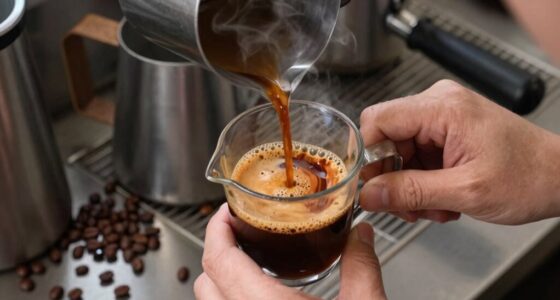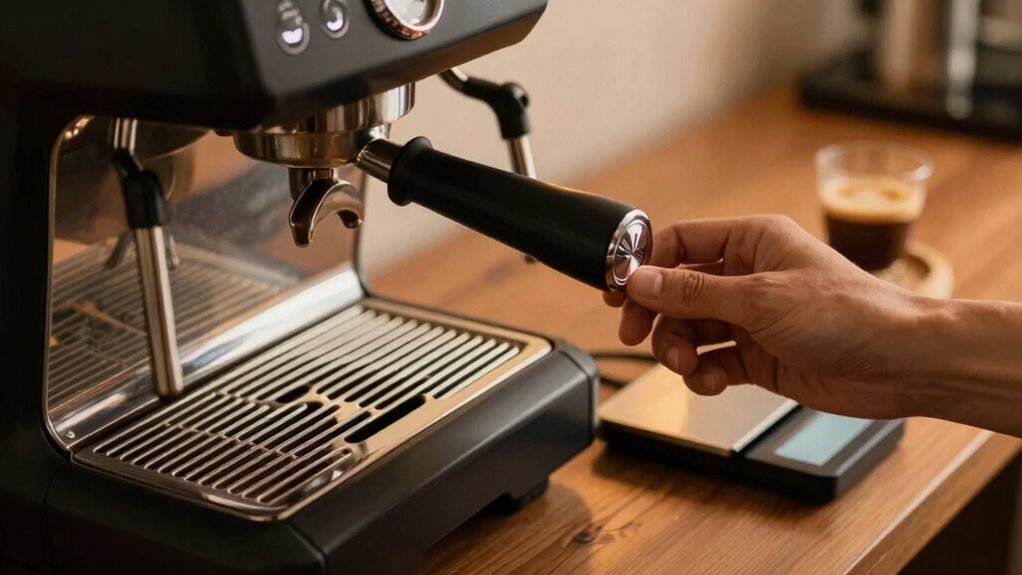

To make dialing in your coffee easier, use the combined shortcut of adjusting both brew ratio and grind size simultaneously. If your coffee tastes bitter or over-extracted, coarsen your grind and slightly increase the brew ratio to reduce extraction time. Underwhelming or weak brews benefit from a finer grind and lower ratio. Recognize how these adjustments interact, and you’ll quickly find the perfect balance. Keep mastering this method, and you’ll gain access to consistent, great flavors every time.

Get kitchen gear delivered free — and shop member deals
- Fast, free delivery on millions of items
- Access to Prime Big Deal Days deals on October 6–7
- Prime Video, Amazon Music and more included
Key Takeaways
- Use grind size adjustments to compensate for brew ratio changes, maintaining optimal extraction times.
- Keep a detailed log of grind size, ratio, and extraction to identify effective combinations quickly.
- Start with a balanced ratio and fine-tune grind size to dial in flavor without extensive trial-and-error.
- Recognize that coarser grinds require higher brew ratios, while finer grinds need lower ratios for ideal extraction.
- View grind size and brew ratio as interconnected tools, adjusting one to simplify achieving desired taste.
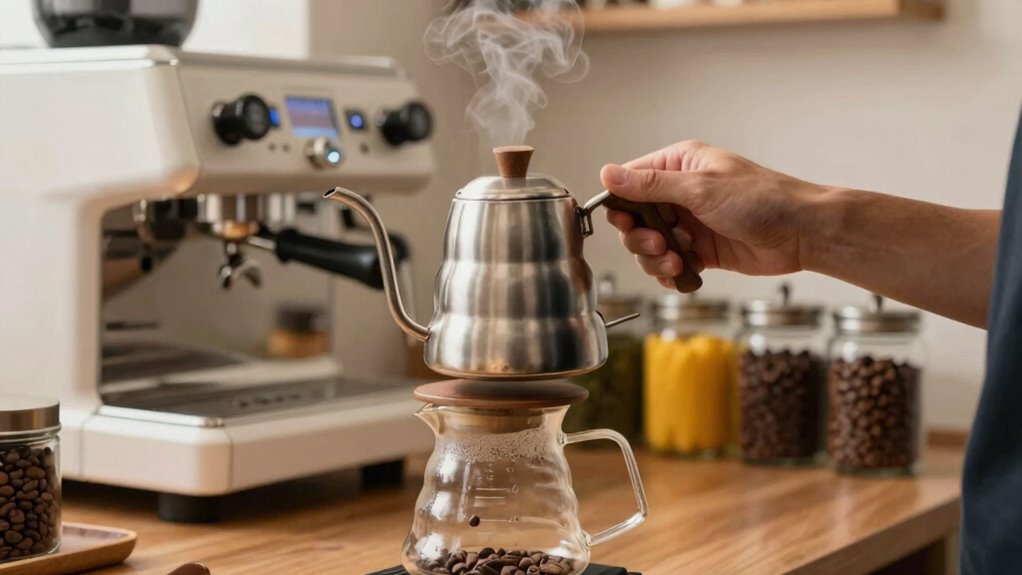
If you want to perfect your coffee brewing process, mastering the brew ratio is essential, but it can often feel complicated or time-consuming. The right ratio influences extraction time, which in turn affects flavor, strength, and overall quality. Getting this balance just right requires experimentation, patience, and a good understanding of how your coffee grind impacts extraction. A finer grind usually increases extraction time, making your brew richer but risking over-extraction, while a coarser grind shortens extraction time, which can lead to underwhelming flavors. Remember, the goal is to find that sweet spot where your coffee is neither too bitter nor too bland.
Mastering brew ratio and grind size helps you achieve perfect extraction and flavor balance in every cup.
The key to simplifying this process lies in understanding that your brew ratio and grind size are interconnected. Instead of starting from scratch each time, you can use a simple shortcut: think of your coffee grind as a dial you can adjust based on your desired extraction time. For example, if your brew tastes too bitter or over-extracted, you might want to coarsen your grind slightly and adjust your brew ratio accordingly. Conversely, if your coffee feels weak or under-extracted, a finer grind and a slightly higher coffee-to-water ratio can improve flavor. This approach helps you dial in your perfect brew faster because you’re not just guessing but making informed adjustments based on how your grind impacts extraction time. Understanding the relationship between brew ratio and grind size can significantly streamline your process. Recognizing extraction time as a crucial factor in brewing gives you a clearer target for adjustments. Additionally, understanding how brewing variables interact can help you develop a more intuitive approach to your coffee-making.
A practical trick is to keep a small notebook or digital log of your adjustments. Note the coffee grind size, brew ratio, and extraction time for each batch. Over time, you’ll notice patterns—perhaps a certain grind size paired with a specific ratio consistently produces your ideal extraction time. This method allows you to skip the trial-and-error phase and move directly toward your preferred taste profile. Remember, the secret isn’t just in the numbers but in how your coffee responds to these adjustments. Once you understand this relationship, you’ll find it much easier to make quick, effective changes on the fly.
The biggest shortcut is adopting a mindset that your grind size and brew ratio are tools for controlling extraction time. By tweaking one, you influence the other, creating a more predictable and manageable process. This way, you’re not just blindly pouring water and hoping for the best—you’re actively guiding your brew toward perfection. With a little practice, you’ll be able to achieve your desired flavor profile faster, consistently, and with less frustration. Mastering this relationship transforms brewing from a guessing game into a straightforward, enjoyable routine, making the whole process more satisfying and less stressful.
As an affiliate, we earn on qualifying purchases.
Frequently Asked Questions
How Does Brew Ratio Affect Coffee Flavor?
Brew ratio directly impacts your coffee’s flavor extraction and taste balance. A higher ratio, with more coffee to water, results in a stronger, more robust flavor, while a lower ratio produces a lighter, more delicate taste. By adjusting the brew ratio, you control how flavors are extracted, ensuring your coffee hits the perfect taste balance you prefer. It’s a simple way to fine-tune your brew for a better, more satisfying cup.
Can I Modify the Brew Ratio for Different Coffee Beans?
Think of your brew ratio as a tailor fitting a suit; you can adjust it for each coffee bean origin. Different beans, like Ethiopian or Colombian, may need tweaks in brew ratio. You might also need to tweak grind size adjustments to really dial in flavor. So yes, you can modify your brew ratio to suit each bean’s unique profile, helping you release the best taste from every shot.
What Tools Help Measure Brew Ratio Accurately?
You can use tools like a digital scale to measure coffee and water precisely, ensuring an accurate brew ratio. A calibrated pour-over or espresso scale helps you monitor water flow, while a thermometer tracks water temperature to optimize extraction. Adjust your grind size accordingly to affect flow rate, and maintain consistent water temperature. These tools make dialing in your coffee easier, giving you control over every variable for the perfect cup.
Is the Brew Ratio the Same for Espresso and Drip Coffee?
No, the brew ratio isn’t the same for espresso and drip coffee. With espresso, you typically use a higher coffee-to-water ratio, around 1:2, to achieve a concentrated shot. For drip coffee, the ratio is usually about 1:15 to 1:17, producing a milder brew. Your coffee equipment and brewing techniques influence these ratios, so adjusting them helps you get the perfect flavor and strength in each method.
How Often Should I Adjust My Brew Ratio?
Think of your brew ratio as a living thing—you should adjust it when your coffee’s flavor shifts. Typically, check and tweak every few weeks, especially if your coffee storage or grinder calibration changes. If your coffee tastes flat or sour, it’s time to revisit your brew ratio. Regularly calibrate your grinder and keep your beans fresh to maintain consistent results and avoid unnecessary adjustments.
coffee grind size adjustment tool
As an affiliate, we earn on qualifying purchases.
As an affiliate, we earn on qualifying purchases.
Conclusion
With this brew ratio shortcut, you’re now armed with a secret weapon, much like a master painter with their brightest palette. It simplifies your dial-in process, turning what once felt like an intricate dance into a smooth, effortless groove. As you embrace this rhythm, remember that every perfect shot is a step closer to barista mastery—your own symphony in a cup. Keep practicing, and let the brew ratio guide your journey, one delicious pour at a time.
As an affiliate, we earn on qualifying purchases.
As an affiliate, we earn on qualifying purchases.
Fall Picks
fall essentials
As an affiliate, we earn on qualifying purchases.