TL;DR
A home project by Shake the Future recycled aluminium coffee capsules into a cast Moka pot. The pot brewed coffee, but porous casting let water and coffee leak through its sides and base, so it was repurposed as a flower pot.
A home recycling project by Shake the Future used aluminium recovered from hundreds of single-use coffee capsules to cast a Moka pot, but the finished brewer leaked through its porous body and was repurposed as a flower pot. The experiment shows that capsule aluminium can be melted and recast, while also exposing a substantial materials challenge for making a usable household item.

Get kitchen gear delivered free with Prime
- Fast, free delivery on millions of items
- Prime Video, Amazon Music and more included
- Member-only deals all year
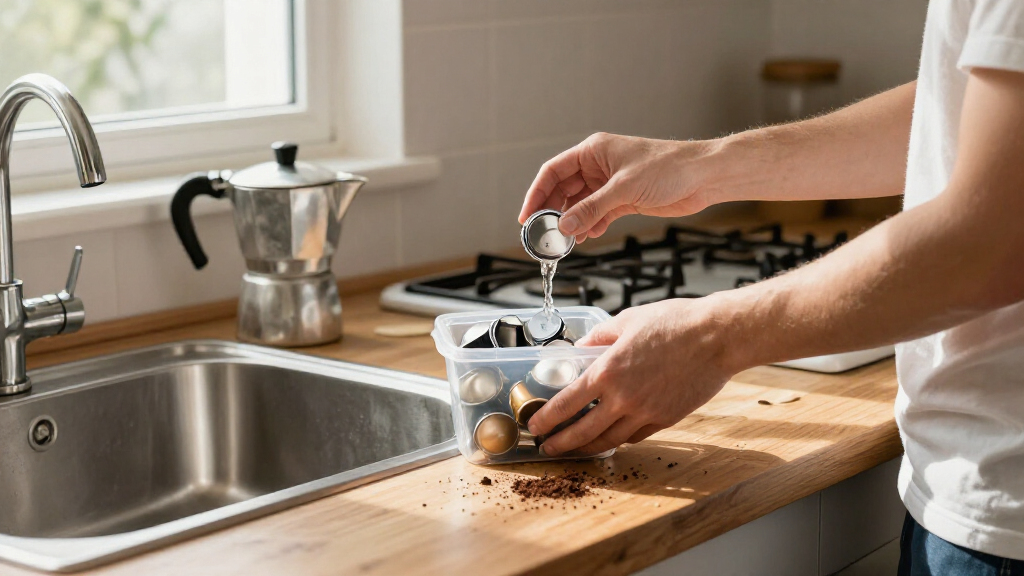
The project began with a practical question: could empty coffee capsules provide enough usable aluminium for a functional object? The capsules were collected and melted in a small furnace. Processing a few hundred took many hours, according to Hackaday’s account, as the project involved burning away plastic and other contaminants before producing aluminium ingots. The recovered metal appeared usable for casting, though the account does not provide a measured yield or analysis of its composition.
For the pot, Shake the Future made a two-part design by 3D-printing it in PLA and using the printed parts for lost-PLA casting. Molten aluminium was poured into the resulting molds, and the two cast pieces were assembled with an off-the-shelf filter and seal. The finished object did work as a Moka pot in the basic sense: it produced coffee. However, water and coffee also escaped through the base and sides instead of remaining inside the brewer.
The project account describes the cast aluminium as rather porous, but does not explain the precise cause or report a repair. Because the leakage undermined its use as a coffee maker, the pot was instead used as a flower pot. Hackaday presents the result as a working but imperfect experiment, not as a ready-to-use product or a tested recycling process for general household use.
From Coffee Capsules to Moka Pot
Shake the Future cast aluminium recovered from used capsules into a Moka pot. It brewed coffee, but leaks through its porous body made it unsuitable as a brewer.
From capsules to cast metal
Plastic and other contaminants were burned away before the recovered aluminium was cast.
Used capsules went into a small furnace to recover aluminium.
A two-part PLA design was used for lost-PLA casting.
The cast pieces were fitted with an off-the-shelf filter and seal.
A brew with a leak
The prototype made coffee, but the cast itself could not hold liquid reliably.
- Capsule aluminium was melted and recast.
- The assembled Moka pot produced coffee.
- Porous metal let water and coffee escape through the base and sides.
- The pot was repurposed as a flower pot.
What remains unresolved
The account shows a small-scale experiment, not a proven household recycling process.
- Exact capsule count and aluminium yield are not reported.
- The cause of the porosity and any repair remain unknown.
- No food-contact testing or leak-free follow-up is reported.
A Casting Defect Limits the Brewer
The experiment connects two familiar household items: single-use coffee capsules and a stovetop brewer that can be used without disposable pods. It demonstrates a possible route for turning capsule aluminium into a new object, rather than treating the empty shells only as waste. But the result also makes clear that recovering a metal is not the same as producing a reliable finished product.
For readers interested in home recycling, the key issue is the quality of the cast. A porous vessel that leaks cannot safely or effectively serve as a coffee maker, regardless of whether its metal came from discarded capsules. The long processing time for a few hundred capsules is another practical limitation reported in this particular setup. The project therefore illustrates both a material’s apparent potential and the work still needed to make the approach useful.
Products Worth Considering

Cuisinart TOA-112 15-in-1 Extra-Large Digital Toaster Oven Air Fryer

Breville Bambino Espresso Machine, Brushed Stainless Steel

Le Creuset Enameled Cast Iron Rectangular Roaster, 5.25 qt, Riviera
As an affiliate, we earn on qualifying purchases.
From Used Pods to Cast Aluminium
Many single-use coffee capsules contain aluminium, alongside plastic or other components. In this project, those materials had to be separated or burned away during melting before the recovered metal could be cast. Hackaday reports that the work involved several hundred capsules and took hours using a small furnace; it does not give a precise count, processing schedule, or aluminium yield.
A Moka pot is a stovetop coffee maker that uses ground coffee rather than disposable capsules. Its filter and seal help the assembled sections function as a brewer, but they cannot prevent liquid from escaping through porous metal walls. Here, the design and assembly proved sufficient to make coffee, while the quality of the cast itself remained the limiting issue. The account does not describe a later version or a successful method for eliminating the leaks.
“The cast aluminium is rather porous.”
— Hackaday’s account of the project
Yield and Leak Fix Remain Unknown
The project account does not state how much aluminium was recovered from the capsules, what proportion was lost during processing, or how the metal’s composition was assessed. It also does not identify why the casting became porous or whether the defect could be corrected by changing the mold, melting process, or pour. Those details matter for judging whether the method can be repeated reliably.
There is no reported follow-up showing a sealed, food-safe Moka pot made this way. The account also does not describe testing the cast metal for contamination or suitability for repeated contact with hot water and coffee. The demonstrated result is therefore limited to a leaky prototype, not evidence that capsule-derived aluminium is ready for routine use in coffee equipment.
A More Reliable Casting Is Needed
The next step, if the project continues, would be to address the porosity and leakage and test whether a revised casting can hold water under normal brewing conditions. Any improved version would also need appropriate checks for material quality and safe use with food and hot liquids. Hackaday’s account does not announce a further build, a planned test, or a timetable, so it is unclear whether another Moka pot will be made.
For now, the project stands as a small-scale demonstration: used capsules supplied metal for a cast object, but the first brewer did not hold liquid reliably. The flower-pot conversion marks the outcome of this attempt, while the wider possibility of making functional items from discarded capsules remains unproven in this example.
Source: Hackaday
Key Questions
What did the project make from coffee capsules?
Shake the Future melted aluminium recovered from used capsules and cast a two-part Moka pot, adding an off-the-shelf filter and seal.
Did the recycled-aluminium pot work?
It produced coffee, but water and coffee leaked through the base and sides because the cast metal was porous. It was later used as a flower pot.
How many capsules were processed?
The account refers to a few hundred capsules but does not give an exact count or the amount of aluminium recovered.
Why did the Moka pot leak?
The project account attributes the problem to porous cast aluminium. It does not identify the precise cause of the porosity or describe a fix.
Is this a proven way to make coffee equipment from capsules?
No. The project demonstrates that capsule aluminium could be melted and cast, but the resulting pot leaked. The account does not report food-contact testing or a reliable, leak-free version.
Source: Hackaday