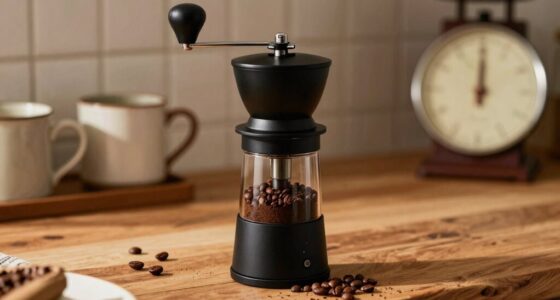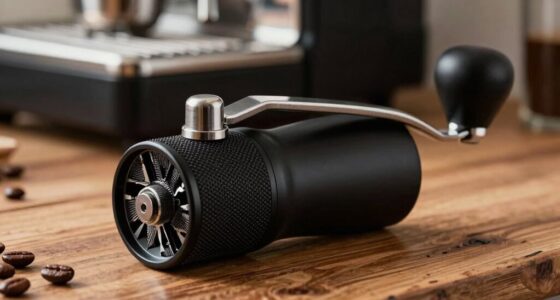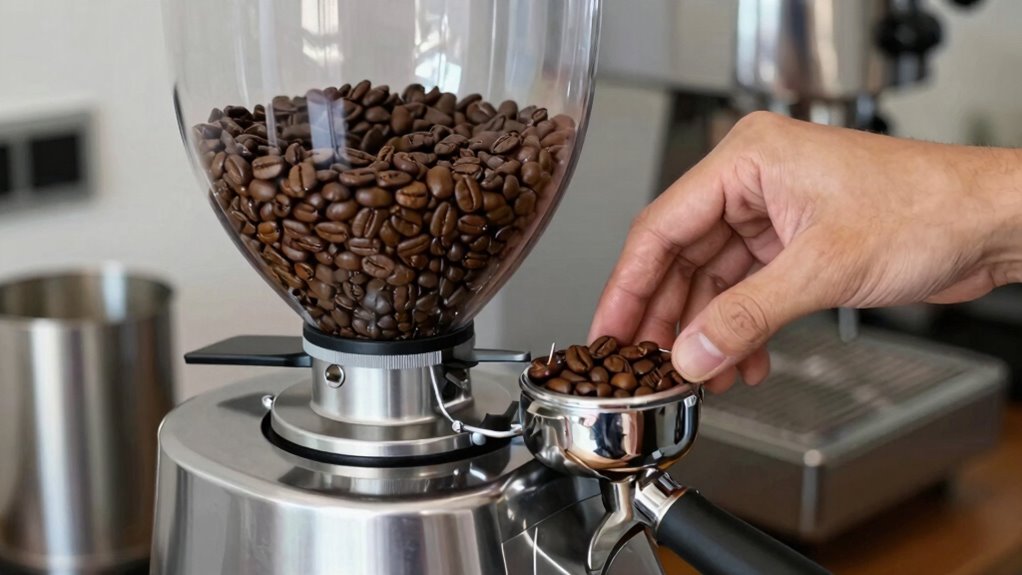

To make your single-dose grinder shine, implement a thorough bean testing workflow focusing on different brewing methods, bean origins, and grind consistency. Adjust settings based on extraction results, particle size, and distribution to optimize flavor and reliability. Document your process carefully, tracking improvements over time. By evaluating versatility across beans and brewing styles, you’ll reveal the grinder’s full potential. Keep exploring these steps, and you’ll discover even more ways to elevate your coffee experience.

Get kitchen gear delivered free with Prime
- Fast, free delivery on millions of items
- Prime Video, Amazon Music and more included
- Member-only deals all year
Key Takeaways
- Use diverse brewing methods to evaluate grinder adaptability and grind performance for different extraction requirements.
- Conduct particle distribution analysis to ensure consistent grind size across various bean types.
- Test with beans from different origins to assess grinder handling and uniformity with varying textures and moisture.
- Implement iterative adjustments based on testing results to optimize grind settings and consistency.
- Document performance metrics regularly to track improvements and confirm reliability across diverse coffee profiles.

Have you ever wondered how developers guarantee their code works flawlessly before deployment? While software relies on testing frameworks and code reviews, coffee enthusiasts depend on a different kind of testing workflow—especially when it comes to perfecting single-dose grinders. These tiny but mighty devices demand meticulous evaluation to guarantee every shot of espresso hits the mark. The first step in this process involves scrutinizing brewing methods, which directly influence the grinder’s performance. Different brewing styles—like pour-over, AeroPress, or espresso—demand specific grind sizes and consistency. By testing how well a grinder adapts to these methods, you identify its strengths and limitations. For instance, a grinder that produces uniform grounds suitable for espresso but struggles with coarser brews may not be versatile enough. Evaluating these brewing methods helps you understand how the grinder performs across various techniques, making sure it can meet diverse preferences. Understanding grind size is crucial because it directly impacts extraction and flavor, and testing with different brewing styles ensures the grinder’s versatility. Additionally, analyzing grind consistency across different brewing methods provides insights into the precision and reliability of the grinder’s performance. This process also includes assessing particle distribution, which is vital for ensuring optimal extraction and flavor balance. Incorporating testing protocols can streamline this process and ensure repeatable, accurate results. Regularly documenting your findings enhances your ability to compare and improve your process over time.
Equally important is bean origin analysis, which helps you grasp how different beans respond to the grinder’s settings. Beans from Ethiopia, Colombia, or Sumatra each have unique textures, moisture content, and flavor profiles. By analyzing how the grinder handles these variations, you determine its ability to produce consistent grounds regardless of bean origin. This step is essential because inconsistent grinding can lead to uneven extraction, resulting in dull or over-extracted coffee. When you test with beans from multiple origins, you uncover how well the grinder maintains uniformity and precision, making it a reliable tool for a range of beans. This process also guides adjustments in grind settings, allowing you to fine-tune the machine for peak results. The workflow continues with iterative testing, where you adjust settings based on initial results and reassess. This is similar to debugging code—finding the right configuration that delivers the best output. You pay close attention to grind size, particle distribution, and consistency, all of which impact flavor extraction. Accurate testing involves measuring grind uniformity and observing extraction times, providing tangible data to refine your process. As you go through these steps, you develop a detailed understanding of the grinder’s capabilities, ultimately making sure that it performs reliably across different brewing methods and bean types. This rigorous approach helps single-dose grinders shine, transforming them from just a gadget into a precision tool tailored to your coffee preferences.
Products Worth Considering

De'Longhi La Specialista Touch Semi-Automatic Espresso Machine with Grinder

De'Longhi La Specialista Arte Evo Espresso Machine with Grinder

Breville Bambino Espresso Machine, Brushed Stainless Steel
As an affiliate, we earn on qualifying purchases.
Frequently Asked Questions
What Types of Beans Are Best for Single-Dose Grinders?
You should choose freshly roasted beans, as their freshness guarantees ideal flavor and aroma. Look for beans with a consistent roast to maintain grind consistency, which is vital for a balanced extraction. Single-dose grinders shine when used with beans that are uniform in size and quality, such as specialty single-origin beans or well-sorted blends. Always store beans properly to preserve freshness and achieve the best results in your brewing process.
How Often Should I Calibrate My Grinder During Testing?
You should calibrate your grinder regularly during testing, ideally after every few batches or when you notice inconsistencies in grind size or extraction. This guarantees peak performance and accurate results. Adjust your grinder calibration whenever you change bean types or roast levels, and consider more frequent calibrations if you’re experimenting with different grind settings. Consistent testing frequency helps maintain precision and guarantees your coffee stays flavorful and balanced.
What Are Common Signs of a Poorly Performing Grinder?
Is your grinder whispering secrets of its decline? Signs of poor performance include inconsistent grind size, uneven extraction, and stale-tasting coffee, which often point to a need for grinder calibration. If your beans aren’t freshly roasted, these issues worsen, making it harder to achieve ideal flavor. Regular calibration ensures your grinder maintains precision, preserving bean freshness and delivering a consistently perfect brew. Don’t ignore these signs—they’re your cue to tune up.
Can the Workflow Be Adapted for Commercial Coffee Production?
Yes, you can adapt this workflow for commercial coffee production. Focus on scaling procedures that maintain consistency and precision while handling larger batches. Incorporate rigorous quality control at each stage, from bean selection to grinding, to guarantee uniformity. By emphasizing these steps, you’ll preserve the benefits of the original workflow—such as ideal grind consistency—while meeting the demands of a high-volume operation.
What Tools Complement the Bean Testing Process?
You might think tools are unnecessary, but they truly enhance your bean testing process. Use precision scales to measure coffee extraction accurately, guaranteeing consistent results. A grinder maintenance kit keeps your equipment in top shape, preventing flavor inconsistencies. A refractometer can help analyze extraction quality, providing valuable insights. These tools streamline your workflow, improve accuracy, and ensure that each grind and brew meets your standards for taste and quality.
Conclusion
By adopting this streamlined bean testing workflow, you’ll uncover the full potential of your single-dose grinder, ensuring every shot is fresh and flavorful. Did you know that freshly ground beans can increase extraction efficiency by up to 30%? That’s a game-changer for coffee lovers aiming for consistency and quality. Embrace these steps, and you’ll not only elevate your brewing game but also enjoy a richer, more satisfying cup every time.