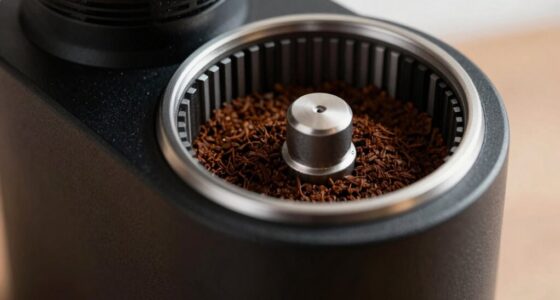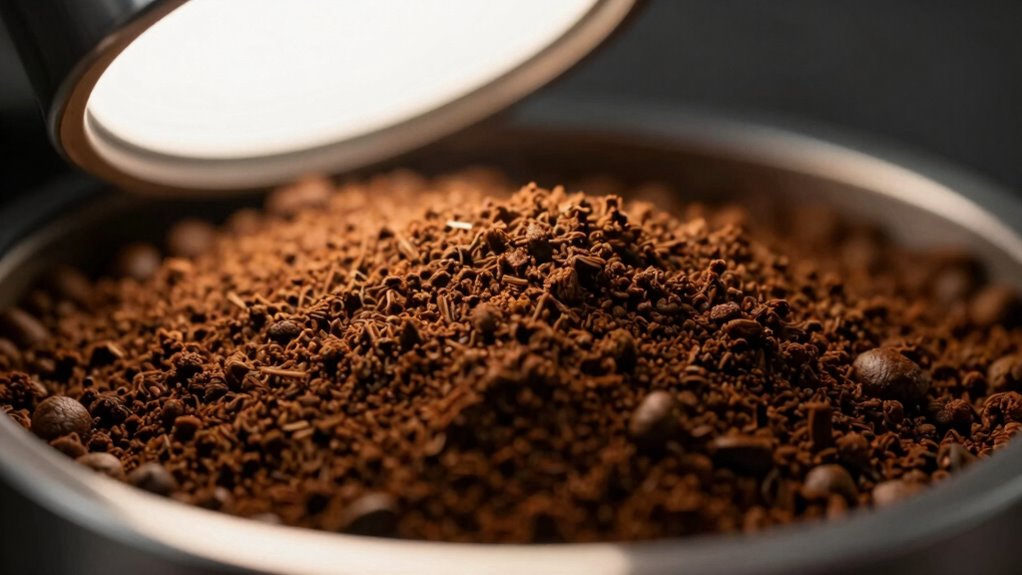

Grind density can trick you during prep because it affects water flow and extraction without obvious signs. A dense grind increases resistance, causing uneven extraction or bitterness, while a loose grind lets water flow too quickly, resulting in weak coffee. Handling, moisture, and tamping all influence density, making it tricky to gauge if your adjustments are working. If you want to understand how to manage these factors for better coffee, keep exploring these key concepts.

Get kitchen gear delivered free — and shop member deals
- Fast, free delivery on millions of items
- Access to Prime Big Deal Days deals on October 6–7
- Prime Video, Amazon Music and more included
Key Takeaways
- Dense grind doesn’t always mean finer particles; packing can affect water flow independently of grind size.
- Variations in moisture and handling can alter perceived grind density, misleading your assessment.
- Tamping and agitation can change how tightly grounds are packed, impacting extraction despite consistent grind size.
- Inconsistent particle sizes within the grind can cause uneven extraction, masking true grind density.
- Focusing solely on grind size can overlook packing and distribution factors that influence water movement during brewing.

When preparing your coffee, it’s tempting to assume that a finer grind always leads to a better extraction, but grind density can be more deceiving than you think. A dense grind doesn’t necessarily mean it’s finely ground; it simply indicates how tightly packed the coffee particles are. This density can influence how water flows through your coffee bed, affecting the overall coffee extraction process. If your grind is overly dense, water may struggle to penetrate evenly, leading to under-extraction in some areas and over-extraction in others. Conversely, if your grind is too loose, water might rush through too quickly, resulting in a weak, under-extracted brew. Understanding this balance is key because grind size consistency plays a critical role in achieving uniform extraction. An inconsistent grind causes uneven particle sizes, which means some particles extract faster than others, leading to a muddled flavor profile.
You might think that just adjusting the grind size will fix these issues, but it’s more complicated. The density of your grind impacts how water interacts with the coffee during extraction. When your grind is too dense, the water faces resistance, which can slow down the extraction and cause bitterness or astringency. On the other hand, a loosely packed grind allows water to flow too freely, missing out on the full flavor potential. The goal is to find a sweet spot where water moves through the coffee evenly, extracting the right compounds without overdoing it. That’s why grind size consistency is so essential—if your grind varies from batch to batch or even within the same batch, your coffee’s flavor will be inconsistent. Additionally, grind density can be affected by factors such as moisture content and grinding technique, which further complicate achieving optimal results. Paying attention to grind uniformity can help minimize these issues and improve overall extraction quality. Recognizing the impact of particle packing can lead to more precise control over your brewing process. Furthermore, proper handling techniques like tamping or agitation can influence the density and ensure a more even extraction. Also, maintaining consistent grind distribution can prevent uneven extraction caused by uneven particle packing.
It’s worth noting that grind density isn’t just about particle size; it’s also about how you handle and prepare your coffee grounds. Tamping, for example, can increase density, influencing how water moves during brewing. You need to pay attention not only to grind size but also to how tightly you pack your grounds. When you pay attention to these details, you’ll notice improvements in your coffee extraction, with a more balanced, flavorful cup. Ultimately, understanding that grind density can trick you helps you focus on consistency and precision, which are crucial for brewing great coffee. Remember, achieving the perfect extraction isn’t just about grind size but about controlling the whole process—from grind size consistency to your tamping technique and brewing time.
coffee grind size and density adjustment tools
As an affiliate, we earn on qualifying purchases.
As an affiliate, we earn on qualifying purchases.
Frequently Asked Questions
How Does Grind Density Affect Extraction Time?
Your grind density directly impacts extraction time by influencing grind size; a finer grind increases density, leading to slower extraction, while a coarser grind decreases density and speeds it up. When your grind is too dense, your coffee flavor can become over-extracted and bitter, whereas a less dense grind may yield under-extracted, sour flavors. Adjusting grind size helps you control extraction time and achieve the desired coffee flavor.
Can Grind Density Influence Brew Temperature?
You might find that grind density can influence brew temperature more than you think—it’s like stirring the pot before boiling. When you adjust grind size, it impacts how water flows through your coffee, affecting temperature stability. Finer grinds tend to retain more heat, while coarser ones allow quicker cooling. So, pay attention to your grind size and water temperature because they work hand in hand to deliver that perfect cup.
Is Grind Density the Same for All Brewing Methods?
No, grind density isn’t the same for all brewing methods. You need to focus on grind uniformity and particle size, which vary depending on your brewing technique. For example, espresso requires a fine, consistent grind, while French press calls for a coarser, more uniform grind. Adjusting these factors guarantees ideal extraction, flavor, and clarity, making your brew taste just right, no matter the method you choose.
How Do I Measure Grind Density Accurately?
You measure grind density by tuning your grinder calibration until the coffee bean texture feels just right—neither too coarse nor too fine. Use a consistent method, like weighing a small sample and checking flow rate or extraction time, to gauge accuracy. Think of it as fine-tuning a musical instrument, ensuring your grind hits the perfect pitch for your brewing method. This approach helps you dial in the ideal grind density every time.
Does Grind Density Impact Flavor Consistency?
Yes, grind density impacts flavor consistency because it influences how evenly water extracts flavors during brewing. Variations in grind density can cause flavor variability, making each cup taste different. This inconsistency presents challenges in maintaining uniform flavor profile across multiple brews. To achieve better consistency, you need to measure and control grind density carefully, ensuring an even grind size that minimizes flavor variability and delivers a more predictable, balanced taste every time.
espresso tampers for even packing
As an affiliate, we earn on qualifying purchases.
As an affiliate, we earn on qualifying purchases.
Conclusion
Remember, just like Icarus soaring too close to the sun, relying solely on grind density can lead you astray. It might seem perfect in the moment, but true mastery comes from understanding the bigger picture. Don’t let the illusion of the perfect grind fool you—trust your experience, stay adaptable, and keep refining your craft. In the end, it’s the balance you strike that really determines your success.
coffee grinder with uniform grind settings
As an affiliate, we earn on qualifying purchases.
As an affiliate, we earn on qualifying purchases.
coffee brewing water flow control devices
As an affiliate, we earn on qualifying purchases.
As an affiliate, we earn on qualifying purchases.
Evergreen bestsellers Picks
bestsellers
As an affiliate, we earn on qualifying purchases.