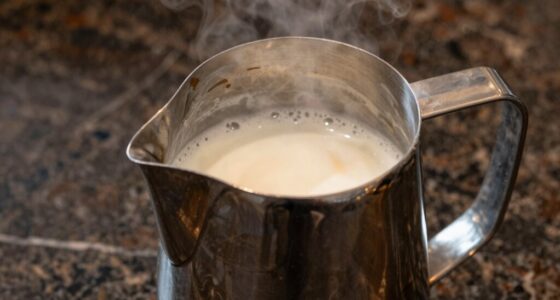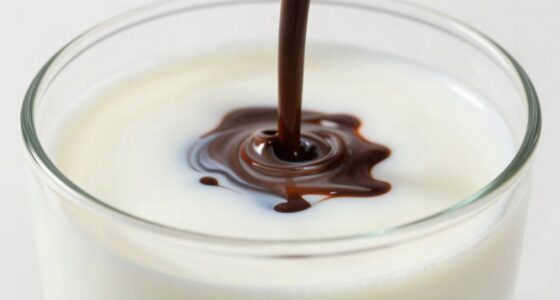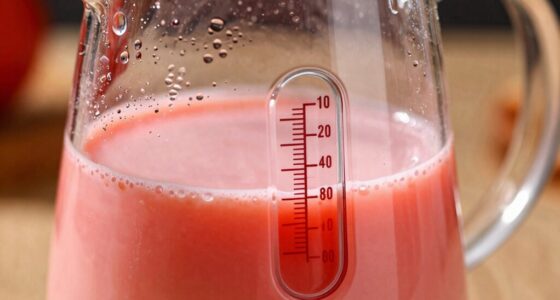
If your milk’s texture falls apart while pouring, it’s likely spoiled. Bacteria break down proteins and fats, causing the milk to become lumpy, curdled, or uneven. When this happens, fats and solids separate, making the flow thin and inconsistent. Proper storage at or below 40°F slows this process, but if milk isn’t kept cold, spoilage accelerates. Keep an eye on signs like sour smell or lumps to avoid this, and discover more ways to prevent texture issues.

Get kitchen gear delivered free with Prime
- Fast, free delivery on millions of items
- Prime Video, Amazon Music and more included
- Member-only deals all year
Key Takeaways
- Spoilage bacteria produce acids that break down milk proteins and fats, causing curdling during pouring.
- Elevated storage temperatures accelerate bacterial activity, leading to texture breakdown while pouring.
- Structural changes from spoilage result in lumpy, uneven flow as fats and proteins separate.
- Improper refrigeration allows bacteria to multiply, compromising milk’s smooth consistency.
- Signs like sour smell and lumps indicate that milk has already begun to spoil before pouring.

Have you ever noticed that milk sometimes loses its smooth, creamy texture just as you’re pouring it, leaving behind a thin, uneven stream? That sudden change isn’t random; it’s often linked to milk spoilage and temperature effects. When milk starts to spoil, bacteria multiply, producing acids that alter its structure. This process can cause the proteins and fats to separate or curdle, disrupting the smooth flow you expect. As a result, instead of pouring out in a steady, creamy stream, the milk appears thin, lumpy, or uneven. You might also notice a sour smell or off-taste, which signals that the milk has gone past its prime due to spoilage. Proper storage techniques are essential to maintain milk’s texture and prevent spoilage. Temperature plays a crucial role in maintaining milk’s texture. Milk is sensitive to temperature effects, and even slight fluctuations can accelerate spoilage. If you leave milk out of the fridge for too long or store it at temperatures above 40°F (4°C), bacteria grow faster. This bacterial activity breaks down the milk’s proteins and fats, leading to the changes in texture you see while pouring. When milk is stored properly—ideally at or below 40°F—it remains fresh longer, and its consistency stays smooth. But once temperature control is compromised, the bacteria can quickly cause the milk to spoil, resulting in that unpleasant, uneven pouring experience.
Spoiled milk curdles and becomes lumpy, disrupting its smooth, creamy pour.
Moreover, the way milk is processed and stored impacts how susceptible it is to texture issues. Pasteurized milk, which is heated to kill harmful bacteria, still contains some bacteria that can multiply if not refrigerated properly. Over time, these bacteria cause the milk to spoil, especially if the storage temperature isn’t kept consistent. When you pour spoiled milk, the fats and proteins may have already separated or curdled, which makes the flow uneven. This separation is a clear sign that the milk has undergone spoilage and is no longer safe or pleasant to drink.
In essence, your milk’s texture while pouring is a direct reflection of its freshness and how well you’ve managed temperature effects. To keep that smooth, creamy pour, always store milk in the coldest part of your fridge and check its expiration date. If the milk smells sour or looks lumpy, it’s best to discard it. Proper storage and attention to temperature effects not only preserve milk’s texture but also prevent the discomfort of pouring spoiled, lumpy milk.
milk storage temperature monitor
As an affiliate, we earn on qualifying purchases.
As an affiliate, we earn on qualifying purchases.
Frequently Asked Questions
Can Temperature Affect Milk’s Texture During Pouring?
Yes, temperature can affect milk’s texture during pouring. When milk’s temperature isn’t stable, its viscosity changes, making it more prone to breaking apart or forming lumps. Cold milk maintains better viscosity and texture, while warmer milk can become thinner and less stable. To keep the texture smooth and consistent, you want to guarantee temperature stability, so the milk pours smoothly without falling apart.
Does the Type of Milk Influence How Quickly It Separates?
Did you know that different milk types can separate in just minutes? The type of milk influences how quickly it separates because of its unique milk composition. Whole milk, with higher fat content, tends to resist fat separation longer than skim milk. Fat separation occurs when the fat globules break apart from the rest of the milk, affecting texture. So, choosing milk with a balanced composition can help maintain its smoothness longer during pouring.
How Does Pouring Speed Impact Milk Texture?
Pouring speed directly impacts milk consistency—pour too fast, and the turbulence can cause the proteins and fats to separate, making the texture fall apart. A steady, controlled pouring technique helps maintain a smooth, uniform consistency. When you pour slowly, you allow the milk’s natural emulsions to stay intact, preventing it from breaking apart mid-pour. So, take your time to preserve the milk’s creamy, cohesive texture.
Can Additives or Flavorings Cause Milk to Break Apart?
Additives and flavorings can cause milk to break apart like oil and water, leading to flavor separation. When you add certain substances—think sweeteners, powders, or syrups—they interact with milk’s proteins and fats, destabilizing the structure. These additive interactions disrupt the smooth, uniform texture, resulting in separation during pouring. To prevent this, choose compatible flavorings and add them gradually, allowing the milk’s natural consistency to stay intact.
Is There a Way to Prevent Milk From Falling Apart While Pouring?
To prevent milk from falling apart while pouring, focus on maintaining a stable milk foam and avoiding the formation of dairy curds. Use fresh, properly heated milk, ideally between 140-150°F, and pour slowly to keep the foam intact. Avoid sudden movements or too high temperatures, which can cause the foam to collapse and curds to form. Stir gently before pouring to guarantee even consistency and minimize separation.
As an affiliate, we earn on qualifying purchases.
Conclusion
As you pour milk, it’s like watching a delicate dance unravel mid-step. The texture falls apart, slipping through your fingers like grains of sand, each tiny particle losing its hold. Understanding the science behind this chaos helps you tame the flow, turning a messy spill into a smooth stream. So next time, handle your pour with patience, and let the milk glide gracefully, a silky ribbon rather than a shattered mosaic.
As an affiliate, we earn on qualifying purchases.
milk pour spout with temperature control
As an affiliate, we earn on qualifying purchases.
As an affiliate, we earn on qualifying purchases.
Fall Picks
fall essentials
As an affiliate, we earn on qualifying purchases.