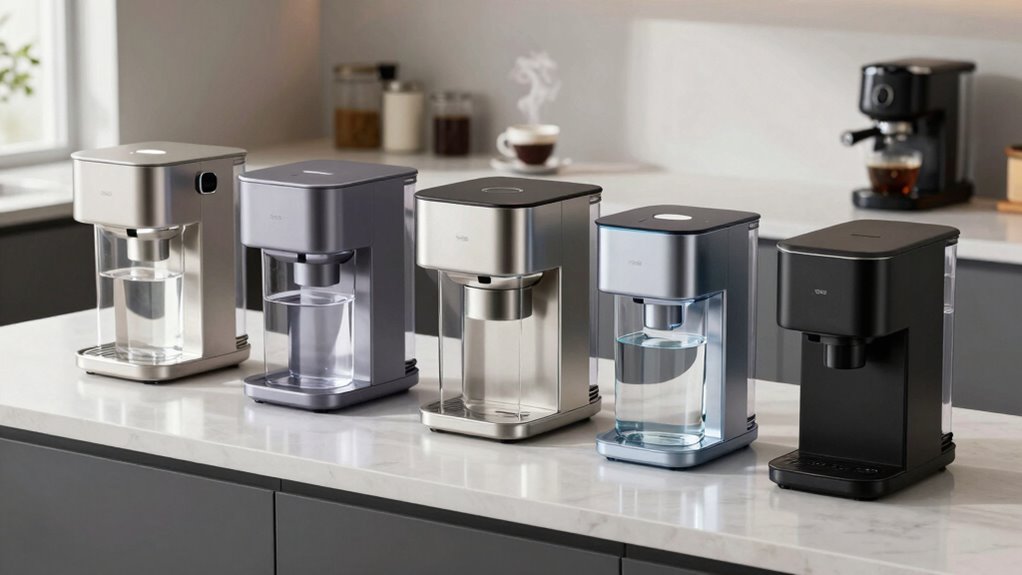
For a countertop water filtration system for coffee under $300, I’d start with the Bluevua RO100ROPOT-Lite as the best overall balance of reverse-osmosis filtration and countertop convenience. The Waterdrop C2SL stands out for mineral addition, while the Avalon non-electric dispenser is a simpler choice for buyers who want to avoid power and complex controls. The main tradeoffs are filtration depth versus mineral content, convenience versus maintenance, and feature-rich hot-and-cold dispensing versus counter space. I compare all 15 options by coffee suitability, everyday usability, upkeep, and value. Read on for the full breakdown and help matching a system to your water and brewing routine.
Complete the kit


Key Takeaways
- Reverse osmosis leads the lineup for broad contaminant reduction, but coffee drinkers should check whether a model adds minerals back or leaves water very low in dissolved minerals.
- Mineralization is a point of separation: the Waterdrop C2SL and M6SL, Waterdrop A2G, and mineralized RO option target buyers who want more than highly purified water alone.
- Hot-and-cold features trade counter space and complexity for convenience; the DREO, Waterdrop A2G, HBN, and CT01 are better fits for multi-use dispensing than for buyers who only need brewing water.
- Not every useful coffee filter needs reverse osmosis: Avalon, Aquasana, and GLACIER FRESH offer simpler filtration approaches, but their treatment capabilities differ from RO systems.
- Portability, capacity, and maintenance separate similar RO dispensers: the Bluevua Travel model favors moving or smaller setups, while larger feature sets can mean more upkeep and a bigger footprint.
| DREO Reverse Osmosis Water Filter Countertop, 7-in-1 RO Filtration System with Self-Cleaning and Autofill |  | Best for Low-Maintenance RO | Filtration system: Reverse osmosis (RO) | Filtration configuration: 7-in-1 | Named contaminants: Chlorine, fluoride, PFOA, PFOS, and more | VIEW ON AMAZON | See Our Full Breakdown |
| Waterdrop A2G Mineral Reverse Osmosis System Countertop, Instant Hot & Cold |  | Best for Temperature-Controlled Coffee and Tea | Filtration stages: 6 | Temperature range: 59°F to 203°F | Capacity: 4.7 liters | VIEW ON AMAZON | See Our Full Breakdown |
| Express Water Countertop Reverse Osmosis Water Filtration System, White |  | Best for Faucet-Connected Brewing | Filtration stages: 4 | Flow rate: 0.5–1 gallon per hour | Contaminant removal: 99.99%, as described | VIEW ON AMAZON | See Our Full Breakdown |
| Waterdrop C2SL Countertop Reverse Osmosis Water Filter with Mineral Addition |  | Best for Mineral-Balanced Daily Brewing | Filtration stages: 7 | Membrane pore size: 0.0001 μm | Named reduction figures: 99.8% PFOA, 99.7% PFOS, 99.96% microplastics, 99.83% lead, 99.51% chlorine, 98.45% fluoride | VIEW ON AMAZON | See Our Full Breakdown |
| Bluevua RO100ROPOT-Lite Countertop Reverse Osmosis Water Filter |  | Best Compact Pick for Small Kitchens | Installation type: Countertop | Purification method: Reverse osmosis | Filter life cycle: 1 year | VIEW ON AMAZON | See Our Full Breakdown |
| Bluevua RO100ROPOT Travel Reverse Osmosis Countertop Water Filter |  | Best for Travel and Small Counters | Filtration technology: Reverse osmosis with UV light | Filtration stages: 6 | Dimensions: 10 x 5 x 13.5 inches | VIEW ON AMAZON | See Our Full Breakdown |
| PR1-P Countertop Reverse Osmosis Water Filter System, 5-Stage Filtration |  | Best for Large Batches Without Plumbing | Filtration stages: 5 | Filtration media: Polypropylene, coconut shell activated carbon, 0.0001 μm RO membrane, post-carbon filter, post-polypropylene | Listed contaminant reduction: Chlorine, fluoride, arsenic, lead, PFOA, PFOS, odors, and TDS | VIEW ON AMAZON | See Our Full Breakdown |
| Waterdrop M6SL Mineral Reverse Osmosis Water Filter Countertop, Room-Temp |  | Best for Mineral-Infused Coffee Water | Filtration technology: Reverse osmosis | Membrane: 0.0001 μm RO membrane | Tank capacity: 185 oz | VIEW ON AMAZON | See Our Full Breakdown |
| Avalon Countertop Water Filter System, NSF Certified Dual Filtration, Non-Electric Dispenser with Drip Tray, Black |  | Best for a Simple, Non-Electric Setup | Type: Countertop water filter | Filtration: Dual filtration: sediment and carbon block | Power: Non-electric | VIEW ON AMAZON | See Our Full Breakdown |
| GLACIER FRESH PC04 Gravity-Fed Countertop Water Filtration System |  | Best for High-Volume, Off-Grid Use | Technology: Elarisey electrosorption | Container type: Dispenser | Installation type: Countertop | VIEW ON AMAZON | See Our Full Breakdown |
| HBN Hot & Cold Countertop Reverse Osmosis Water Filter System, 6 Temp Options, Dual Filters PAC+ROC, Touch Control, for Home Kitchen or Office Use |  | Best for Coffee Temperature Control | Purification method: Reverse osmosis with PAC and ROC filters | Temperature options: 50°F, room temperature, 113°F, 131°F, 185°F, and 212°F | Dispense volumes: 10 oz and 17 oz, with manual stop | VIEW ON AMAZON | See Our Full Breakdown |
| Waterdrop CT01 Countertop Water Filter System, Hot and Cold Water Dispenser |  | Best Mineral-Retaining Hot-and-Cold Pick | Filtration: Six-stage activated carbon | Filter capacity: 300 gallons | Filter life cycle: Six months | VIEW ON AMAZON | See Our Full Breakdown |
| Bluevua RO100ROPOT Countertop Reverse Osmosis Water Filter System |  | Best Glass-Carafe RO Pick | Filtration stages: 5 | Filtration type: Countertop reverse osmosis | Carafe material: High-borosilicate glass | VIEW ON AMAZON | See Our Full Breakdown |
| Aquasana Countertop Water Filter – Reduces Lead, PFAS & Microplastics |  | Best for Targeted Contaminant Reduction | Filtration technology: Claryum | Stated contaminants reduced: Lead, PFAS, microplastics, mercury, pesticides, and pharmaceuticals | Flow rate: 8 oz in 8 seconds | VIEW ON AMAZON | See Our Full Breakdown |
| Reverse Osmosis Water Filter Countertop Natural Mineralized |  | Best High-Capacity Hot-Water RO Pick | Filtration stages: 10 | Filtration method: Reverse osmosis with mineralization | Capacity: 5 liters | VIEW ON AMAZON | See Our Full Breakdown |
| countertop water filtration system for coffee under 300 | Dimensions |
|---|---|
| DREO Reverse Osmosis Water Fil | — |
| Waterdrop A2G Mineral Reverse | 15.9 × 8.2 × 15.7 inches |
| Express Water Countertop Rever | — |
| Waterdrop C2SL Countertop Reve | — |
| Bluevua RO100ROPOT-Lite Counte | 9.7 × 9.5 × 14.1 inches |
| Bluevua RO100ROPOT Travel Reve | 10 x 5 x 13.5 inches |
| PR1-P Countertop Reverse Osmos | 14.6 x 7 x 14.2 inches |
| Waterdrop M6SL Mineral Reverse | — |
| Avalon Countertop Water Filter | — |
| GLACIER FRESH PC04 Gravity-Fed | 14.25 x 13.58 x 16.14 inches |
| HBN Hot & Cold Countertop Reve | 16.4 × 9.1 × 14.8 inches |
| Waterdrop CT01 Countertop Wate | 14.43 × 10.61 × 13.43 inches |
| Bluevua RO100ROPOT Countertop | — |
| Aquasana Countertop Water Filt | — |
| Reverse Osmosis Water Filter C | 11 × 14.8 × 17.7 inches |
More Details on Our Top Picks
DREO Reverse Osmosis Water Filter Countertop, 7-in-1 RO Filtration System with Self-Cleaning and Autofill
For coffee drinkers who want broad contaminant reduction without connecting a system to the faucet, the DREO 7-in-1 pairs reverse osmosis filtration with an autofill pitcher and self-cleaning. That combination makes it a more convenience-focused pick than the Express Water Countertop Reverse Osmosis System, which connects to compatible faucets and has a stated flow rate but no listed autofill feature. DREO’s description names chlorine, fluoride, PFOA, and PFOS among the contaminants it removes, and lists NSF/ANSI 58. The tradeoff is that the supplied details do not state filter life or production rate, so it is harder to plan ongoing upkeep or judge how quickly it can supply water for several brews. I’d choose it for a simple countertop routine, not for buyers who need clearly documented capacity and replacement intervals.
Pros:- Reverse osmosis filtration is described as reducing chlorine, fluoride, PFOA, and PFOS.
- Self-cleaning can reduce routine maintenance effort.
- Autofill pitcher simplifies collecting water for brewing.
- Installation-free setup avoids faucet compatibility concerns.
Cons:- Filter lifespan is not specified in the supplied product details.
- No filtration flow rate or tank capacity is provided for planning coffee-making demand.
Best for: Coffee drinkers who want countertop RO filtration, a pitcher that fills automatically, and less hands-on cleaning.
Not ideal for: Buyers who need a published filter replacement interval or water production rate before choosing a system.
- Filtration system:Reverse osmosis (RO)
- Filtration configuration:7-in-1
- Named contaminants:Chlorine, fluoride, PFOA, PFOS, and more
- Standard:NSF/ANSI 58
- Maintenance feature:Self-cleaning
- Dispensing feature:Autofill pitcher
- Installation:Installation-free
Our verdict“Choose DREO if autofill and self-cleaning matter more to you than having published capacity and filter-life details.”
Waterdrop A2G Mineral Reverse Osmosis System Countertop, Instant Hot & Cold
The Waterdrop A2G is the most beverage-oriented option here: its instant hot-and-cold dispensing spans 59°F to 203°F, so it can serve more than room-temperature water for coffee preparation. It also adds minerals after six-stage RO filtration, a contrast with the DREO 7-in-1, whose listed strengths center on self-cleaning and an autofill pitcher rather than temperature selection. The 4.7-liter capacity gives a household a useful reservoir, but the unit weighs 22 pounds and measures nearly 16 inches tall, so it needs a committed spot on the counter. Its 3:1 pure-water ratio is stated, while filter replacement frequency is not. I’d favor this model when on-demand temperature flexibility matters; buyers focused on a smaller footprint or simpler water-only setup may prefer the Bluevua RO100ROPOT-Lite.
Pros:- Instant hot and cold dispensing supports varied brewing and drinking needs.
- Temperature range reaches 203°F for hot-water dispensing.
- Mineral addition distinguishes it from RO systems without listed remineralization.
- Portable, installation-free setup avoids plumbing work.
Cons:- The 22-pound body and nearly 16-inch height take substantial counter space.
- A 4.7-liter capacity may mean frequent refills in a busy household.
- Filter replacement details are not specified in the supplied product information.
Best for: Coffee and tea drinkers who want filtered water dispensed hot or cold without heating water separately.
Not ideal for: People with crowded counters or those who mainly need room-temperature water and want a lighter, simpler appliance.
- Filtration stages:6
- Temperature range:59°F to 203°F
- Capacity:4.7 liters
- Dimensions:15.9 × 8.2 × 15.7 inches
- Weight:22 pounds
- Pure-water ratio:3:1
- Mineral addition:Adds beneficial minerals
Our verdict“Pick the A2G if you want mineralized RO water dispensed at selectable hot and cold temperatures and have room for its larger body.”
Express Water Countertop Reverse Osmosis Water Filtration System, White
Unlike the pitcher-style Bluevua RO100ROPOT-Lite, the Express Water system connects to a compatible faucet and produces a stated 0.5–1 gallon per hour. That makes its output rate easier to evaluate for a steady coffee routine, though it is not an instant hot-water dispenser: it filters cold water only, so you’ll still need a kettle or brewer to heat it. The four-stage RO setup is described as removing 99.99% of contaminants, and its filters are listed at approximately six months. Quick-connect fittings support straightforward setup, but the faucet must have a threaded removable aerator or a suitable adapter. I’d rank this above self-contained options for buyers comfortable with a faucet connection and clear flow information, but below them for renters whose taps or kitchen setup are a poor fit.
Pros:- Stated flow rate of 0.5–1 gallon per hour helps set expectations for water supply.
- Four-stage reverse osmosis filtration is described as removing 99.99% of contaminants.
- Quick-connect fittings support a relatively direct setup on compatible faucets.
- Approximately six-month filter life is provided in the product details.
Cons:- Requires a threaded removable-aerator faucet or an appropriate adapter.
- Cold-water-only operation means coffee water must be heated separately.
- The stated output may not suit high-demand households.
Best for: Apartment, RV, or office users with a compatible threaded-aerator faucet who want a stated filtration rate for regular brewing.
Not ideal for: Renters with incompatible faucets, buyers who cannot connect equipment to a tap, or anyone expecting hot water directly from the unit.
- Filtration stages:4
- Flow rate:0.5–1 gallon per hour
- Contaminant removal:99.99%, as described
- Faucet compatibility:Threaded removable-aerator faucets
- Water pressure range:45–80 PSI
- Water temperature range:40–85°F
- Filter life:Approximately six months
- Warranty:1 year
Our verdict“Choose Express Water if you have a compatible faucet and value a published flow rate more than a self-contained, hot-water-ready design.”
Waterdrop C2SL Countertop Reverse Osmosis Water Filter with Mineral Addition
The Waterdrop C2SL combines seven-stage RO filtration with mineral addition, which gives coffee drinkers a different tradeoff from the more appliance-like Waterdrop A2G: C2SL lists a 108-ounce tank and smart maintenance alerts, but no instant hot-and-cold dispensing. Its specified reductions include fluoride, chlorine, lead, microplastics, PFOA, and PFOS, while calcium, magnesium, potassium, and sodium are added back. That mineral profile may appeal to buyers who prefer not to brew with straight RO water, though the product details do not establish a particular coffee flavor outcome. Setup needs no plumbing, and the listed filter life reaches 12 months or 528 gallons. Its 3:1 pure-to-drain ratio and space-taking countertop tank make it a better match for one or two people than a high-volume household.
Pros:- Adds calcium, magnesium, potassium, and sodium after RO filtration.
- 108-ounce tank provides a substantial ready-water supply for a small household.
- Smart display and voice alerts help track maintenance.
- Filter life is specified as up to 12 months or 528 gallons.
Cons:- Countertop tank requires dedicated space.
- Designed for smaller households rather than high-volume use.
- Does not list instant hot-water dispensing, unlike the Waterdrop A2G.
Best for: One- or two-person households seeking mineral-added RO water, a larger reservoir, and reminders for filter upkeep.
Not ideal for: Large households or coffee drinkers who want hot water dispensed directly from the filtration unit.
- Filtration stages:7
- Membrane pore size:0.0001 μm
- Named reduction figures:99.8% PFOA, 99.7% PFOS, 99.96% microplastics, 99.83% lead, 99.51% chlorine, 98.45% fluoride
- Minerals added:Calcium, magnesium, potassium, sodium
- Tank capacity:108 oz
- Filter life:Up to 12 months or 528 gallons
- Pure-to-drain ratio:3:1
- Certification:NSF/ANSI/CAN 372
Our verdict“Choose the C2SL if you want mineral-added RO water in a larger countertop reservoir and do not need built-in hot-water dispensing.”
Bluevua RO100ROPOT-Lite Countertop Reverse Osmosis Water Filter
With a footprint of 9.7 by 9.5 inches and a height of 14.1 inches, the Bluevua RO100ROPOT-Lite is the most compact stated option in this group. It suits a small kitchen better than the larger Waterdrop A2G, which adds hot-and-cold dispensing but occupies more counter space and weighs 22 pounds. Bluevua’s installation-free RO design produces water at a listed 0.26 liters per minute and includes a borosilicate glass carafe, a useful distinction for buyers who prefer glass storage. Its smart LED display tracks filter life and water quality, and the filter cycle is listed as one year. The tradeoff is limited capacity, so frequent coffee brewing or serving multiple people may require more refills. I’d pick it for compactness and simple carafe use, not for high-volume convenience.
Pros:- Compact listed dimensions suit a smaller countertop.
- Borosilicate glass carafe offers an alternative to plastic water storage.
- Installation-free setup makes it straightforward to place and use.
- Smart LED display tracks filter life and water quality.
Cons:- Limited capacity may require repeated refills for multiple coffee drinkers.
- Listed flow rate is 0.26 liters per minute, slower than a high-throughput setup may require.
- Filter replacement is required on a one-year cycle.
Best for: Solo coffee drinkers or couples with limited counter space who prefer storing filtered water in a glass carafe.
Not ideal for: Large households or frequent brewers who need a bigger ready supply or faster output than the listed rate.
- Installation type:Countertop
- Purification method:Reverse osmosis
- Filter life cycle:1 year
- Dimensions:9.7 × 9.5 × 14.1 inches
- Capacity:12 liters
- Weight:5 kg
- Material:Borosilicate glass
- Flow rate:0.26 liters per minute
- Pure-to-drain ratio:3:1
Our verdict“Choose the RO100ROPOT-Lite if counter space and a glass carafe matter more than high-volume output or built-in temperature control.”
Bluevua RO100ROPOT Travel Reverse Osmosis Countertop Water Filter
The Bluevua RO100ROPOT Travel is the compact pick for coffee drinkers who want reverse-osmosis filtration without plumbing or a permanent setup. Its six-stage process with UV offers a more involved treatment approach than the Avalon dual-filter dispenser, while its 10-inch length and 11-pound weight make it easier to move than a large-capacity unit such as the Waterdrop M6SL. That portability comes with a small serving size: it dispenses just 18 ounces per cycle, so filling a larger coffee maker takes repeated runs. The glass bottle is useful for collecting water, but there is no built-in storage tank. It also needs an outlet, unlike the gravity-fed GLACIER FRESH PC04. I’d choose it for occasional brewing or limited counter space, not for preparing several pots back to back.
Pros:- Six-stage reverse osmosis filtration includes UV treatment.
- Compact 10 x 5 x 13.5-inch footprint is easier to relocate than large-tank systems.
- Plug-and-play setup avoids plumbing installation.
- Glass bottle is included for collecting filtered water.
Cons:- Only 18 ounces are dispensed per cycle, making larger brews slower to prepare.
- No built-in water storage tank.
- Requires an electrical outlet, unlike the gravity-fed GLACIER FRESH PC04.
Best for: Coffee drinkers in small kitchens, temporary homes, or travel settings who want plug-and-play RO filtration and usually brew one serving at a time.
Not ideal for: Households that make multiple pots of coffee in quick succession, since each cycle dispenses only 18 ounces and there is no built-in storage tank.
- Filtration technology:Reverse osmosis with UV light
- Filtration stages:6
- Dimensions:10 x 5 x 13.5 inches
- Weight:11 lbs (5 kg)
- Capacity:2000 liters
- Filtered water output:18 oz per cycle
- Waste water ratio:3:1
- Material and power:Glass; corded electric
Our verdict“Choose the Bluevua Travel if portability and a small footprint matter more than having a large supply ready for coffee.”
PR1-P Countertop Reverse Osmosis Water Filter System, 5-Stage Filtration
The PR1-P suits coffee drinkers who want a larger batch of filtered water ready without connecting a countertop system to a water line. Its five-stage RO process includes a 0.0001 μm membrane and a glass pitcher, and the stated output of up to 68 fluid ounces per cycle is far more convenient for filling a carafe or brewing for several people than the Bluevua RO100ROPOT Travel’s 18-ounce serving. The tradeoff is a taller, wider setup: the listed dimensions are 14.6 x 7 x 14.2 inches, with at least 18 inches of vertical clearance required. Its filling cycle may also produce noticeable dripping sounds. Like the Bluevua, it has a 3:1 waste-water ratio, so neither is a zero-waste option. I’d favor the PR1-P for batch convenience, but not for a crowded shelf.
Pros:- Produces up to 68 fluid ounces per cycle for larger brewing needs.
- Five-stage filtration includes a 0.0001 μm RO membrane and post-carbon filter.
- High-borosilicate glass pitcher provides a separate vessel for filtered water.
- No installation is required.
Cons:- Needs at least 18 inches of vertical clearance.
- Filling can create noticeable dripping sounds.
- The 3:1 waste-water ratio produces drain water.
Best for: Coffee drinkers who want to fill a carafe or brew for several people at once and prefer a pitcher-based RO system that does not require installation.
Not ideal for: People with low cabinets or limited counter clearance, or anyone who needs a quiet system during filling.
- Filtration stages:5
- Filtration media:Polypropylene, coconut shell activated carbon, 0.0001 μm RO membrane, post-carbon filter, post-polypropylene
- Listed contaminant reduction:Chlorine, fluoride, arsenic, lead, PFOA, PFOS, odors, and TDS
- Water production:Up to 68 fl. oz (2 L) per cycle
- Filter life:CF filter: 6 months; RO filter: 12 months
- Dimensions:14.6 x 7 x 14.2 inches
- Waste water ratio:3:1
- Materials:BPA-free plastics and high-borosilicate glass pitcher
Our verdict“Pick the PR1-P if you want a larger pitcher of RO-filtered water for coffee and have enough counter clearance.”
Waterdrop M6SL Mineral Reverse Osmosis Water Filter Countertop, Room-Temp
The Waterdrop M6SL is the lineup’s mineral-focused RO option: after filtration, it adds potassium, calcium, sodium, and magnesium to the water. That makes it a distinct choice for coffee drinkers who prefer mineralized water rather than the highly reduced TDS output specified for the PR1-P. Its 185-ounce tank and 135-ounce pure-water output also make it better suited to keeping water on hand for repeated brewing than the Bluevua RO100ROPOT Travel, which dispenses only 18 ounces per cycle. The added capacity takes up more space, and the product data does not provide dimensions, so counter fit is harder to judge. Setup may also be less straightforward, and the pitcher needs careful handling during flushing. I’d choose it for mineral preference and stored capacity, not for buyers seeking the simplest small-counter RO system.
Pros:- Adds potassium, calcium, sodium, and magnesium after RO filtration.
- 185-ounce tank and 135-ounce pure-water output support repeated brewing.
- 0.0001 μm RO membrane is specified.
- Includes smart touch controls and NFC support with filter-life indicators.
Cons:- Dimensions are not specified, making counter fit difficult to assess.
- Setup can be complex compared with the plug-and-play Bluevua RO100ROPOT Travel.
- Pitcher must be handled carefully during flushing.
Best for: Coffee drinkers who specifically want mineral-infused RO water and a larger supply available for repeated brewing.
Not ideal for: Buyers with very limited counter space or those who want a straightforward setup with clearly documented dimensions.
- Filtration technology:Reverse osmosis
- Membrane:0.0001 μm RO membrane
- Tank capacity:185 oz
- Pure-water output:135 oz
- Waste water:50 oz
- Water ratio:3:1 pure to drain
- Minerals added:K⁺, Ca²⁺, Na⁺, Mg²⁺
- Material and power:Glass pitcher; plug-in
Our verdict“Choose the Waterdrop M6SL if you value mineral-infused water and larger stored capacity more than compact size or simple setup.”
Avalon Countertop Water Filter System, NSF Certified Dual Filtration, Non-Electric Dispenser with Drip Tray, Black
The Avalon countertop system is the simplest option here for buyers who want water on demand without an electrical appliance or repeated pitcher refills. Its sediment and carbon-block filters differ from the reverse-osmosis systems in this roundup: compared with the PR1-P or Bluevua RO100ROPOT Travel, it offers a less elaborate treatment method, but also avoids their powered filtration cycles. That may suit coffee drinkers who mainly want a basic countertop filtration step and already have a compatible water-source connection. The filter-life indicator helps track maintenance, while the drip tray catches spills during dispensing. It only provides room-temperature water, and its connection requirement makes it less portable than the plug-and-play Bluevua. The supplied details do not specify capacity or dimensions, so I would check fit and source compatibility before choosing it for a coffee station.
Pros:- Non-electric operation avoids a powered filtration cycle.
- Dual sediment and carbon-block filtration.
- Filter-life indicator helps track maintenance.
- Bottleless design includes a drip tray.
Cons:- Requires connection to a water source, so it is less portable than the Bluevua RO100ROPOT Travel.
- Dispenses room-temperature water only.
- Capacity and dimensions are not specified in the supplied product data.
Best for: Coffee drinkers with a suitable water-source connection who want an always-ready, room-temperature dispenser without electricity.
Not ideal for: Renters or travelers who need a portable system, and buyers seeking the RO treatment method or mineral additions offered by other picks.
- Type:Countertop water filter
- Filtration:Dual filtration: sediment and carbon block
- Power:Non-electric
- Color:Black
- Design:Bottleless
- Water temperature:Room temperature
- Features:Filter-life indicator and drip tray
Our verdict“Choose Avalon if you have a compatible water connection and want a non-electric room-temperature dispenser rather than an RO system.”
GLACIER FRESH PC04 Gravity-Fed Countertop Water Filtration System
The GLACIER FRESH PC04 is the high-volume, no-electricity choice for households that want a large dispenser rather than an RO pitcher. Its 2.25-gallon capacity can keep coffee water available for repeated brews, a substantial contrast with the Bluevua RO100ROPOT Travel’s 18-ounce output per cycle. Gravity-fed operation also suits outdoor or emergency use where an outlet is unavailable. The tradeoff is counter space: at 14.25 x 13.58 x 16.14 inches, it is much larger than the travel model and needs a permanent spot. Its electrosorption method is different from the RO systems in this roundup, so buyers specifically seeking reverse-osmosis filtration should choose the PR1-P or Waterdrop M6SL instead. Filter replacement is listed every three months, which may mean more frequent upkeep than the PR1-P’s stated RO-filter interval.
Pros:- 2.25-gallon capacity supports repeated brewing and shared use.
- Gravity-fed operation requires no electricity.
- Stainless-steel construction is suited to countertop or outdoor use.
- Designed for countertop placement without a powered system.
Cons:- Large 14.25 x 13.58 x 16.14-inch footprint takes substantial counter space.
- Filter life is listed as three months, requiring regular replacement.
- Performance depends on source-water quality and differs from the RO systems in this roundup.
Best for: Families, shared coffee stations, and off-grid users who need a large gravity-fed supply and do not want to rely on electricity.
Not ideal for: Small kitchens or buyers specifically seeking reverse-osmosis filtration, since this dispenser is bulky and uses electrosorption instead.
- Technology:Elarisey electrosorption
- Container type:Dispenser
- Installation type:Countertop
- Power source:Gravity-fed
- Filter life cycle:3 months
- Dimensions:14.25 x 13.58 x 16.14 inches
- Capacity:2.25 gallons
- Material:Stainless steel
Our verdict“Pick the GLACIER FRESH PC04 if you need a large, electricity-free supply more than compact size or RO filtration.”
HBN Hot & Cold Countertop Reverse Osmosis Water Filter System, 6 Temp Options, Dual Filters PAC+ROC, Touch Control, for Home Kitchen or Office Use
For coffee drinkers who want hot water at a chosen temperature, the HBN combines reverse osmosis filtration with four hot settings, including 185°F and 212°F, plus cold and room-temperature dispensing. That range offers more control for brewing than the Waterdrop CT01, which reaches 203°F and uses activated carbon filtration rather than RO. The HBN also dispenses set portions or lets you stop the flow manually, which can make repeat cup filling less fiddly.
The tradeoff is a 1.3-gallon tank and a relatively large countertop footprint; it is not a compact carafe-style option like the Bluevua RO100ROPOT. Its quick hot-and-cold functions add flexibility, but also make it a more feature-heavy choice than a basic filter. I would pick it for varied hot drinks, not for buyers seeking the simplest or smallest coffee-water setup.
Pros:- Offers hot settings up to 212°F, including a 185°F option for brewing
- Reverse osmosis membrane paired with PAC and ROC filters
- Provides cold, room-temperature, and four hot-water choices
- Manual stop and 10-ounce or 17-ounce dispensing options
Cons:- The 16.4 × 9.1 × 14.8-inch footprint takes meaningful counter space
- The 1.3-gallon tank may require frequent refills for multiple coffee drinkers
- More controls and temperature functions than buyers need for basic filtered water
Best for: Coffee and tea drinkers who want RO-filtered water, several brewing temperatures, and portion controls in a plug-in countertop dispenser.
Not ideal for: Buyers with limited counter space or anyone who only needs room-temperature water and prefers a simpler, less feature-heavy filter.
- Purification method:Reverse osmosis with PAC and ROC filters
- Temperature options:50°F, room temperature, 113°F, 131°F, 185°F, and 212°F
- Dispense volumes:10 oz and 17 oz, with manual stop
- RO membrane capacity:75 GPD
- Stated filter capacity:Up to 1,057 gallons
- Tank capacity:1.3 gallons
- Dimensions:16.4 × 9.1 × 14.8 inches
- Installation:Countertop; no plumbing required
Our verdict“Choose the HBN if temperature choice and RO filtration matter more than a compact footprint or a simple setup.”
Waterdrop CT01 Countertop Water Filter System, Hot and Cold Water Dispenser
The Waterdrop CT01 suits coffee drinkers who want filtered water without stripping out minerals. Its six-stage activated-carbon system is designed to retain beneficial minerals, and it produces hot water up to 203°F alongside cold water. For brewing, that means convenient temperature choices in one countertop unit, while the HBN Hot & Cold RO system is the stronger fit for shoppers specifically seeking reverse osmosis and a hotter maximum setting.
The CT01’s zero-waste filtration approach avoids the wastewater associated with RO systems, but it also does not significantly lower TDS. That distinction matters if reducing dissolved solids is a priority, rather than preserving mineral content. Its 1.32-gallon reservoir is useful for shared kitchens, though the unit still needs counter space and replacement filters every six months. I’d favor it for convenience and mineral retention, not for maximum TDS reduction.
Pros:- Six-stage activated-carbon filtration retains beneficial minerals
- Provides hot water up to 203°F and cold water on demand
- Produces no wastewater according to the supplied product information
- 1.32-gallon capacity supports shared household use
Cons:- Does not significantly reduce TDS, unlike the HBN and Bluevua RO systems
- Filter replacement is specified every six months
- Countertop-only installation limits placement options
Best for: Households that want hot and cold filtered water for coffee and other drinks while retaining minerals and avoiding RO wastewater.
Not ideal for: Buyers who want reverse osmosis or a substantial reduction in TDS, or who need an under-sink rather than countertop system.
- Filtration:Six-stage activated carbon
- Filter capacity:300 gallons
- Filter life cycle:Six months
- Maximum water temperature:203°F
- Maximum supported feed-water TDS:700 PPM
- Container capacity:1.32 gallons
- Dimensions:14.43 × 10.61 × 13.43 inches
- Installation:Countertop; no plumbing required
Our verdict“Pick the CT01 if you want mineral-retaining filtered water and hot-and-cold convenience rather than RO-level TDS reduction.”
Bluevua RO100ROPOT Countertop Reverse Osmosis Water Filter System
The Bluevua RO100ROPOT makes sense for coffee drinkers who prefer a carafe over a hot-water dispenser. Its five-stage reverse osmosis system provides mineral-enriched water, and the high-borosilicate glass carafe offers a non-plastic vessel for collecting and pouring it. Unlike the HBN and Waterdrop CT01, this model does not offer instant hot and cold dispensing, so brewing water still needs to be heated separately. In return, its format is more straightforward for someone who wants filtered water ready to pour.
The 2:1 water-saving ratio and power-saving feature are useful differentiators among the RO choices, though this is still an electric countertop appliance rather than a faucet-connected system. Its stated filter life of 12–24 months reduces how often replacements may be needed compared with the CT01’s six-month schedule, but the actual interval depends on use. I’d choose it for glass storage and RO filtration, not for temperature control at the tap.
Pros:- Five-stage reverse osmosis filtration with mineral enrichment
- High-borosilicate glass carafe provides a glass collection vessel
- Stated water-saving ratio of 2:1
- Filter life is listed as 12–24 months
Cons:- No hot-water dispensing or selectable brewing temperatures
- Requires electricity and countertop placement
- Filter life varies within the stated 12–24-month range
Best for: Coffee drinkers who want countertop RO water collected in a glass carafe and are comfortable heating water separately.
Not ideal for: Anyone who wants instant hot water, set brewing temperatures, or a dispenser that pours directly into a cup.
- Filtration stages:5
- Filtration type:Countertop reverse osmosis
- Carafe material:High-borosilicate glass
- Filter life:12–24 months
- Water-saving ratio:2:1
- Water treatment:Mineral enrichment
- Power feature:Power-saving design
- Warranty:1-year limited
Our verdict“Choose the Bluevua RO100ROPOT if glass-carafe storage and RO filtration matter more than instant hot-water convenience.”
Aquasana Countertop Water Filter – Reduces Lead, PFAS & Microplastics
Aquasana is the straightforward choice for buyers focused on reducing named contaminants, including lead, PFAS, and microplastics, while retaining essential minerals. Its stated flow rate—8 ounces in 8 seconds—makes it practical for filling a coffee kettle without waiting on a slow pour. Compared with the Bluevua RO100ROPOT, Aquasana is not a reverse osmosis system and does not reduce TDS; it is better matched to people who value the listed contaminant-reduction claims and mineral retention over RO treatment.
That simpler approach also means no temperature controls or built-in hot-water function: you’ll still need a kettle or coffee machine. The filter is rated for up to six months or 300 gallons, so replacement is a recurring part of ownership, much like the Waterdrop CT01. I would choose Aquasana as a focused filtration step before brewing, but skip it if you want one appliance to filter and heat water.
Pros:- Stated reduction of lead, PFAS, microplastics, mercury, pesticides, and pharmaceuticals
- Retains essential minerals rather than reducing TDS
- Flow rate is listed as 8 ounces in 8 seconds
- Countertop setup requires no installation
Cons:- Does not reduce TDS like the Bluevua RO100ROPOT
- No hot-water dispensing or coffee-brewing temperature controls
- Filter replacement is listed every six months or 300 gallons
Best for: Coffee drinkers who want a quick-flow countertop filter with stated reductions for lead, PFAS, and microplastics while retaining minerals.
Not ideal for: Buyers seeking reverse osmosis, lower TDS, or instant hot water and temperature selection in the filtration unit.
- Filtration technology:Claryum
- Stated contaminants reduced:Lead, PFAS, microplastics, mercury, pesticides, and pharmaceuticals
- Flow rate:8 oz in 8 seconds
- Filter lifespan:Up to 6 months or 300 gallons
- TDS reduction:Does not reduce TDS
- Mineral retention:Retains essential minerals
- Installation:Countertop; no installation required
Our verdict“Pick Aquasana if named contaminant reduction and fast filling matter more than RO treatment or integrated hot water.”
Reverse Osmosis Water Filter Countertop Natural Mineralized
This countertop RO system pairs a large 5-liter tank with mineralization and five hot-water settings, making it the most capacity-focused hot-water option in this group. For a coffee routine involving several cups or other hot drinks, fewer refills can be more useful than the HBN’s smaller 1.3-gallon tank. Its listed temperature range extends from 41°F to 212°F, while the HBN offers clearly specified selections, including 185°F; this product’s description confirms five settings but does not list each one.
The tradeoff is size: at 11 × 14.8 × 17.7 inches and 16.5 pounds, it takes more counter space than the Bluevua RO100ROPOT carafe system. Its ten-stage filtration and built-in TDS meter appeal to buyers who want more information about their water, but the supplied data does not specify contaminant-reduction claims or replacement details beyond a four-year filter life cycle. I’d choose it for capacity and hot-water access, not a small kitchen.
Pros:- Large 5-liter capacity can reduce refill frequency
- Reverse osmosis filtration paired with mineralization
- Five hot-water settings within a stated 41°F–212°F range
- Built-in TDS meter provides a water-reading feature
Cons:- The 17.7-inch height and 16.5-pound weight make it less suited to tight counters
- Individual temperature settings are not specified in the supplied details
- The listed four-year filter life cycle gives limited detail about replacement timing by filter component
Best for: Frequent coffee and hot-drink makers who want countertop RO, mineralization, multiple temperature settings, and a large reservoir.
Not ideal for: People with narrow counters or shoppers who need clearly listed contaminant-reduction claims and detailed filter-replacement instructions.
- Filtration stages:10
- Filtration method:Reverse osmosis with mineralization
- Capacity:5 liters
- Dimensions:11 × 14.8 × 17.7 inches
- Weight:16.5 pounds
- Temperature range:41°F to 212°F
- Filter life cycle:4 years
- Built-in TDS meter:Yes
- Installation:Countertop; no plumbing required
Our verdict“Choose this system if a large tank and hot-water functions outweigh its bulk and less detailed filter information.”

How We Picked
I ranked these systems around the needs of someone making coffee at home, not around feature counts alone. I looked at filtration approach and stated treatment claims, mineral addition, dispensing temperature and speed, footprint, ease of filling, filter upkeep, and whether the design makes sense for regular brewing. Coffee water needs to taste clean without being treated as interchangeable with the most stripped-down water; mineral balance and the brewer’s own water guidance matter too.
The order favors useful filtration paired with practical daily operation, followed by systems with a clear advantage for a narrower buyer. Reverse-osmosis models with mineral features or approachable dispensing have an edge for coffee-focused use, while simpler or gravity-fed systems can rank well for buyers who value low complexity. I also distinguish between countertop RO dispensers and non-RO filters rather than treating their claims as equivalent. Product names and feature descriptions alone do not establish certification, performance on a particular contaminant, or eligibility under a buyer’s budget, so I recommend checking current specifications, replacement-filter requirements, and seller pricing before purchase.
Factors to Consider When Choosing Countertop Water Filtration System For Coffee Under 300
Choosing a filter for coffee involves more than picking the longest contaminant list. I would match the treatment method to the water going into the machine, then weigh mineral content, daily workflow, and ongoing filter costs. These broader checks can prevent a countertop system from solving the wrong problem.
Match Filtration to Your Source Water
Start with a municipal water report or a suitable test of your tap water instead of assuming every home needs reverse osmosis. RO can reduce many dissolved substances, but it may be more treatment than needed when the main concern is chlorine taste or odor. Simpler carbon-based systems such as the Avalon or Aquasana approach may suit that narrower goal, depending on the exact model claims and your water. Check whether the specific contaminant you care about appears in the product’s certified or documented reduction claims. A common mistake is treating the phrase “multi-stage” as proof that a system addresses every concern. If your source is a private well, test it first and choose treatment based on the results rather than coffee taste alone.
Think About Minerals as Part of Coffee Taste
Reverse osmosis can produce water with very low mineral content, and that can affect how coffee extracts and tastes. A remineralization stage may make a system more appealing to coffee drinkers, but “mineralized” does not automatically mean the water matches a preferred brewing profile. Check what the manufacturer says is added back and whether the brewer or coffee equipment maker gives water guidance. You can also compare the filtered water’s taste and measured mineral content with your brewing needs. Avoid assuming that the hardest water is best: excess minerals can contribute to scale, while very low mineral content can give a flat cup. The right target depends on both your recipe and your equipment.
Calculate the Real Cost of Keeping It Running
The initial purchase is only one part of the budget, especially with RO systems that use multiple filters or a membrane. Before choosing a model, look up replacement intervals, the cost and availability of each cartridge, and whether the system has a filter-life indicator. Compare those figures with how much water your household will dispense; a coffee-only user may need less capacity than a family using the dispenser throughout the day. A system with more stages can add treatment options, but it can also mean more parts to replace. Check whether flushing, cleaning, or tank care is required, since skipped maintenance can undermine convenience. Under a firm budget, leave room for recurring filters rather than spending the whole allowance on the dispenser.
Measure the Whole Countertop Footprint
Measure the space the machine occupies, but also account for the room needed to open a lid, remove a tank, and pour in water. Countertop RO dispensers can be more convenient than plumbing a system in, yet their reservoirs still need regular refilling and cleaning. Hot-and-cold models add dispensing options but may take more space and involve more controls than a coffee-focused setup requires. If you move often or brew in a small kitchen, a travel-oriented or compact design may be a better fit than a larger dispenser. Check clearance under cabinets and the distance to an outlet before ordering an electric unit. Choosing by listed dimensions alone can miss the space needed for everyday use.
Choose Dispensing Features You Will Actually Use
Room-temperature water is enough for filling many coffee brewers, so instant hot water is a convenience rather than a requirement for better coffee. A hot-and-cold dispenser can earn its space if you also want drinking water at different temperatures or use it in an office. Touch controls, preset temperatures, autofill, and self-cleaning can simplify some routines, but each feature may add complexity or maintenance. Non-electric dispensers avoid power needs and can suit buyers who prefer a simpler setup, though they do not offer the same powered dispensing. Think about your daily routine before paying for extra functions. The best feature set is the one that gets used without making filter care harder.
Check Claims, Certifications, and Brewer Compatibility
Do not treat a brand name or a broad filtration phrase as proof of a specific performance claim. Look for certification details tied to the exact model and contaminant, and confirm that the replacement filters listed are intended for that unit. If you use an espresso machine, kettle, or brewer with strict water requirements, follow its guidance on mineral content and hardness. Some water profiles can increase scale risk, while others may not suit the taste you want. A countertop filter also does not remove the need to descale equipment on the schedule its maker recommends. When documentation is unclear, contact the manufacturer before relying on the system for a particular water concern.
Frequently Asked Questions
Is reverse-osmosis water a good choice for coffee?
It can be, but the result depends on mineral content and your brewing equipment. RO systems reduce many dissolved substances, which can improve taste when tap water has unwanted flavors or high mineral content. Very low-mineral water may produce a less satisfying cup and may not match a brewer’s recommended range. Models with mineral addition may address that concern, though you should check what the system adds and how it affects water quality. Follow your brewer’s guidance and compare the filtered water’s taste before settling on a daily recipe.
Should I choose a mineralizing RO system or a simpler countertop filter?
Choose based on what is in your water and what you want to change. Mineralizing RO systems make more sense when you want broad reduction plus some minerals added back, while a simpler filter may be enough if taste or a narrower set of concerns drives your purchase. The Waterdrop C2SL and M6SL are examples in this lineup with mineral features; Avalon and Aquasana offer alternatives for buyers who do not want an RO dispenser. Compare exact treatment claims and maintenance requirements rather than relying on category labels. If coffee taste is the main concern, start by checking your tap water and your brewer’s water recommendations.
Can a countertop filter make coffee water without an electrical connection?
Yes. The Avalon non-electric dispenser is the clearest fit among these listed products for a setup that avoids powered dispensing, and gravity-fed designs such as the GLACIER FRESH are also relevant to buyers seeking fewer electrical features. Those options differ from electric RO dispensers in treatment method, dispensing speed, and upkeep, so they are not automatic substitutes. Check the product’s stated filtration claims against your water concerns. Also consider how much water you need to filter and whether refilling or waiting for gravity filtration fits your routine. A non-electric choice may simplify placement, but it will not provide powered hot or cold water.
Do hot-and-cold countertop systems improve coffee, or just add convenience?
Hot-water dispensing can save a step for some brewing routines, but it does not by itself improve water quality or guarantee a better cup. Coffee extraction depends on the water profile, brewing temperature, grind, and recipe, so a temperature feature is useful only if it suits how you brew. The DREO, Waterdrop A2G, HBN, and CT01 include temperature-oriented convenience features, making them more versatile for shared household use. They may be less appealing if you only need room-temperature water for a brewer and want a smaller, simpler appliance. Compare footprint, filter care, and temperature controls before treating extra settings as a coffee benefit.
What should I check before buying a system advertised as under $300?
Confirm the current selling price for the exact model and check whether it stays within your budget at checkout, since prices and bundles can change. Then add the ongoing cost of replacement filters and review how often each component needs changing. Verify the model’s dimensions, tank capacity, power needs, and replacement-filter availability for your kitchen. Read the specific certification or performance documentation for contaminants that matter to you rather than relying on a general filtration claim. If the system includes hot-and-cold functions, check whether those features justify the added footprint and upkeep for your household.
Conclusion
For most coffee-focused buyers, I’d choose the Bluevua RO100ROPOT-Lite as best overall for its countertop RO format and practical balance. The best value direction is a simpler system whose treatment claims match your tap water, rather than paying for hot-and-cold controls you will not use; compare the Express Water or basic Bluevua options after checking current pricing and filter costs. For a best premium-style feature set, consider the Waterdrop A2G or DREO if temperature options and dispensing convenience matter beyond coffee. Beginners who want fewer powered features can start with the Avalon, while buyers who prioritize mineral addition should compare the Waterdrop C2SL, M6SL, and mineralized RO option. For specific needs, the Bluevua Travel model suits portability, and Aquasana or GLACIER FRESH may suit shoppers seeking a non-RO approach. I’d make the final choice by matching documented filtration claims, water profile, and filter upkeep to your brewing routine.