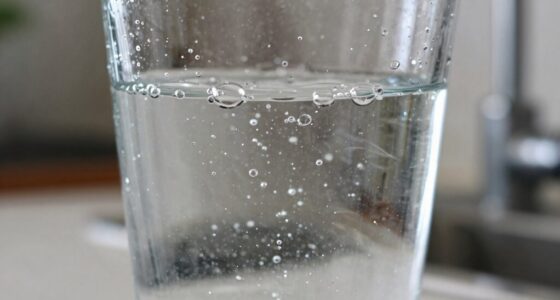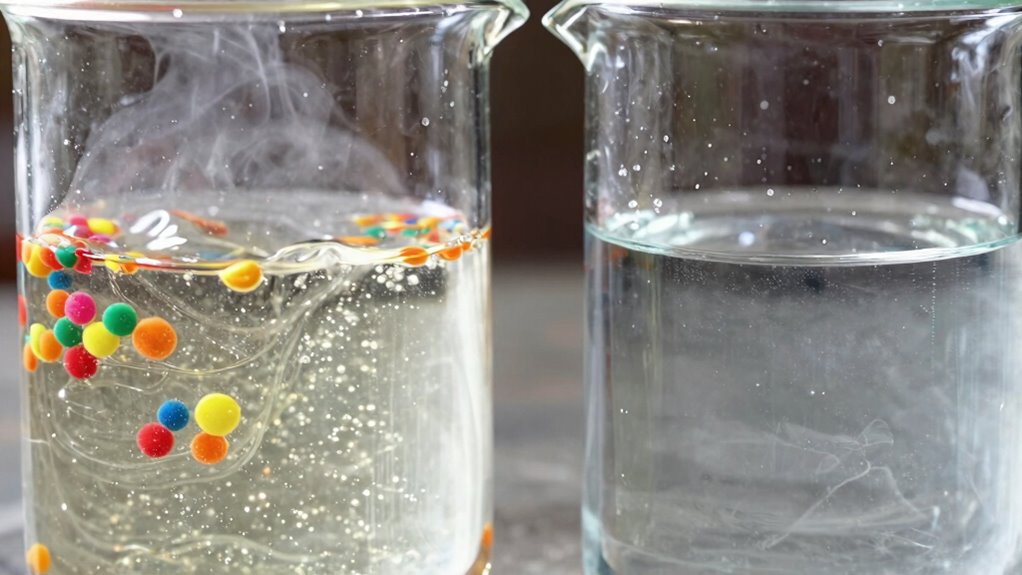

When you use hotter water, molecules gain more energy and move faster. This increased activity causes particles to collide more often and forcefully, helping solids dissolve quickly. As temperature rises, solubility for most solids improves because the molecules can interact more effectively. If you want to understand how this thermal boost works in detail and how it affects different substances, keep exploring how temperature influences solubility.

Get kitchen gear delivered free — and shop member deals
- Fast, free delivery on millions of items
- Access to Prime Big Deal Days deals on October 6–7
- Prime Video, Amazon Music and more included
Key Takeaways
- Heating increases molecular energy, leading to more frequent and forceful collisions between solvent and solute.
- Higher temperatures boost the kinetic energy of water molecules, enhancing their ability to dissolve solids faster.
- Elevated thermal activity allows molecules to interact more effectively, raising solubility limits.
- Hotter water reduces the energy barrier for dissolving solids, resulting in quicker extraction of compounds.
- For gases, increased temperature decreases solubility, but for solids, it significantly improves dissolution speed and capacity.
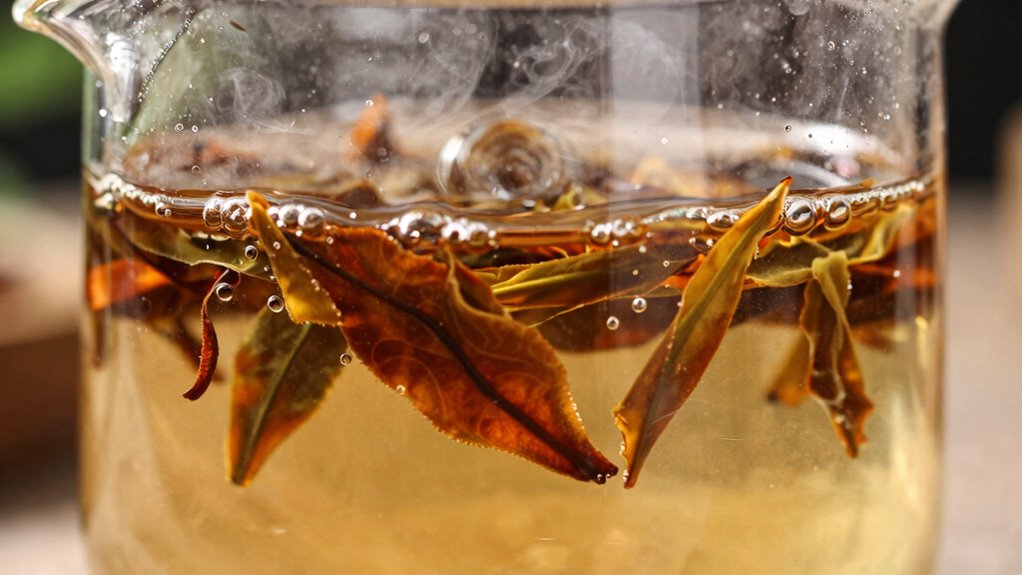
Have you ever wondered how the temperature of a liquid affects its ability to dissolve substances? When you heat water or any solvent, you’re influencing how quickly and efficiently it can break down and incorporate solutes. This is because of the thermal effects that come into play with temperature changes. As temperature rises, the solubility increase of many solids in liquids becomes apparent, making hot water an excellent solvent for various applications. These thermal effects fundamentally give molecules more energy, allowing them more movement and interaction more effectively with solutes. Temperature control plays a critical role in optimizing solubility and extraction processes. When you increase the temperature, the particles in the solvent gain kinetic energy. This heightened activity means that solvent molecules collide with solute particles more frequently and with greater force. As a result, more solute dissolves in a shorter amount of time. This is why hot water can extract flavors from tea leaves or dissolve sugar quicker than cold water. The thermal effects amplify the solubility increase, making the process more efficient. It’s not just about getting things to dissolve faster; it’s also about the amount of solute that can be dissolved at a given temperature. Typically, many solids have a higher maximum solubility in hot water compared to cold.
Heating liquids increases molecular energy, enhancing solubility and dissolving substances more efficiently.
This phenomenon isn’t limited to solids. The thermal effects also impact gases and liquids, although in different ways. For gases, increasing temperature actually decreases solubility, which is why carbonated drinks lose their fizz when warmed. But for solids and liquids, the solubility increase with temperature is consistent and predictable. You can often observe this while cooking; boiling sugar or salt in water results in a more concentrated solution because the solubility increase allows more to dissolve at higher temperatures.
Understanding these thermal effects helps you manipulate solutions for various purposes. For instance, in pharmaceuticals, hot solvents are used to extract active ingredients more effectively. In culinary settings, heating liquids enhances extraction processes, improving flavor and texture. The key is recognizing that temperature influences molecular behavior, which in turn affects how much of a substance can dissolve. The faster movement of molecules at higher temperatures boosts the solubility increase, making hot liquids invaluable for extraction and dissolution tasks. So, next time you heat your tea or prepare a solution, remember that thermal effects are at work, making your liquid a more powerful solvent by increasing its solubility.
As an affiliate, we earn on qualifying purchases.
Frequently Asked Questions
How Does Pressure Impact Solubility at Different Temperatures?
Pressure effects influence solubility, especially at different temperatures. When you increase pressure, you often raise solubility, but this effect depends on temperature dependence. At higher temperatures, molecules move faster, making solubility more responsive to pressure changes. So, if you increase both pressure and temperature, you’ll likely see a significant boost in solubility. However, the exact impact varies based on the specific substance and conditions involved.
Are There Substances That Dissolve Better in Cold Water?
Sometimes, cold water reveals its selective solubility, letting certain substances dissolve better than in hot water. You might find that compounds like gases or some salts prefer the cool embrace of cold water, quietly dissolving without fuss. Don’t overlook the subtlety of temperature; it guides what dissolves easily. In this dance of molecules, cold water’s gentle touch can surprise you, serving as a perfect solvent for specific materials.
What Role Does Agitation Play in Solubility?
Agitation boosts solubility by increasing mixing speed and agitation efficiency. When you stir or shake a solution, you expose fresh solvent to the solute, helping it dissolve faster. This process reduces the boundary layer around particles, allowing molecules to disperse more quickly. The more efficient your agitation, the faster the solute dissolves, especially in cases where diffusion alone might be slow. So, consistent stirring considerably improves solubility outcomes.
How Does Solubility Change Over Time With Temperature Variations?
As temperature varies, solubility changes because of phase change and reaching the saturation point. When water heats up, molecules gain energy, increasing solubility, so more material dissolves faster. If you cool the solution, solubility decreases, and you might reach the saturation point sooner, causing crystals to form. Over time, higher temperatures maintain higher solubility, allowing more solute to stay dissolved before any phase change occurs.
Can Solubility Be Reversed by Cooling the Solution?
Imagine dissolving sugar in hot water, then cooling it down. You can see the sugar recrystallize, demonstrating reversible dissolution. Yes, solubility can be reversed by cooling the solution because of temperature effects. When temperature drops, dissolved substances tend to come out of solution, forming crystals. This process highlights the reversible nature of dissolution, showing how temperature changes influence whether a substance remains dissolved or precipitates out.
temperature controlled stirring hot plate
As an affiliate, we earn on qualifying purchases.
As an affiliate, we earn on qualifying purchases.
Conclusion
So, next time you brew coffee or steep tea, remember that hotter water dissolves more compounds faster because increased temperature boosts molecule movement, overcoming solubility limits more quickly. While some might think hotter water simply speeds up extraction, it’s actually about breaking molecular bonds more efficiently. This confirms the theory that higher temperatures enhance solubility, proving that heat isn’t just for speed but also for maximizing flavor and extraction in your favorite drinks.
high temperature laboratory glassware
As an affiliate, we earn on qualifying purchases.
As an affiliate, we earn on qualifying purchases.
tea infuser with temperature control
As an affiliate, we earn on qualifying purchases.
As an affiliate, we earn on qualifying purchases.
Fall Picks
fall essentials
As an affiliate, we earn on qualifying purchases.